
The tokobashira (alcove post) is the aesthetic and structural pivot of the Japanese tea room. Crafted from unpeeled Japanese cedar (kawa-tsuki sugi), fluted weeping cherry, or natural bamboo, it requires precise seasonal felling, shadow-curing to retain bark adhesion, and intricate hand-scribed joinery to seat onto undulating granite stones and horizontal chigaidana shelving assemblies.
At a Glance: Key Takeaways
- Autumn-Felled Cedar: Harvesting timber in October–December when sap dormancy prevents bark delamination.
- Scribing to Raw Stone: Hikari transfer method enabling timber column ends to mirror uneven granite boulders.
- Concealed Blind Joinery: Hidden mortise-and-tenon connections locking chigaidana shelves without visible screws or brackets.
- Natural Texture Preservation: Zero chemical lacquer; surfaces burnished solely with natural walnut oil or rice-bran friction.
- Asymmetrical Elevation: Staggered shelf heights creating dynamic vertical rhythm opposite the hanging scroll.
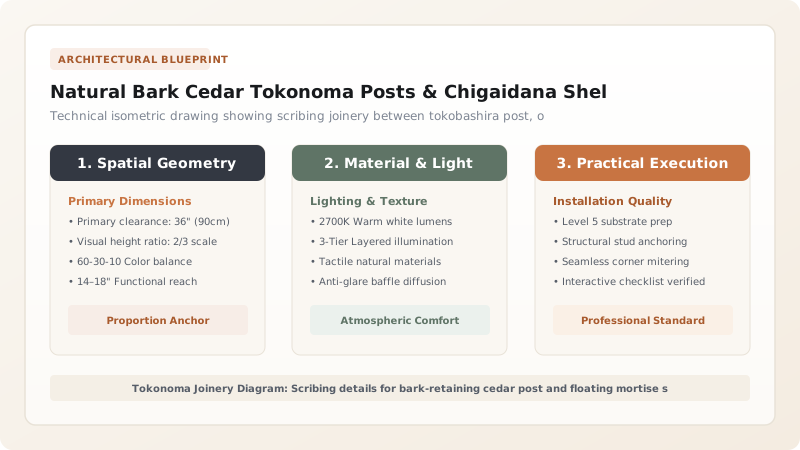
1. Botanical Selection & Seasoning of Tokobashira Timbers
In Japanese Sukiya-zukuri, the tokobashira is the spiritual heart of the interior. Choosing the correct timber requires profound botanical knowledge. The primary species utilized by master sukiya-daiku (carpenters) include:
- Kawa-tsuki Sugi (Cryptomeria japonica): Cryptomeria with its outer rough bark perfectly preserved. Found primarily in the Yoshino and Kitayama regions of Japan.
- Shibori-maruta: Artificially or naturally fluted cedar logs exhibiting gentle vertical ripples along their surface, produced by wrapping constricting cords around the living tree.
- Natsu-tsubaki (Stewartia pseudocamellia): Valued for its silky, mottled reddish-brown exfoliating bark and high compressive strength.
- Sakura (Prunus serrulata): Weeping wild cherry logs prized for horizontal lenticels and warm amber luster.
Harvesting must occur strictly between late October and mid-December. If cut during spring or summer, active sap flow causes the cambium layer to soften, leading to catastrophic bark peeling as the wood dries. Following felling, logs are debarked only where intended, washed with cold well water, and air-dried under shade for 18 to 24 months until reaching an equilibrium moisture content (EMC) of 10% to 12%.
2. The Art of Hikari Scribing: Fitting Posts to Undressed Stone
Traditional Sukiya columns do not sit on flat concrete footings or steel plates; they rest directly upon natural, unhewn river or granite stones known as tsukubai-ishi or soseki. To achieve a 100% bearing contact across the irregular stone topography, carpenters use the ancient transfer technique known as hikari-tsuke (ひかり付け):
The carpenter sets the natural timber upright on temporary shims directly over its intended position. Using a specialized Japanese compass-like scribe tool (hikari-bō or sumisashi), the irregular profile of the stone is scribed continuously around the base of the timber column at an exact offset height \(h\):
The carpenter then hollows out the base of the timber using curved gouges (soto-maru nomi) and Japanese hand saws, creating a concave perimeter that mirrors the stone's peaks and valleys with less than 0.5mm clearance. The center of the post base is slightly undercut (tsubomi) so that bearing weight concentrates firmly along the stable outer ring.
3. Chigaidana Staggered Shelving & Blind Joinery Dynamics
Adjacent to the tokonoma alcove sits the chigaidana (違棚)—a set of two staggered, asymmetrical floating display shelves. The upper shelf is termed ten-bukuro or kami-dana, while the lower shelf is known as ji-dana.
The structural magic of the chigaidana lies in its absolute visual weightlessness. There are no visible diagonal brackets, corbels, or metallic angle brackets. Instead, the shelves are anchored through:
- Ebizuka (海老塚): A delicate vertical support post connecting the overlapping ends of the two shelves, often turned from fine-grained boxwood or dark persimmon (kurogaki).
- Kakushi-hozo (Concealed Tenons): Blind mortise-and-tenon joints routed into the wall timber studs (hashira) and shelf edges, secured from underneath with blind hardwood dowels (shachi-sen).
- End Grain Fascia (Edging): The front edges of the shelves are bound with a thin strip of contrasting dense hardwood or black Urushi lacquer to conceal the horizontal growth rings.
Tokonoma Timber & Joinery Selection Guide
Use this reference table to calculate exact physical dimensions, ratios, and specifications before purchasing:
| Wood Species | Bark / Surface Finish | Ideal Room Aesthetic | Structural Bearing Capacity |
|---|---|---|---|
| Yoshino Sugi (Cedar) | Unpeeled natural rough bark | Rustic, wabi-sabi mountain hut style (sōan-chashitsu) | High axial compression (42 MPa parallel to grain) |
| Kitayama Shibori Cedar | Debarked, naturally fluted rippled surface | Refined, elegant urban tea sanctuary (kirei-sabi) | Very high axial stiffness; fine uniform grain |
| Wild Cherry (Sakura) | Smooth reddish-brown bark with lenticels | Literati tea room (bunjin-chashitsu); high contrast | Dense, heavy; resists surface denting and scratching |
| Kurogaki (Black Persimmon) | Planed silky smooth, natural black ink veining | Exclusive decorative shelving and chigaidana posts | Extremely dense; hard-wearing joinery stock |
Technical Timber Constraints
Every successful decoration project must account for physical and environmental constraints:
Bark Fragility
Handlers must wrap the unpeeled post in soft cotton batting and heavy paper during all stages of transport and framing.
Differential Shrinkage
Natural logs retain radial moisture gradients. The post must feature a hidden back-cut relief kerf (sewari) to channel shrinkage stress away from visible faces.
Carpentry Protocol for Scribing and Installing a Tokobashira Post
Execute this professional sequence to achieve flawless results without backtracking:
Foundation Stone Dressing & Leveling
Position the natural granite footing stone in the alcove corner. Level the stone's center of mass using gravel tamping, ensuring no rocking under dynamic load.
Timber Plumb & Plumb-Bob Alignment
Erect the seasoned unpeeled cedar log over the stone. Use plumb bobs along two orthogonal axes to ensure absolute vertical alignment.
Hikari Compass Transfer
Run the scribing tool smoothly around the stone, etching the continuous contour line onto the bark and wood of the timber base at calibrated offset height.
Hand Gouge Undercutting
Saw off the waste timber and gouge the underside so that the perimeter edge matches the stone contour, slightly dishing the center to guarantee perimeter contact.
Dry Fitting & Chalk Verification
Rub chalk or dry pigment onto the stone summit. Lower the post onto the stone, remove it, and check that chalk transfers uniformly across the entire perimeter ring.
Upper Otoshigake Beam Interlocking
Mortise the upper section of the post to receive the horizontal otoshigake lintel, securing the joint with a hardwood blind wedge.
Common Mistakes & Countermeasures
Avoid these costly errors that compromise aesthetics, ergonomics, and budget:
Felling cedar trees in spring during sap flow
Flat-cutting the post base and packing mortar between timber and stone
Project Execution Checklist
Track your physical progress. Checkboxes persist automatically on this device:
Frequently Asked Questions
What is the purpose of the vertical slot cut down the back of the tokobashira?
This hidden cut is known as a sewari (背割り). By cutting a relief kerf from the surface to the core of the timber along its unseen backside, carpenters predetermine where radial shrinkage tension releases, completely preventing visible cracks and checks from forming on the front bark surfaces.
Can an unpeeled post withstand structural building loads?
Yes. Japanese cedar (Cryptomeria japonica) has excellent axial compressive strength parallel to the grain. As long as the base is properly scribed to the footing stone and the post remains dry, it can support significant roof and ceiling framing loads.


