
Juraku-tsuchi is an exquisite Kyoto clay plaster applied over hand-split bamboo lath (take-komai). Characterized by natural mineral ochres, chopped fermented rice straw (wara), and unburnished matte texture, it provides exceptional natural humidity regulation, non-toxic fire resistance, and superior acoustic absorption in traditional Japanese architecture.
At a Glance: Key Takeaways
- Woven Bamboo Lath: Flexible split madake bamboo tied with boiled palm twine, forming an elastic substrate.
- Fermented Straw Fiber: Aged rice straw releasing lignin and cellulose binders that prevent drying fissures.
- Kyoto Silt Geology: Fine particle size distribution (< 0.05mm) offering delicate tactile texture and warm amber hues.
- Acoustic Flutter Elimination: Open porous micro-structure delivering NRC 0.45 sound absorption without fiberglass.
- Zero-Waste Reversible Assembly: Pure clay plaster can be stripped, rehydrated, and reapplied indefinitely.
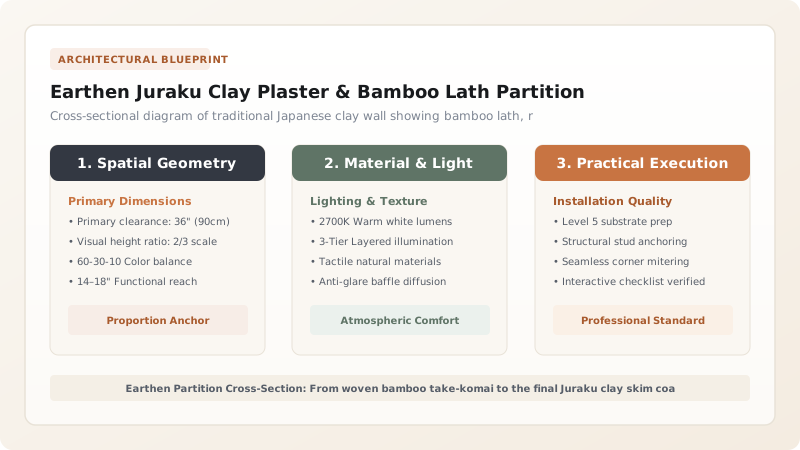
1. Geological Mineralogy of Kyoto Juraku Clay
Authentic Juraku-tsuchi (聚楽土) is an earthen clay harvested from specific geological strata around the historic Juraku-dai palace site in Kyoto. Geologically, it consists of weathered feldspar, montmorillonite, and quartz silt deposited in ancient river basins. Unlike heavy ball clays or kaolin, Juraku clay features an optimal natural blend of clay binder (18–25%) and fine silica silt (75–82%).
This particle distribution gives the wet plaster high plasticity under the trowel while exhibiting very low linear shrinkage (less than 2.5% when properly mixed with river sand). The characteristic golden-brown to warm gray color derives entirely from oxidized iron and trace manganese minerals, requiring zero artificial chemical pigments.
2. Weaving the Take-Komai Bamboo Skeleton
Before clay is mixed, artisans weave the take-komai (竹小舞)—a self-supporting lattice of split bamboo canes spanning between the structural posts:
- Vertical Canes (Tate-komai): Split bamboo sections approximately 15mm wide and 5mm thick, inserted into shallow pre-drilled holes or grooves in the horizontal sill and lintel beams.
- Horizontal Canes (Yoko-komai): Split bamboo lashed across the vertical canes at 30mm to 40mm on-center intervals.
- Lashing Twine: Bound tightly at every intersection with shuro-nawa (boiled palm-fiber cord) or natural hemp cord.
This bamboo grid provides exceptional structural elasticity. In earthquake-prone Japan, a take-komai clay partition does not crack like rigid masonry; instead, the bamboo canes flex and dissipate seismic shear energy through micro-friction across the interwoven grid.
3. The Three-Coat Application Sequence & Straw Fermentation
Traditional Japanese earthen walls are built through three distinct layers over a period of 60 to 90 days:
- Arakabe (Rough Scratch Coat): Heavy sticky clay blended with long chopped rice straw (wara) cut to 50–100mm. The wet clay-straw slurry is traditionally fermented in sealed vats for 3 to 6 months before use; anaerobic bacteria break down the straw, producing organic enzymes and lignin that dramatically increase adhesive bonding strength. Applied from both sides of the bamboo lath so that clay squeezes through and locks the canes together.
- Chūnuri (Brown Coat): A blend of subsoil clay, medium river sand (0.5–1.2mm), and medium-cut straw (20–30mm). This layer levels the wall to within 1.5mm tolerance and cures for 2 to 4 weeks.
- Uwanuri / Juraku-nuri (Finish Coat): The final 1.5mm skim coat of authentic Juraku clay, ultra-fine washed river sand (0.1–0.3mm), and microscopic sifted straw fibers (miji-wara), burnished with a thin steel trowel (jigane kote).
Layer Specifications of Earthen Sukiya Partitions
Use this reference table to calculate exact physical dimensions, ratios, and specifications before purchasing:
| Plaster Coat | Binder-to-Aggregate Ratio | Reinforcement Fiber | Drying Time / Curing Standard |
|---|---|---|---|
| Arakabe (Scratch) | 1 part heavy clay : 1 part rough sand | Fermented rice straw (50–100mm) | 28–45 days (must crack thoroughly before next coat) |
| Chūnuri (Brown) | 1 part clay : 2.5 parts river sand | Clean chopped straw (20–30mm) | 14–21 days until moisture content < 6% |
| Juraku-nuri (Finish) | 1 part Juraku clay : 2 parts fine silica sand | Microscopic sifted straw (miji-wara) | 48–72 hours to air-dry; zero forced heating |
Environmental & Structural Constraints
Every successful decoration project must account for physical and environmental constraints:
Water Splash Vulnerability
Unsealed earthen plaster cannot withstand direct rain or faucet splashing; exterior elevations must feature minimum 900mm roof eaves.
Scratch Resistance
Juraku finishes are softer than gypsum or lime plasters; high-traffic residential hallways require lower wainscoting (腰壁, koshikabe).
Protocol for Weaving and Plastering a Juraku Wall
Execute this professional sequence to achieve flawless results without backtracking:
Timber Mortising for Bamboo
Rout continuous 8mm grooves or drill 12mm holes along the inner faces of timber columns to anchor the bamboo lath perimeter.
Take-Komai Bamboo Lashing
Weave split madake bamboo slats into a 35mm grid, lashing intersections with soaked shuro-nawa palm twine tied with clove hitches.
Arakabe Mud Application
Press fermented clay-straw mud into the bamboo mesh from the front face; immediately smooth the extruded mud on the rear face (ura-gaeshi).
Drying & Shrinkage Monitoring
Allow the arakabe layer to dry naturally for 30 days until large shrinkage cracks form, providing mechanical keys for subsequent coats.
Chūnuri Leveling Coat
Trowel the brown coat to establish a perfectly flat, plumb surface. Scratch lightly to key the surface for finish plaster.
Juraku Finish Troweling
Trowel the 1.5mm Juraku finish coat in continuous passes from top to bottom, maintaining a wet edge to eliminate visible lap marks.
Common Mistakes & Countermeasures
Avoid these costly errors that compromise aesthetics, ergonomics, and budget:
Using modern cement or acrylic bonding agents in Juraku clay
Applying the finish coat before the scratch coat has fully cured
Project Execution Checklist
Track your physical progress. Checkboxes persist automatically on this device:
Frequently Asked Questions
How does Juraku clay improve indoor air quality?
Juraku clay is 100% natural, emitting zero VOCs, formaldehyde, or synthetic off-gassing. Its clay minerals naturally absorb odors, trap volatile organic compounds from the air, and actively buffer relative humidity between 40% and 60%, preventing mold and dust mite propagation.
Can damaged Juraku plaster be repaired?
Yes. Unlike paint or gypsum drywall, damaged earthen plaster can be gently rehydrated with water mist, carefully worked with a small Japanese spatula, and re-blended with fresh Juraku slurry seamlessly.


