
Water-mist tension shrinkage (Kiri-fuki) and track friction control represent the finishing mechanical disciplines of traditional Japanese Shoji craftsmanship. Newly pasted washi paper invariably exhibits minor surface slack and subtle ripples. Master artisans resolve this through the ancient physics of controlled moisture contraction: using a traditional mouth-blown brass atomizer (Kiri-fuki), a uniform, micro-fine mist of clean lukewarm water is fogged across the unpasted paper face. As the elongated Kozo mulberry bast fibers absorb moisture, they expand temporarily; then, as water evaporates evenly into the surrounding air, the cellulose fibers cross-link and contract in three dimensions, pulling the washi into a drum-tight, vibration-resonant membrane that hums when tapped. Simultaneously, the screen's bottom sliding horns (Ki-bana) and hardwood floor tracks (Shikii) are burnished with pure cold-pressed camellia oil (Tsubaki-abura) and natural beeswax, reducing sliding friction to near zero for silent, featherlight operation.
At a Glance: Key Takeaways
- Kiri-Fuki Atomization Mechanics: Traditional brass mouth-pipe atomizer generating a 20-to-50 micron water droplet fog.
- Cellulose Shrinkage Kinetics: Kozo bast fibers contracting 1.5% to 2.5% during evaporation, eliminating all surface slack.
- Acoustic Drum Resonance: Tautly cured paper producing a crisp, resonant musical pitch when tapped with knuckle.
- Camellia Oil (Tsubaki-Abura): Non-drying, acid-free conifer-safe plant oil lubricating wood sliding tracks without sticky gumming.
- Beeswax Track Burnishing (Ibota Wax): Natural plant wax or refined beeswax creating a glass-smooth microscopic bearing glaze.
- Zero Roller Hardware: 100% traditional wood-on-wood sliding physics eliminating noisy modern metal rollers.
- Vapor Breathing Dynamics: Finished drum-tight paper expanding and contracting passively with indoor humidity cycles.
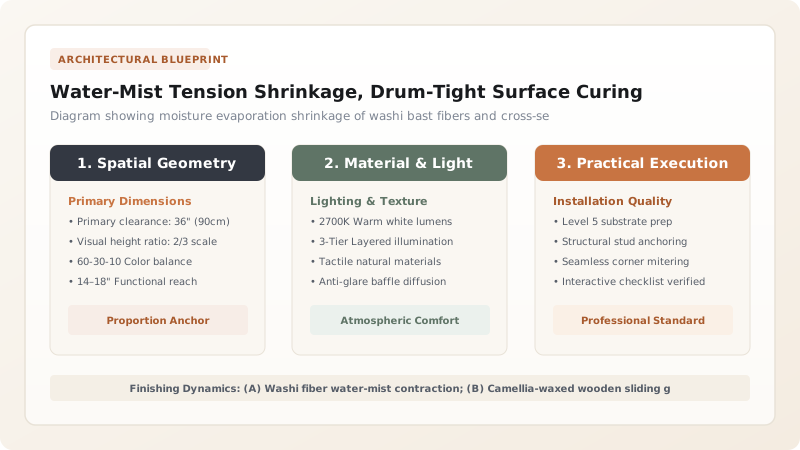
1. The Physics of Kiri-Fuki: Controlled Moisture Contraction
When washi paper is unrolled and pasted onto a Shoji frame, slight atmospheric variations and manual finger tension inevitably leave minor wrinkles, sag, or uneven slack across the rectangular bays. If left alone, the paper looks loose, sloppy, and gathers dust.
To achieve the legendary taiko-bari (drum-tight tension), craftsmen utilize Kiri-fuki (霧吹き). A traditional kiri-fuki is a simple L-shaped double-brass tube that operates on the Venturi aerodynamic principle: by blowing forcefully through the horizontal mouthpiece, a vacuum is created over the vertical tube submerged in clean water, atomizing the liquid into an ultra-fine, fog-like micro-spray ($20 - 50\,\mu\text{m}$ droplet size).
When this fine fog lands on the washi, the amorphous cellulose and hemicellulose chains in the Kozo bast fibers absorb water molecules, swelling temporarily. As the water evaporates into the ambient air, strong capillary forces draw the cellulose microfibrils into tight parallel alignment. The entire sheet contracts uniformly in all directions by approximately $1.5\%$ to $2.5\%$, pulling the paper into a perfectly flat, drum-tight, wrinkle-free acoustic membrane.
2. Wood-on-Wood Sliding Dynamics: Shikii and Kamoi Track Physics
Traditional Japanese architecture rejects modern mechanical sliding hardware—such as ball-bearing metal wheels, aluminum tracks, and plastic rollers—because they generate harsh, scraping acoustic noise that destroys tatami tranquility. Shoji slide on pure wood-on-wood contact:
- Shikii (Bottom Threshold Track): Milled from hard, dense, close-grained hardwoods—such as Japanese Zelkova (Keyaki), Cherry (Sakura), or dense Hinoki. The track features dual parallel grooves (typically 21mm wide and only 3mm deep) with rounded bottom corners.
- Ki-bana & Sliding Horns: The bottom rail of the Shoji frame features small projecting wooden glide horns (ki-bana) that seat inside the track grooves with 1.5mm lateral clearance.
- Kamoi (Top Header Track): The upper door header features much deeper grooves (typically 15mm deep). This allows the screen to be lifted upward into the top groove, clearing the bottom track for effortless installation and seasonal removal.
3. Natural Track Lubrication: Camellia Oil and Ibota Wax
To achieve frictionless, whisper-quiet glide without modern petrochemical greases that attract grit and turn black, craftsmen use traditional organic lubricants:
- Tsubaki-Abura (Camellia Oil): Cold-pressed from the seeds of Camellia japonica, this light, non-drying, acid-free oil has been used in Japan for over a millennium. Applied sparingly to the wooden grooves, it penetrates deep into the hardwood fibers without gumming, preventing humidity-induced swelling.
- Ibota Wax (Ibota-ro): Harvested from the natural white wax secretions of scale insects (Ericerus pela) living on the Ibota privet tree. Ibota wax is an extraordinarily hard natural ester wax with a high melting point ($82^\circ\text{C}$). Rubbed vigorously into the tracks with cotton cloths, the friction melts the wax into a glass-hard microscopic glaze. Combined with camellia oil, the Shoji glides with a single fingertip, whispering silently across the wood floor.
Shoji Sliding Track Tolerances, Lubricants, and Mist Parameters
Use this reference table to calculate exact physical dimensions, ratios, and specifications before purchasing:
| Engineering Parameter | Standard Dimension / Ratio | Material Specification | Application Tooling | Performance Benchmark |
|---|---|---|---|---|
| Bottom Track Groove (Shikii) | 21mm wide x 3.0mm deep | Keyaki (Zelkova) or Sakura | Japanese track grooving plane (Kanna) | Dead level; mirror planed floor |
| Top Header Groove (Kamoi) | 21mm wide x 15.0mm deep | Hinoki or Sugi header timber | Deep grooving routing plane | Provides vertical lift clearance for removal |
| Sliding Clearance Gap | 1.5 mm total lateral float | Wood-on-wood contact | Feeler gauge / sliding test | Zero side-binding; smooth straight glide |
| Kiri-Fuki Atomizer Mist | 20–50 micron droplet fog | Pure lukewarm deionized water | Traditional brass mouth atomizer | Uniform dampening without liquid droplets |
| Track Penetrating Lubricant | 100% Pure Camellia Oil | Acid-free, non-drying plant oil | Soft cotton rag rubbing | Zero wood swelling; silent glide |
| Hard Track Finish Glaze | Ibota Wax or Virgin Beeswax | Hard micro-crystalline wax cake | Friction buffing with burlap | Glass-smooth frictionless surface |
Practical Constraints
Every successful decoration project must account for physical and environmental constraints:
Seasonal Track Swelling in Humid Climates
Aerosol Atomization Skill
Master Execution Sequence for Water-Mist Tensioning and Track Tuning
Execute this professional sequence to achieve flawless results without backtracking:
Starch Paste Dryout Confirmation
Verify that newly pasted Shoji screen has rested flat for at least 60 minutes and starch paste is firm along all kumiko ribs.
Kiri-Fuki Atomizer Preparation
Fill brass kiri-fuki container with clean, lukewarm deionized water; test spray pattern in open air to confirm an ultra-fine, fog-like mist.
Uniform Water-Mist Fogging
Hold atomizer 400mm away from the unpasted paper face; sweep rhythmically back and forth, fogging the entire surface evenly with a faint moisture sheen.
Shaded Tension Drying
Allow screen to dry undisturbed in a shaded, draft-free room for 2 hours; do NOT place in direct sun or blow with electric heaters.
Acoustic Tension Verification
Tap the center of several paper bays lightly with middle knuckle; verify the washi emits a crisp, resonant drum-like musical pitch (taiko-bari).
Shikii Track Cleaning and Vacuuming
Vacuum hardwood floor grooves thoroughly; wipe clean with dry microfiber cloth to remove all abrasive silica dust and grit.
Camellia Oil and Wax Burnishing
Rub raw beeswax or Ibota wax cake along the bottom track grooves; buff vigorously with coarse burlap cloth; apply two drops of pure camellia oil.
Shoji Screen Hanging and Glide Tuning
Lift Shoji screen upward into top kamoi groove; drop lower horns into bottom shikii track; test slide with single pinky finger to confirm featherlight glide.
Common Mistakes & Countermeasures
Avoid these costly errors that compromise aesthetics, ergonomics, and budget:
Spraying heavy water droplets from a standard garden pump sprayer onto freshly pasted washi
Using silicone spray, WD-40, or motor oil to lubricate wooden sliding tracks
Drying the misted Shoji screen in direct hot sunlight or with high-heat hair dryers
Project Execution Checklist
Track your physical progress. Checkboxes persist automatically on this device:
Frequently Asked Questions
Why does spraying water on paper make it tighter instead of soggy?
Washi paper is made of long, flexible Kozo plant bast fibers. When misted lightly with water, the fibers absorb moisture and swell temporarily. As the water evaporates, strong capillary surface tension pulls the microscopic cellulose fibers closer together than they were originally, shrinking the sheet and pulling it drum-tight.
Can I use candle wax to lubricate sticking Shoji tracks?
Modern paraffin candles contain petroleum derivatives that leave a sticky, gummy residue in wooden tracks over time. Traditional Japanese craftsmen use pure beeswax or authentic Ibota wax (Ibota-ro), which is completely natural, hard, and buffs into a clean, glass-like glaze without gumming.
What should I do if a Shoji screen sticks and won't slide easily?
First, vacuum the bottom track thoroughly to remove dirt and sand. Inspect the bottom of the Shoji frame to ensure no wood burrs are dragging. Rub a block of pure beeswax or paraffin-free wood wax along the bottom groove and buff with a dry cotton rag. Finally, apply a tiny drop of pure camellia oil to the track.


