
Quarter-sawn Hinoki selection and half-lap Kumiko lattice joinery represent the absolute pinnacle of Japanese micro-woodworking precision. The internal lattice of a Shoji screen (Kumiko) is constructed from slender timber ribs measuring only 3.0mm to 4.5mm in thickness and 12mm to 16mm in depth. Master sashimono woodworkers source exclusively vertical-grain quarter-sawn wood (masame) from old-growth Hinoki (Chamaecyparis obtusa) or Akita Sugi (Cryptomeria japonica), where annual growth rings exceed 15 to 20 rings per inch. Using specialized Japanese pull-saws (dozuki), spacing jigs, and gang-cutting miter boxes, artisans cut hundreds of micro half-lap notches across bundles of clamped strips simultaneously. Assembled with zero glue or nails, the interlocking strips create a rigid, self-tensioning, dimensionally stable wooden lattice that remains perfectly flat across decades of seasonal humidity swings.
At a Glance: Key Takeaways
- Masame Grain Purity: 100% vertical-grain conifer timber with ring orientation between 80° and 90° to face.
- Dimensional Precision: Sliced kumiko ribs calibrated to 3.2mm ±0.05mm tolerance using wooden hand planes (kanna).
- Gang-Cutting Half-Lap Notches: Bundles of 30 to 50 strips notched simultaneously in indexing miter boxes.
- Dozuki Micro-Saws: Ultra-thin 0.25mm blade Japanese saws with crosscut teeth ensuring splinter-free notch shoulders.
- Frictional Interlocking Fit: Snug finger-press tolerances (0.02mm interference) that hold together without adhesive.
- Planar Flatness Verification: Entire 1.8m tall lattice flat within 0.5mm, eliminating warpage against washi paper.
- Acoustic Tone Testing: Hinoki lattice ringing with bright musical pitch when tapped, verifying unbroken wood fibers.
1. Conifer Dendrology: Why Masame Grain is Mandatory
In thin-section woodworking, wood movement is the ultimate enemy. A wooden rib 3mm thick by 1,800mm long will twist, bow, or cup uncontrollably if it contains the slightest grain irregularity. Master Shoji makers use exclusively Masame (柾目, quarter-sawn) wood from slow-grown mountain conifers:
- Kiso Hinoki (Chamaecyparis obtusa): Harvested from old-growth forests in Nagano and Gifu prefectures, Hinoki has tight, uniform annual rings (up to 25 rings/cm), natural insect-repelling terpene oils, and exceptional dimensional stability (tangential-to-radial shrinkage ratio near $1.0$).
- Akita Sugi (Cryptomeria japonica): Sourced from northern Honshu, slow-grown winter cedar has a warm reddish-cinnamon heartwood, silky texture, and light weight, prized for formal palace screens.
In masame grain, growth rings run dead perpendicular to the width face (85°–90°). When ambient humidity shifts between dry winter and muggy monsoon summer, the rib expands and contracts purely in thickness, with zero tendency to twist or bow out of plane.
2. Gang-Cutting Mechanics: Indexing Miter Jigs and Dozuki Saws
Cutting half-lap notches one piece at a time would inevitably introduce accumulated pitch errors: over a 60-course grid, an error of only 0.2mm per cut results in a catastrophic 12mm misalignment at the top rail. Masons execute gang-cutting (Taba-giri):
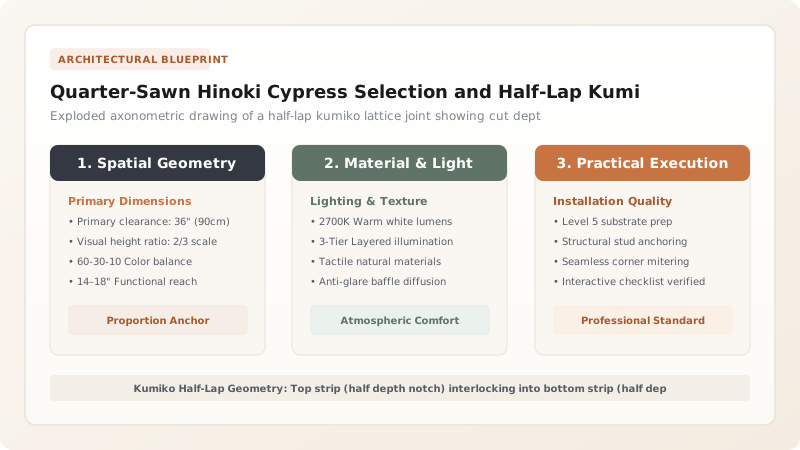
Thirty to fifty identical kumiko strips are clamped tightly together between wooden cheeks, forming a solid rectangular block. The block is mounted into a specialized hardwood indexing miter box (Kizuki-dai). Using an ultra-fine Japanese Dozuki saw with an 0.25mm blade kerf and 30 teeth per inch, the craftsman cuts across the entire bundle in single continuous strokes. An iron indexing pin advances the bundle by exact pitch increments (e.g., exactly 60.0mm). This guarantees that every notch in all fifty strips is located at the exact same sub-millimeter position.
3. Nailless Interlocking Dynamics and Self-Tensioning Grids
Once notched, the strips are assembled into the master grid. Each vertical strip drops into its corresponding horizontal notch with a satisfying, gentle 'snick' under light thumb pressure.
The joint tolerance is calibrated to an interference fit of approximately 0.02mm. If the notch is too loose, the grid will wobble and rattle; if it is too tight, forcing the wood compresses grain fibers and bows the strip into an S-curve. When properly assembled, the hundreds of microscopic friction points work in dynamic equilibrium: the grid becomes a self-tensioning, rigid structural diaphragm that resists diagonal racking forces without requiring steel diagonal bracing.
Kumiko Strip Dimensions, Notching Tolerances, and Species Grading
Use this reference table to calculate exact physical dimensions, ratios, and specifications before purchasing:
| Lattice Component | Timber Species | Strip Thickness x Depth | Notch Depth Ratio | Allowable Pitch Tolerance |
|---|---|---|---|---|
| Main Horizontal Ribs | Kiso Hinoki (Quarter-Sawn) | 3.5 x 12.0 mm | 50% depth (6.0 mm) | ± 0.05 mm across bundle |
| Main Vertical Ribs | Kiso Hinoki (Quarter-Sawn) | 3.5 x 12.0 mm | 50% depth (6.0 mm) | ± 0.05 mm across bundle |
| Decorative Asanoha Infills | Akita Sugi (Quarter-Sawn) | 1.8 x 10.0 mm | Chamfered 60° miters | ± 0.02 mm (micrometer fit) |
| Perimeter Tenon Tongues | Kiso Hinoki Heartwood | 3.5 x 15.0 mm extension | Housed in stile mortise | Snug friction fit (no glue) |
| Koshi Base Frame Ribs | Dense Old-Growth Hinoki | 6.0 x 18.0 mm | Full lap mortise | ± 0.1 mm |
Practical Constraints
Every successful decoration project must account for physical and environmental constraints:
Extreme Tool Honing Demands
Workshop Climate Control
Master Step-by-Step Procedure for Slicing and Assembling Kumiko
Execute this professional sequence to achieve flawless results without backtracking:
Quarter-Sawn Billet Selection
Inspect Hinoki billet with magnifying loupe; confirm vertical grain orientation is between 85° and 90° with zero grain runout.
Precision Ripping on Table Saw
Rip strips to 4.0mm thickness using thin-kerf carbide blade; allow strips to rest for 48 hours to release internal drying stress.
Thickness Planing with Japanese Kanna
Pass strips through wooden shooting board jig (dai); plane both faces with hand kanna plane to final calibrated 3.50mm dimension.
Bundle Clamping and Alignment
Clamp 40 strips between wooden jaw protectors; plane the edges dead level with iron jointer plane; strike reference square line.
Gang-Cutting with Dozuki Saw
Mount bundle in Kizuki-dai indexing jig; saw half-lap notches to exact 6.0mm half-depth at 60.0mm pitch intervals across all strips.
Notch Bottom Cleaning with Chisel
Clear residual wood fibers from bottom of notches using narrow 3.5mm Japanese paring chisel (oire-nomi), verifying flat floor.
Friction Grid Assembly
Lay horizontal strips on clean felt table; press vertical strips into notches using finger pressure, tapping gently with boxwood mallet.
Tenon Fitting into Outer Frame
Fit the perimeter ends of the completed kumiko lattice into mortises carved along the inside of the outer frame stiles, testing for planar flatness.
Common Mistakes & Countermeasures
Avoid these costly errors that compromise aesthetics, ergonomics, and budget:
Using flat-sawn (itame) conifer lumber with curved growth rings for kumiko strips
Applying synthetic wood glues inside the half-lap kumiko joints
Sawing notches with a thick-kerf Western handsaw instead of a thin-kerf Dozuki saw
Project Execution Checklist
Track your physical progress. Checkboxes persist automatically on this device:
Frequently Asked Questions
What is the difference between simple Shoji grids and decorative Kumiko art?
Simple Shoji grids (Yokoshige or Tateshige) consist of straight, perpendicular rectilinear strips forming square or rectangular boxes. Decorative Kumiko art (such as Asanoha or Kikko) incorporates diagonal, triangular, and hexagonal micro-elements hand-beveled at 60° and 30° angles to form intricate geometric mosaics inside the main grid.
Why is Hinoki (Japanese Cypress) preferred over oak or walnut for Shoji?
Oak and walnut are heavy hardwoods with high shrinkage rates that warp easily in thin sections. Hinoki is lightweight, dimensionally stable, has straight uniform grain, resists rot and insects naturally, and emits a soothing, fragrant natural aroma (hinokitiol).
How do you clean dust out of an intricate Kumiko lattice?
Traditional Japanese housekeepers use a soft natural feather duster (hataki) or a soft horsehair brush to gently flick dust off the unpapered wooden grid ribs. Modern vacuums fitted with soft horsehair brush attachments on low suction can also be used.


