
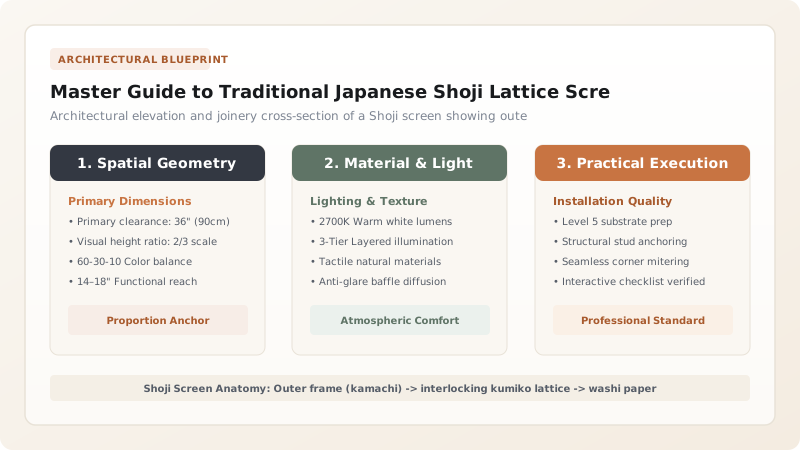
Shoji (障子) are traditional Japanese sliding translucent lattice screens that define the delicate, light-filtering architectural harmony of Sukiya-zukuri and Shoin-zukuri interiors. Unlike opaque Fusuma room dividers, Shoji screens are designed to diffuse natural daylight gently into interior living spaces while maintaining privacy. Constructed from flawless, quarter-sawn native conifers—predominantly Hinoki (Japanese cypress) and Akita Sugi (cedar)—the structural outer frame houses an intricate geometric interior lattice (Kumiko) assembled purely with precision half-lap and mortise joints without nails or glue. The exterior face is lined with handmade Kozo (paper mulberry) Washi paper adhered with water-soluble fermented rice starch paste (Nori). Upon drying, a fine misting of water shrinks the long bast mulberry fibers, pulling the paper drum-tight and transforming harsh exterior sunlight into an ethereal, shadowless interior glow.
At a Glance: Key Takeaways
- Flawless Conifer Selection: Quarter-sawn Hinoki (Chamaecyparis obtusa) and straight-grain Akita Sugi (Cryptomeria japonica).
- Precision Kumiko Lattice: Slender timber ribs (typically 3mm to 6mm thick) interlocked with half-lap joints at exact spacing.
- Handmade Kozo Washi: Pure paper mulberry bast fiber paper providing high tensile tear strength and natural daylight diffusion.
- Water-Soluble Nori Starch Paste: Reversible fermented rice or wheat starch adhesive permitting effortless annual paper replacement.
- Water-Mist Drum Tightening: Controlled shrinkage mechanics pulling dampened washi paper into drum-tight, wrinkle-free tension.
- Frictionless Track Sliding: Bottom rails sliding smoothly in hardwood grooves (shikii) lubricated with camellia oil and wax.
- Daylight Modulation: Diffuses up to 50% of direct solar radiation, eliminating glare while brightening interior tatami mats.
In-Depth Guides in this Directory
Explore specialized subtopic blueprints, technical dimensions, and execution checklists:
Quarter-Sawn Hinoki Cypress Selection and Half-Lap Kumiko Lattice Joinery
Technical woodworking manual on selecting quarter-sawn Hinoki and Sugi, gang-cutting half-lap joints, and assembling nailless Kumiko lattice grids.
Handmade Kozo Mulberry Washi Paper, Natural Starch (Nori) Paste, and Papering Discipline
Technical manual on handmade Kozo washi papermaking, cooking natural fermented nori starch paste, and the traditional Japanese Shoji papering procedure.
Water-Mist Tension Shrinkage, Drum-Tight Surface Curing, and Camellia Oil Track Friction Control
Technical manual on water-mist tension shrinkage (Kiri-fuki), drum-tight washi curing, and camellia oil/beeswax sliding track friction control for Shoji screens.
1. Aesthetic Philosophy: In Praise of Shadows and Diffused Daylight
In his seminal 1933 essay In Praise of Shadows (陰翳礼讚), author Jun'ichirō Tanizaki observed that Western architecture seeks to banish shadows with intense, uniform electric illumination, whereas traditional Japanese architecture embraces the subtle beauty of twilight and graded shade. The Shoji screen is the physical instrument of this aesthetic philosophy.
Unlike clear glass windows that transmit harsh direct solar glare and create deep, jarring black shadows, the translucent washi paper of a Shoji screen functions as a giant optical diffuser. Incident sunlight is refracted in millions of directions by the randomized bast fibers of the mulberry paper. The light enters the tatami room as a soft, ethereal, omnidirectional glow, softening facial features, reducing eye strain, and creating an atmosphere of contemplative serenity.
2. Kumiko Precision Joinery: Quarter-Sawn Hinoki and Nailless Grids
The interior grid of a Shoji is called the Kumiko (組子). Constructing kumiko requires woodworking tolerances measured in tenths of a millimeter:
- Wood Selection: Only straight-grained, quarter-sawn wood (masame) from ancient Japanese Cypress (Hinoki) or Cedar (Sugi) is used. Flat-sawn wood (itame) expands and warps unevenly with seasonal humidity, which would twist the delicate lattice out of planar alignment.
- Grid Geometry: Lattice styles range from the serene, regular rectangular grids of Yokoshige-shoji (closely spaced horizontal bars) to complex geometric patterns like Asanoha (hemp leaf) and Kikko (tortoiseshell).
- Half-Lap Friction Interlocking: Each slender wooden rib (typically 3mm thick and 12mm deep) is notched with matching half-lap slots using micro-saws and guide jigs. When assembled, the hundreds of intersections press together with light finger friction. Zero nails, screws, or glue are used, allowing the lattice to flex microscopically with atmospheric changes without buckling.
3. The Papering Ceremony: Kozo Washi, Nori Starch, and Drum Tension
A Shoji screen is a living architectural element designed to be re-papered annually (historically as part of the late-December Oosouji New Year purification ritual). The papering process is a disciplined art:
The paper is authentic Kozo Washi, crafted by hand from the inner bast fibers of paper mulberry shrubs (Broussonetia papyrifera). The fibers are extraordinarily long (up to 20mm), conferring phenomenal tensile burst strength and tear resistance despite weighing only 30 to 45 g/m².
The paper is adhered exclusively to the exterior face of the kumiko grid using warm Nori (fermented rice or wheat starch paste). Chemical glues and synthetic tapes are strictly forbidden: starch paste holds securely yet dissolves instantly in water, allowing old discolored paper to be peeled away cleanly during annual restoration. Once pasted, the paper is lightly misted with clean water from a mouth-blower or fine spray atomizer. As the wet fibers dry, they contract evenly in all directions, pulling the washi into a drum-tight, wrinkle-free, vibrating membrane that hums musically when tapped with a fingertip.
Shoji Screen Dimensions, Kumiko Styles, and Washi Typologies
Use this reference table to calculate exact physical dimensions, ratios, and specifications before purchasing:
| Shoji Style / Component | Timber Wood Material | Lattice Sizing (mm) | Washi Paper Specification | Daylight Diffusion Factor |
|---|---|---|---|---|
| Yokoshige-Shoji | Quarter-sawn Hinoki cypress | Kumiko 3.5 x 12 mm; 60mm grid | Pure handmade Kozo washi (35 g/m²) | Diffuses 45%–50% direct sunlight |
| Tateshige-Shoji | Akita Sugi (Cedar) | Kumiko 3.0 x 14 mm; vertical bias | Bleached mulberry washi (40 g/m²) | Diffuses 40%–45% daylight; elegant vertical lines |
| Yukimi-Shoji (Snow Watching) | Hinoki frame + Sugi lattice | Upper lattice + lower sliding glass | Medium Kozo washi + float glass insert | Allows garden snow view while seated on tatami |
| Mizuguruma / Geometric | Fine-grain Kiso Hinoki | Compound 45° and 60° kumiko | Thin translucent Tengujo washi | Dramatic shadow tapestry for luxury tea pavilions |
| Gari-Shoji (Base Kickboard) | Hinoki frame + solid wood panel | Base cedar kickplate (koshi) 300mm | Heavyweight Mulberry washi (50 g/m²) | Protects paper from accidental feet kicks |
Practical Constraints
Every successful decoration project must account for physical and environmental constraints:
Vulnerability to Punctures and Pets
Humidity and Track Binding
Master Fabrication and Papering Sequence for a Traditional Shoji Screen
Execute this professional sequence to achieve flawless results without backtracking:
Quarter-Sawn Timber Milling and Acclimatization
Mill defect-free Hinoki into true vertical-grain (masame) stiles and rails; acclimatize timber in workshop for 30 days to stabilize moisture below 10%.
Outer Frame (Kamachi) Mortise Joinery
Cut through-tenons and haunched mortises on top/bottom rails and vertical stiles; plane surfaces glass-smooth with Japanese kanna hand plane.
Kumiko Strip Slicing and Thickness Gauging
Rip slender 3.5mm thick lattice strips from cedar billets; pass strips through precision wooden thickness planer to ensure ±0.1mm tolerance.
Half-Lap Notch Gang Cutting
Clamp dozens of kumiko strips together in wooden indexing miter boxes; saw half-lap notches simultaneously to guarantee 100% pitch alignment.
Nailless Lattice Grid Assembly
Interlock horizontal and vertical kumiko strips by hand, tapping intersections with wooden mallets; seat lattice into mortises inside the outer frame.
Nori Rice Starch Paste Compounding
Cook pure wheat or rice starch in water until thick and translucent; strain through horsehair sieve; dilute with water to creamy brushable consistency.
Washi Paper Alignment and Pasting
Brush thin line of starch paste along lattice grid face; unroll continuous Kozo washi roll from top to bottom, smoothing paper with soft horsehair brush.
Water-Mist Tensioning and Track Fitting
Mist dry paper lightly with clean water; allow 2 hours for drum-tight contraction; wax bottom sliding horn (ki-bana) with camellia oil for silent sliding.
Common Mistakes & Countermeasures
Avoid these costly errors that compromise aesthetics, ergonomics, and budget:
Using modern chemical wood glue or cyanoacrylate in kumiko lattice joints
Applying washi paper using synthetic double-sided tape instead of natural nori starch paste
Soaking washi paper with heavy dripping water instead of a micro-fine mist
Project Execution Checklist
Track your physical progress. Checkboxes persist automatically on this device:
Frequently Asked Questions
What is the difference between Shoji and Fusuma?
Shoji are translucent exterior or interior sliding screens covered on one side with white washi paper, designed specifically to let natural daylight filter into the room. Fusuma are solid, opaque sliding doors covered on both sides with thick, decorated or painted heavy paper or silk, designed to block light, sound, and visual privacy between rooms.
How do you remove old paper from a Shoji screen without damaging the wood?
Lay the screen flat on a clean floor. Using a soft paintbrush or water atomizer, wet all the wooden lattice lines where the paper is glued. Wait 5 minutes for the natural nori starch paste to re-liquify, then simply peel the entire sheet of old paper off in one clean pull. Wipe the wood with a damp cloth and let dry.
Can modern tear-resistant paper be used on authentic Shoji?
Yes. Contemporary manufacturers produce laminated washi (two plies of authentic mulberry paper with an invisible microscopically thin polyester film laminated in the center). It looks and feels identical to traditional washi and diffuses light beautifully, but is virtually impossible to tear or puncture with a finger.


