
Hanji paper flooring (termed Jangpanji) is the luxurious, tactile living surface of traditional Korean Hanok architecture. Made from handmade paper derived from the inner bark of paper mulberry trees (daknamu), multiple plies of heavy long-fiber paper are pasted directly onto the dry hwangto clay floor using fermented wheat starch paste. Once dried under gentle subfloor heat, the taut paper surface is saturated with successive hand-rubbed coats of hot boiled perilla oil (deulkireum) or soybean oil (kongkireum). Through oxidation and heat-accelerated polymerization, the oil cures into a resilient, leather-like, waterproof amber membrane that radiates deep golden luster, feels smooth under bare feet, and endures for generations.
At a Glance: Key Takeaways
- Fiber Source: 100% native Korean paper mulberry inner bast fibers (dak), offering exceptional tensile tear resistance.
- Multi-Ply Lamination: 2 base plies of raw hanji (chobae) + 2 intermediate plies (jungbae) + 1 heavy surface sheet (jangpanji).
- Natural Wheat Paste: Fermented wheat starch (milgaru pul) cooked with alum to inhibit fungal growth and insect attack.
- Polymerizing Vegetable Oils: Raw perilla oil boiled with natural litharge or soybean oil steeped with persimmon juice.
- Amber Patina (Kureum): Warm golden translucent luster that deepens with age and radiant ondol heat.
- Tactile Comfort: Warm, flexible, non-static, and completely non-toxic under direct skin contact.
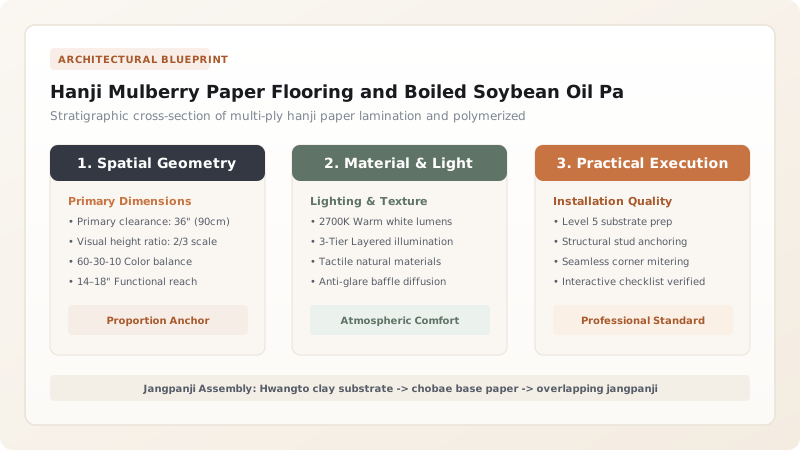
1. Dak Mulberry Bast Fiber and the Manufacture of Heavy Jangpanji
Unlike wood-pulp papers whose short cellulose fibers degrade rapidly under heat, authentic Korean Hanji is crafted from the inner bast of the paper mulberry tree (Broussonetia kazinoki). These bast fibers are extraordinarily long (up to 15–20mm) and interlock in random multidirectional matrices during the traditional swinging-screen vat-dipping process (oubal-teugi).
For flooring applications, standard window washi is far too thin. Craftsmen utilize specialized Jangpanji, an ultra-heavyweight paper (150–250 g/m²) produced by laminating two or three damp sheets directly on the drying board. The resulting sheets possess high tensile burst strength ($>450 \text{ kPa}$), high vapor permeability, and an uncanny ability to expand and contract with the clay subfloor without buckling or tearing.
2. Multi-Ply Floor Papering: Joint Shingling and Starch Dynamics
Installing a jangpanji floor requires meticulous substrate preparation and sequential lamination:
- Chobae (Base Primer Layer): The dry hwangto floor is swept clean. Thin, inexpensive raw hanji sheets are applied using thin wheat starch paste to seal remaining clay dust and provide a smooth, uniform bonding ground.
- Jungbae (Intermediate Leveling): A secondary layer of medium-weight hanji is laid perpendicular to the base coat, staggering all joints by 150mm to eliminate telegraphing seams.
- Sangbae / Jangpanji (Heavy Surface Sheets): The heavyweight oiled-grade sheets are cut into large rectilinear tiles (typically 900 x 900mm or 600 x 900mm). Sheets are soaked in water for 30 minutes to expand fully before pasting.
- Shingled Lap Joints: Sheets overlap by exactly 15 to 20mm in the direction away from the primary room entrance, ensuring that shuffling socks or floor cushions do not catch against raised paper edges.
3. Perilla Oil Boiling, Hand-Rubbed Saturation, and Radiant Thermal Curing
The transformation of pale white paper into golden amber leather is achieved through traditional oil saturation (dobe-kireum). Raw perilla or soybean oil is gently heated in cast iron pots until it begins to polymerize. For darker antique tones, natural persimmon tannin juice (gam-sup) or gardenia seed extract is mixed into the first coat.
Using thick wool pads or horsehair brushes, artisans rub the warm oil deeply into the paper pores until the sheets become completely translucent and saturated down to the clay bed. A gentle fire is maintained in the agungi hearth to heat the subfloor to approximately 35°C. Over 48 to 72 hours, the oil oxidizes into a tough, natural linoleum-like film. A second and third light coat are burnished into the surface with silk rags, creating a satiny, waterproof floor that repels tea spills and acquires an increasingly rich amber glow over decades of use.
Hanji Paper Flooring Layering and Oil Application Matrix
Use this reference table to calculate exact physical dimensions, ratios, and specifications before purchasing:
| Application Stage | Paper / Oil Material | Paste / Coverage Ratio | Primary Function | Curing Condition |
|---|---|---|---|---|
| Base Layer (Chobae) | Unbleached dak hanji (45 g/m²) | Thin fermented wheat starch (1:4) | Consolidates clay dust & seals porosity | Ambient dry, 24 hours |
| Cross Layer (Jungbae) | Medium dak hanji (70 g/m²) | Medium wheat starch (1:3) | Bridges minor subfloor imperfections | Low ondol heat (25°C), 24h |
| Surface Layer (Jangpanji) | Heavyweight 3-ply dak (180 g/m²) | Thick boiled wheat starch (1:2) | Durable tactile wear-layer & footprint | Taut shrinkage dry, 48 hours |
| Primer Oil Saturation | Hot boiled perilla oil + persimmon | 180–220 ml/m² (deep saturation) | Translucency, amber color & moisture proofing | 35°C radiant floor heat, 48h |
| Finish Burnish Coats | Refined perilla oil (room temp) | 40–60 ml/m² (hand-rubbed silk) | Specular satiny sheen & abrasion coat | Continuous occupancy curing |
Practical Constraints
Every successful decoration project must account for physical and environmental constraints:
Maintenance Re-Oiling Routine
Point Load Indentations
Master Craft Protocol for Installing an Oiled Hanji Floor
Execute this professional sequence to achieve flawless results without backtracking:
Substrate Brooming and Priming
Clean dry hwangto floor thoroughly; apply a thin wash of dilute wheat starch paste to bind loose surface clay dust.
Pre-Soaking Jangpanji Sheets
Submerge heavy mulberry paper sheets in clean water for 20 minutes; stack between damp linen towels to relax cellulose fibers.
Base Layer (Chobae) Pasting
Apply first layer of raw hanji using broad horsehair paste brushes, smoothing out all air pockets from center toward walls.
Cross-Ply Intermediate Lamination
Paste the second intermediate paper layer perpendicular to the first, overlapping joints by 100mm to create a cross-laminated web.
Surface Jangpanji Layout
Align pre-expanded heavyweight sheets with 18mm directional laps; roll seams firmly with wooden hand rollers to fuse plies.
Tension Drying Under Gentle Heat
Fire the ondol hearth gently to warm the floor to 28°C; allow paper to shrink bone-dry and drum-taut over 48 hours.
Boiled Oil Hand Saturation
Heat natural perilla oil to 70°C; massage generously into paper with wool pads until paper turns uniformly translucent amber.
Silk Rapping and Final Burnish
Wipe away excess surface oil; burnish the floor with dry silk cloths under continuing gentle heat until a non-sticky satin luster is achieved.
Common Mistakes & Countermeasures
Avoid these costly errors that compromise aesthetics, ergonomics, and budget:
Pasting dry, un-soaked heavyweight jangpanji paper
Applying synthetic polyurethane or epoxies over hanji
Using raw, unboiled supermarket cooking oil
Project Execution Checklist
Track your physical progress. Checkboxes persist automatically on this device:
Frequently Asked Questions
Can an oiled hanji paper floor be cleaned with water?
Yes. Properly polymerized perilla oil forms a waterproof hydrophobic film. Routine cleaning is performed with a lightly damp, well-wrung cotton rag. Avoid harsh detergents, bleach, or ammonia, which break down the natural polymerized oil matrix.
How long does an authentic oiled hanji floor last in daily use?
In traditional Korean Hanoks where inhabitants remove shoes and walk in socks or bare feet, a high-quality 5-ply jangpanji floor lasts 20 to 30 years with occasional annual perilla oil touch-ups.
Why does the floor develop an amber-yellow color instead of staying white?
The golden amber color (kureum) is a natural chemical result of perilla oil oxidation. Linolenic acid molecules cross-link under the gentle radiant heat of the ondol, shifting the refractive index and creating a warm, translucent amber tone that darkens gracefully over decades.


