
Tokonoma Sacred Alcove Proportions and Cedar Posts represent the spiritual and visual focal point of the Japanese traditional interior. Emerging from medieval Zen monastery altars and refined in tea house architecture, the tokonoma is an elevated recessed alcove dedicated to displaying a single seasonal hanging scroll (kakemono) and unpretentious flower arrangement (chabana). Framed by a magnificent, character-rich natural wooden pillar (toko-bashira)—frequently an unpeeled mountain cedar (kitayama sugi) or knobby cherry trunk—the alcove's subtle proportions embody the sacred emptiness (ma) of Zen spatial design.
At a Glance: Key Takeaways
- Toko-Bashira Main Pillar: A natural, characterful wooden post serving as the structural and aesthetic anchor of the room.
- Kitayama Cedar (Sugi): Cultivated in Kyoto hills, famous for silky peeled bark, natural fluting, and straight vertical grain.
- Toko-Kamachi Alcove Curb: Lacquered black or natural hardwood threshold beam elevating the alcove 80mm–100mm above tatami.
- Otoshi-Gake Hanging Header: Horizontal beam concealing the top alcove ceiling joint and framing the hanging scroll.
- Seasonal Scroll & Chabana Display: Minimalist focal altar reflecting the impermanence of nature (ichigo ichie).
- Hierarchy of Guest Seating: The most honored guest (shokyaku) sits on the tatami mat directly facing the toko-bashira.
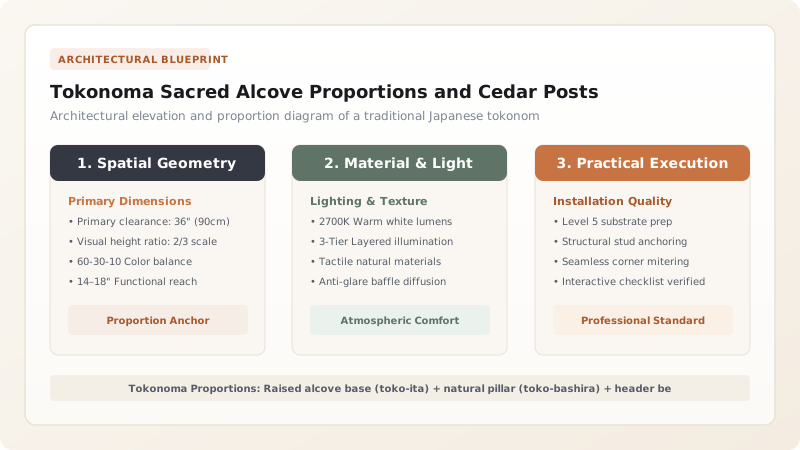
1. Spiritual Ancestry: The Sacred Altar of the Zen Temple
The tokonoma (literally 'bed alcove') traces its lineage to 14th-century Muromachi Zen monasteries, where a raised table held a trio of sacred objects: an incense burner, a flower vase, and a candle, set before a Buddhist scroll. Over centuries, secular domestic architecture adapted this religious altar into an aesthetic sanctum.
In the tea house, the tokonoma is the absolute focal point. It is not an area for general storage or furniture; stepping into the tokonoma is strictly forbidden. It is a contemplative portal where seasonal flowers (chabana) and calligraphic Zen scrolls awaken the guest to the present moment (ichigo ichie: 'one time, one meeting').
2. Dendrology & Joinery: The Character of the Toko-Bashira
The single most important wooden member in the entire tea house is the toko-bashira (alcove pillar). In formal aristocratic rooms, this post was square, planed, and coated in black Urushi lacquer. In the wabi tea house, it is always a natural, unpeeled, or hand-planed tree trunk celebrating natural asymmetry.
Prized selections include:
- Kitayama Sugi (Kyoto Mountain Cedar): Grown in northern Kyoto, foresters strip young trees to produce natural fluted ridges (shibohō-sugi) with silky, lustrous surfaces.
- Kuroki (Natural Bark Wood): Oak, pine, or chestnut logs retaining their rough natural bark, evoking the rugged atmosphere of a mountain hermitage.
- Kobushi (Wild Magnolia): Irregular, sinuous trunks with organic bends and character knots.
3. Dimensional Anatomy: The Toko-Kamachi and Otoshi-Gake
The bottom of the alcove is elevated 80mm to 120mm above the tatami floor, bounded by a horizontal front curb known as the toko-kamachi. Sawn from dense Zelkova (keyaki) or pine, this beam is either finished in matte black urushi lacquer or hand-scraped with an adze (chouna) to reveal rhythmic scallop ripples.
The floor of the alcove (toko-ita) is clad either in a wide, flawless timber plank or a specialized tatami mat with a black-and-white patterned border (koma-beri tatami). Overhead, the alcove ceiling drops 150mm lower than the main room ceiling, masked by an overhanging header beam (otoshi-gake). This deliberate ceiling drop creates an optical shadow pocket that enhances the perceived depth and solemnity of the alcove.
Tokonoma Architectural Classification & Proportions
Use this reference table to calculate exact physical dimensions, ratios, and specifications before purchasing:
| Style Grade | Japanese Term | Toko-Bashira Post Selection | Toko-Kamachi Curb Finish | Ceiling / Wall Detailing |
|---|---|---|---|---|
| Formal (Imperial/Temple) | Shin | Square planed cypress, black urushi | High-gloss black lacquer, gold leaf | Papered walls with gilded borders |
| Semi-Formal (Living Hall) | Gyo | Square cedar with rounded corners | Wiped urushi lacquer over keyaki | Fine Juraku clay, cedar board ceiling |
| Rustic Wabi (Tearoom) | So | Unpeeled Kitayama cedar or wild cherry | Natural bark or adze-scalloped pine | Rustic Juraku clay + woven bamboo ceiling |
| Sunken Alcove | Fumi-komi-doko | Slender bamboo or willow trunk | Zero curb; floor flush with tatami | Minimalist, intimate rustic corner |
Structural & Sourcing Constraints
Every successful decoration project must account for physical and environmental constraints:
Log Scribing Complexity
Fitting an irregular, curved, unpeeled log against dead-square horizontal beams requires master Japanese stereotomy (hikaritsuke).
Single Tree Sourcing
A top-grade naturally fluted Kitayama cedar pillar takes 30 to 40 years of careful mountain forestry and costs thousands of dollars.
Protocol for Scribing and Installing a Tokonoma Alcove
Execute this professional sequence to achieve flawless results without backtracking:
Toko-Bashira Orientation & Face Selection
Inspect the natural cedar post; rotate on timber horses to select the most harmonious, characterful face to face the room.
Scribing to Stone Plinth or Floor Joist
Scribe (hikikaeshi) the irregular natural bottom contours of the cedar post to seat seamlessly over the floor plate or natural foundation stone.
Mortising the Otoshi-Gake Header
Chisel a blind mortise into the top third of the toko-bashira; fit the horizontal otoshi-gake header with a housed tenon.
Toko-Kamachi Curb Bedding
Install the heavy front curb beam; bed securely into wall posts; verify dead-level alignment with the main room tatami frame.
Toko-Ita Floorboard Laying
Fit 30mm thick quarter-sawn cedar or zelkova floorboards behind the curb; tongue-and-groove boards with expansion clearances.
Alcove Earthen Wall Plastering
Apply Juraku clay plaster to the three interior alcove walls; insert a forged iron hook (jiku-kugi) in the rear wall center for the scroll.
Common Mistakes & Countermeasures
Avoid these costly errors that compromise aesthetics, ergonomics, and budget:
Placing the hanging scroll hook off-center or at the incorrect height
Using kiln-dried dimensional lumber for the toko-bashira
Project Execution Checklist
Track your physical progress. Checkboxes persist automatically on this device:
Frequently Asked Questions
Why is it strictly forbidden to step inside a tokonoma?
In Japanese cultural hierarchy, the tokonoma represents sacred, consecrated space. It is the spiritual heart of the home, housing the seasonal scroll, flower arrangement, and family treasures. Stepping into the alcove with bare feet or slippers is considered a severe cultural violation, akin to stepping onto an altar in a sacred sanctuary.
How are flowers arranged in a tearoom tokonoma?
Flower arrangements in a tea house are called 'chabana' (tea flowers). Unlike complex Western bouquets or formal ikebana, chabana follows the Zen rule: 'Arrange flowers as they grow in the field.' A master uses only one or two simple seasonal wild blossoms placed informally in a bamboo vase, expressing the fleeting, unadorned beauty of nature.


