
In Commesso Fiorentino, painting in stone requires selecting raw semi-precious minerals whose natural geological inclusions mimic pictorial chiaroscuro. Artisans scout mineral veins across chalcedony, Sicilian jaspers, Bohemian agates, and Afghan lapis lazuli to locate subtle chromatic transitions that depict shadows on petals or drapery folds. Selected stones are pre-assembled on temporary card backing—a process known as 'basting' (l'imbastitura)—before permanent mastic bedding.
At a Glance: Key Takeaways
- Optical Shading Method: Natural mineral zoning & inclusions (zero artificial stains)
- Premier Minerals: Lapis Lazuli (Badakhshan), Barga Jasper, Volterra Chalcedony
- Standard Slice Depth: 2.5mm to 3.0mm thickness with polished test faces
- Temporary Montage: L'imbastitura (basting with animal bone glue on card)
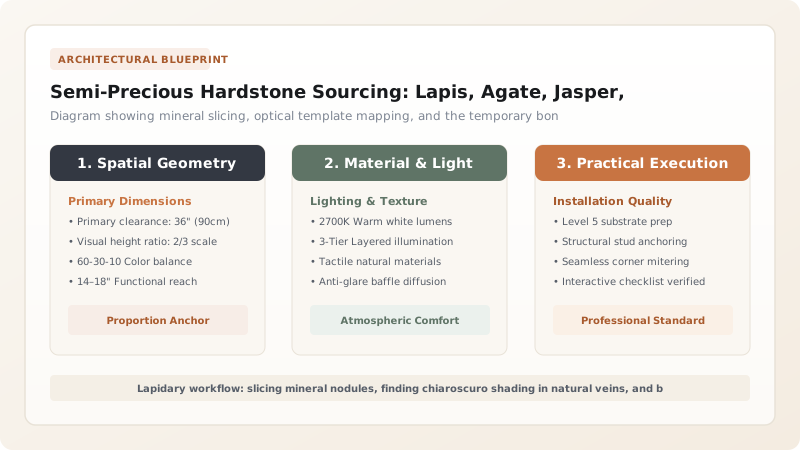
The Global Geological Palette of the Medici Grand Dukes
During the 16th and 17th centuries, the Medici established diplomatic and trade routes specifically to procure rare minerals for the Opificio. Slabs arrived in Florence from every corner of the known world: cobalt-rich lapis lazuli from Badakhshan (Afghanistan), emerald-green malachite from the Urals, blood-red jaspers from Sicily and Bohemia, and petrified silicified woods from the Americas.
Locally, Tuscany supplied exquisite stones: Alberese limestone (famed for creating architectural stone ruins), Barga jasper (renowned for deep ochres and crimson reds), and translucent dendritic chalcedony from Volterra. Each mineral family brought specific mechanical behaviors and crystal structures to the lapidary bench.
Optical Prospecting: Finding Chiaroscuro in Natural Stone Veins
Unlike a painter who blends pigments on a palette to create transitions from light to shadow, the Commesso master must find ready-made shadows formed inside the earth millions of years ago. This art of optical selection is called la macchia (the natural mark or stain).
Artisans wet raw stone slices with water or alcohol to reveal their true polished color. Moving a tracing-paper cartoon over the stone wafer, the master searches for a band where dark mineral inclusions fade into translucent quartz. By aligning this vein with a rose petal template, the petal naturally appears three-dimensional and lit from one side, achieving photorealistic chiaroscuro without a drop of paint.
Diamond Wafering and Thickness Calibration
Raw mineral nodules are sliced into thin veneers using diamond-edged continuous rim lapidary saws cooled with water or light mineral oil. Historic masters used cast-iron discs fed with diamond dust pounded in olive oil.
The target thickness is strictly calibrated to 2.5mm to 3.0mm. Slices thinner than 2mm risk shattering during wire sawing or warping when hot mastic is applied; slices thicker than 3.5mm dramatically increase wire sawing friction and add excessive deadweight to the finished furniture top or architectural panel.
L'Imbastitura: Basting the Mosaic onto Paper Backing
Because a commesso panel may consist of hundreds or thousands of microscopic stone pieces, the assembly cannot be glued directly to the slate backing piece-by-piece. The master uses the imbastitura (basting) technique.
As each stone is cut and filed to perfection, its front face is glued face-down onto a heavy paper cartoon using water-soluble animal hide glue or starch paste. The entire composition is built upside down like a complex jigsaw puzzle. Once all pieces are snapped into place and verified with zero light gaps, the reverse side is leveled with diamond files, ready to receive the hot colofonia mastic and slate slab.
Master Hardstone Selection & Chromatic Mapping Guide
Use this reference table to calculate exact physical dimensions, ratios, and specifications before purchasing:
| Target Image Element | Recommended Mineral | Geographic Provenance | Natural Inclusions Used for Shading | Mohs Hardness |
|---|---|---|---|---|
| Foliage & Tree Leaves | Prase / Green Jasper | Bohemia / Urals | Epidote & chlorite moss-like veining | 6.5 – 7.0 |
| Rose & Tulip Petals | Sicilian Diaspro Rosso | Sicily (Sciacca) | Hematite color zoning from crimson to pink | 6.5 – 7.0 |
| Sky, Water, & Grapes | Lapis Lazuli / Sodalite | Badakhshan (Afghanistan) | Calcite white marbling & gold pyrite sparks | 5.5 – 6.0 |
| Bird Feathers & Skin | Dendritic Chalcedony | Volterra (Tuscany) | Manganese oxide branch-like dendrites | 6.5 – 7.0 |
| Architecture & Ruins | Alberese Limestone | Arno Valley (Tuscany) | Calcite seismic faulting & natural fractures | 3.5 – 4.0 |
Practical Constraints
Every successful decoration project must account for physical and environmental constraints:
Brittle Cleavage Planes in Natural Lapis Lazuli
White calcite veins inside lapis lazuli are soft and fracture easily under wire sawing, requiring gentle handling and slow feed rates.
Geological Depletion of Historic Tuscan Quarries
Historic quarries for Barga jasper and Volterra chalcedony are exhausted; conservators must rely on historic mineral reserves or international equivalents.
Execution Blueprint & Craftsmanship Sequence
Execute this professional sequence to achieve flawless results without backtracking:
Raw Mineral Nodule Inspection
Inspect raw hardstone boulders for internal fractures and fissures using bright fiber-optic raking light; reject heavily fractured zones.
Diamond Slabbing to 2.8mm Wafers
Mount nodules on a diamond lapidary slab saw; cut parallel 2.8mm wafers using water-soluble coolant, maintaining uniform thickness.
Surface Wetting and Chiaroscuro Mapping
Submerge stone wafers in water to reveal full saturation; shift translucent vellum templates across mineral veins to find natural shading gradients.
Individual Piece Cutting and Bevel Filing
Cut individual segments with the archietto wire saw; dress beveled rear edges with diamond needle files until adjacent pieces mate seamlessly.
L'Imbastitura Face-Down Paper Assembly
Paste the polished front face of each stone piece face-down onto the master drawing using reversible bone glue, assembling the full design.
Rear Surface Leveling and Degreasing
Grind the exposed reverse stone backs on a diamond lap plate until flush and level; clean with pure alcohol before applying mastic.
Common Mistakes & Countermeasures
Avoid these costly errors that compromise aesthetics, ergonomics, and budget:
Using Dyed or Artificially Stained Commercial Agates
Assembling Stones Face-Up Directly onto Wet Mastic
Project Execution Checklist
Track your physical progress. Checkboxes persist automatically on this device:
Frequently Asked Questions
Why is Commesso Fiorentino called 'painting in stone'?
Because it captures the subtle tonal gradients, reflections, and three-dimensional realism of oil paintings without using brushes or pigments, relying entirely on the natural color variations found inside hardstones.
How is the temporary paper backing removed after the mastic has cured?
Once the stone commesso is bedded into the hot colofonia mastic on the slate slab and cooled, conservators apply warm water compresses. The animal bone glue dissolves instantly, allowing the paper cartoon to peel away cleanly.


