
Florentine wire sawing using the 'archietto' is the core mechanical technique that makes Commesso lapidary inlay possible. Because hardstones like agate and jasper are harder than steel, steel-toothed blades cannot cut them. Instead, a flexible wooden bow made of seasoned sweet chestnut or hazel is strung with soft annealed iron wire (filo di ferro). As the wire rubs against the stone, an abrasive slurry of fine emery or silicon carbide becomes embedded in the soft iron, cutting micro-kerf contours at a 75-degree reverse bevel.
At a Glance: Key Takeaways
- Abrasive Slurry: Silicon carbide / Turkish emery powder (320 to 600 mesh) + Water
- Bow Material: Seasoned Sweet Chestnut (Castanea sativa) or Hazel (Corylus)
- Sawing Wire: Annealed soft dead-mild iron wire (0.22mm to 0.35mm dia)
- Undercut Angle: 75° to 80° inward bevel angle (Taglio a bisello)
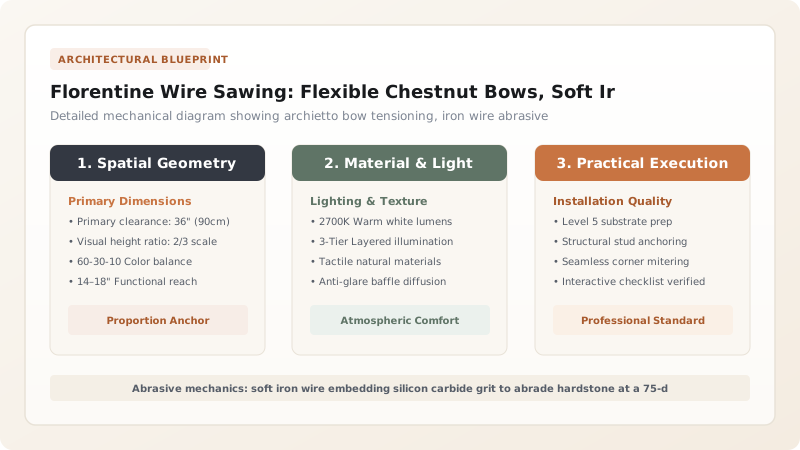
Anatomy and Wood Selection of the Florentine Archietto
The Archietto is deceptively simple yet mechanically sophisticated. It consists of a curved stave (approx. 60cm to 75cm long) fashioned from seasoned sweet chestnut (Castanea sativa) or wild hazel. These woods combine exceptional flexural elasticity with low weight, preventing wrist fatigue during 8-hour sawing sessions.
The ends of the wooden bow are fitted with brass collets or hand-forged iron clamping screws. A tensioning cord (often braided hemp or gut) spans the upper stave; twisting a small wooden toggle (garrote) tightens the stave, imparting high spring tension into the cutting wire strung across the lower horns.
The Physics of Soft Iron Wire vs Hard Stone
A common misconception is that the wire must be hard steel. In reality, hardened steel wire is useless because abrasive grains simply bounce off its rigid surface. Instead, the archietto requires dead-mild, annealed soft iron wire (0.22mm to 0.35mm diameter).
Because the iron is softer than the abrasive crystals (silicon carbide or corundum), the sharp abrasive grains press into the soft iron matrix, becoming temporarily embedded like tiny cutting teeth. As the craftsman draws the wire back and forth across the stone, it acts as a micro-abrasive file, grinding away the mineral without chipping delicate crystal edges.
Abrasive Compounding: Emery and Silicon Carbide Slurries
Historically, Florentine masters used crushed Turkish emery (natural corundum, Al2O3, Mohs 9). In modern conservation, black silicon carbide (SiC, Mohs 9.5) is preferred for its uniform crystalline cleavage and rapid cutting speed.
The dry abrasive is blended with clean water and a drop of liquid detergent (to break surface tension) until reaching a light syrup consistency. The slurry is brushed continuously onto the wire entry point with a small quill or gravity dripper. As cutting progresses, the wire wears thin; craftsmen develop the tactile sensitivity to replace the wire before it snaps mid-contour.
The Undercut Bevel (Taglio a Bisello): Geometry of Zero-Tolerance Seams
The secret of Commesso’s seamless finish lies in the taglio a bisello. The artisan never cuts the stone perpendicular (90 degrees) to the surface. Clamping the stone slice at an angle, the wire is guided at a continuous 75 to 80-degree inward slope.
This produces a wedge profile: the top visible face matches the paper template with microscopic accuracy, while the underside recedes by 0.5mm. When two adjacent stones are brought together, only the knife-edge front surfaces make contact. This eliminates friction and allows complex interlocking curves to snap together with absolute zero visible joint gap.
Wire Sawing Parameter & Slurry Selection Guide
Use this reference table to calculate exact physical dimensions, ratios, and specifications before purchasing:
| Stone Thickness | Hardness (Mohs) | Iron Wire Diameter | Abrasive Grit | Cutting Speed (Linear mm/min) |
|---|---|---|---|---|
| 1.5mm – 2.0mm | Mohs 5.5 – 6.0 (Lapis) | 0.22mm annealed iron | 400-mesh Silicon Carbide | 8 – 12 mm/min |
| 2.5mm – 3.0mm | Mohs 6.5 – 7.0 (Jasper) | 0.28mm dead-mild iron | 320-mesh Silicon Carbide | 4 – 6 mm/min |
| 3.0mm – 4.0mm | Mohs 7.0 (Agate/Quartz) | 0.35mm soft iron wire | 240-mesh Silicon Carbide | 2 – 4 mm/min |
| Delicate Shell/Coral | Mohs 3.5 – 4.0 (Organic) | 0.18mm fine iron wire | 600-mesh Turkish Emery | 15 – 20 mm/min |
Practical Constraints
Every successful decoration project must account for physical and environmental constraints:
Frequent Wire Breakage During Tight Reverse Curves
Navigating sharp 90-degree internal corners causes metal fatigue in iron wire, requiring frequent re-stringing.
Noise and Ergonomic Strain from Continuous Hand Sawing
Prolonged sawing requires custom ergonomic wooden arm-rests and hearing protection to maintain artisan stamina.
Execution Blueprint & Craftsmanship Sequence
Execute this professional sequence to achieve flawless results without backtracking:
Chestnut Bow Selection and Conditioning
Select a knot-free seasoned chestnut branch; oil with raw linseed oil and test elasticity by deflecting stave horns 50mm under hand load.
Annealed Iron Wire Threading and Tensioning
Lock 0.28mm soft iron wire into bow collets; twist the upper cord toggle until the wire emits a crisp high-pitched musical ring when plucked.
Stone Slice Mounting in Bench Vise
Clamp the paper-templated stone slice in the wooden hand-vise, angling the working plane so the wire saw will naturally cut an 80-degree undercut.
Slurry Application and Kerf Starting
Dab wet 320-mesh silicon carbide slurry onto the contour line; draw the wire saw backward with light pressure to establish the starter kerf.
Rhythmic Beveled Contour Sawing
Work the bow with smooth full-length strokes at 60 strokes per minute, replenishing abrasive slurry continuously to prevent wire jamming.
Kerf Inspection and Needle Filing
Wash stone in water; inspect cut edge with a 10x loupe and dress the reverse bevel with diamond needle files to remove any microscopic burrs.
Common Mistakes & Countermeasures
Avoid these costly errors that compromise aesthetics, ergonomics, and budget:
Applying Excessive Downward Hand Force on the Bow
Letting the Abrasive Slurry Dry Out During Sawing
Project Execution Checklist
Track your physical progress. Checkboxes persist automatically on this device:
Frequently Asked Questions
Why can't modern laser or waterjet cutters replace the archietto?
Modern CNC waterjets can cut flat shapes, but they struggle to maintain the continuous variable 3D undercut bevel (taglio a bisello) required for complex interlocking curves, and the waterjet's garnet impact can shatter delicate crystalline agate veining.
How long does a single wire last before breaking?
Depending on stone hardness and contour complexity, a length of iron wire typically lasts 20 to 45 minutes of active cutting before thinning to the point where it must be replaced.


