
The permanent structural consolidation of a Florentine commesso panel relies on 'Mastice di Colofonia'—a traditional hot-melt adhesive composed of purified pine rosin (colofonia) and virgin beeswax fluxed with fine brick dust. Poured molten at 110°C over pre-heated stone assemblies, it penetrates microscopic rear undercuts. The entire mosaic is bedded onto a rigid backing slab of black slate from Lavagna (ardesia), ensuring extreme dimensional stability, zero warping, and complete thermal reversibility.
At a Glance: Key Takeaways
- Application Temp: 105°C to 115°C (Molten fluid state)
- Backing Substrate: Lavagna Black Slate (Ardesia Ligure, 20mm to 30mm thick)
- Mastic Formulation: 75% Purified Pine Rosin (Colofonia) : 25% Virgin Yellow Beeswax
- Mineral Filler: 15% Pulverized fired clay brick dust (polvere di cocciopesto)
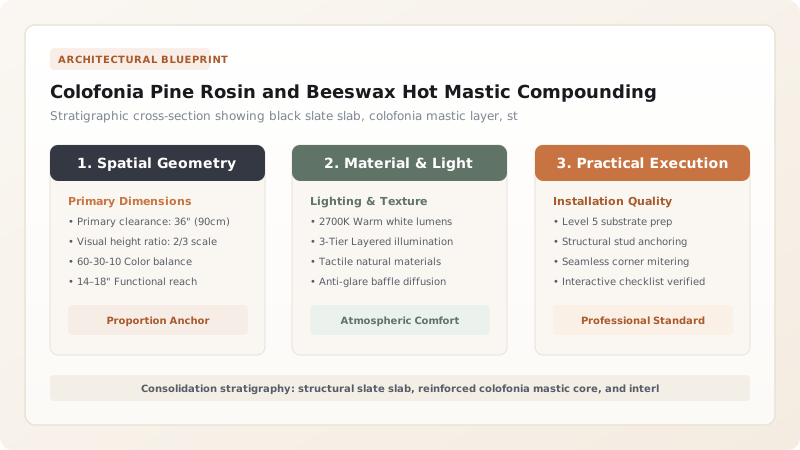
Chemical Formulation and Viscoelasticity of Mastice di Colofonia
Modern synthetic epoxies become brittle with age and cross-link irreversibly, making future conservation impossible without destroying irreplaceable hardstones. Renaissance masters formulated an ingenious thermoplastic composite: Mastice di Colofonia.
The base is colofonia (rosin distilled from maritime pine resin), an abietic acid-rich solid that melts into a liquid glass at 85°C. To counteract the natural brittleness of pure rosin, 20% to 25% virgin yellow beeswax is introduced. The beeswax acts as a permanent plasticizer, allowing the cured mastic to flex microscopically with subtle seasonal building vibrations without cracking.
Mineral Grog Reinforcement: Cocciopesto and Slate Dust
To reduce thermal shrinkage when cooling from 110°C down to room temperature, master lapidaries fold in 10% to 15% (by weight) of ultra-fine pulverized terra-cotta brick dust (cocciopesto) or black slate flour.
This inorganic filler lowers the thermal expansion coefficient of the organic resin matrix, matches the thermal mass of the hardstone veneers, and reinforces the mastic against gravitational creep when commesso panels are mounted vertically in wall niches or grand altars.
Substrate Engineering: Why Lavagna Black Slate (Ardesia) is Universal
The foundation of every authentic Pietra Dura commesso is a slab of black slate quarried from the Ligurian coast near Lavagna (ardesia). Slate exhibits unique geological characteristics that make it vastly superior to wood, bronze, or white marble.
As a fine-grained, foliated metamorphic rock, slate can be split and honed into large slabs (20mm to 30mm thick) that are perfectly planar and completely free of internal tension. It possesses an exceptionally low thermal expansion coefficient, zero porosity, and high flexural elasticity. Unlike white marble, it never warps or bows, providing a permanent flat foundation for centuries.
The Bedding Procedure, Cooling Dynamics, and Diamond Lapping
Before pouring, both the slate backing slab and the basted hardstone mosaic are pre-heated in a warming oven or over electric heating pads to 60°C. This prevents the molten 110°C mastic from chilling instantly upon contact, allowing it to wet every microscopic undercut cavity.
The mastic is poured generously, and the slate slab is pressed firmly into the molten resin under uniform lead weights. After slow cooling for 24 hours, the temporary paper facing is soaked off with warm water. The face is leveled with diamond grinding blocks (from 220 grit down to 3,000 grit) and buffed with tin oxide on wool felt pads until it achieves a brilliant, liquid-mirror gloss.
Mastic Formulation & Backing Slab Specifications
Use this reference table to calculate exact physical dimensions, ratios, and specifications before purchasing:
| Application Type | Colofonia Rosin (%) | Beeswax (%) | Mineral Filler (%) | Slate Slab Thickness |
|---|---|---|---|---|
| Horizontal Tabletop Commesso | 75% | 25% | 15% Cocciopesto brick dust | 25mm – 30mm Ardesia Slate |
| Vertical Wall Plaque / Niche | 80% | 20% | 20% Pulverized slate powder | 20mm – 25mm Ardesia Slate |
| Miniature Cabinet Insert | 70% | 30% | 10% Fine terracotta flour | 12mm – 15mm Dense Slate |
| Reversible Conservation Patch | 65% | 35% | Zero filler (pure resin blend) | Original historic substrate |
Practical Constraints
Every successful decoration project must account for physical and environmental constraints:
Flammability of Natural Pine Rosin and Wax Vapors
Mastic melting must always be executed in temperature-controlled electric melting pots or double boilers away from open flame.
Heavy Deadweight of Solid Slate Tabletops
A 120cm × 80cm commesso tabletop bedded on 30mm slate weighs over 100 kg, requiring heavy-duty timber or marble support pedestals.
Execution Blueprint & Craftsmanship Sequence
Execute this professional sequence to achieve flawless results without backtracking:
Mastic Compounding and Melting
Melt crushed colofonia pine rosin in a double-boiler kettle to 105°C; stir in shredded virgin yellow beeswax and fine brick dust until homogenous.
Slate Slab Leveling and Pre-Heating
Lap the Lavagna black slate slab flat; score cross-hatch keying grooves across the top face and pre-heat on a warming pad to 60°C.
Stone Mosaic Pre-Warming
Pre-heat the basted hardstone mosaic (held together with face-down paper) to 50°C to prevent thermal shock and premature mastic gelling.
Molten Mastic Pouring and Slate Placement
Pour molten mastic evenly over the heated slate; invert the stone mosaic into the liquid bed, pressing down firmly to expel air bubbles.
Weighted Clamping and Annealing
Place flat wooden platens and 50kg lead weights over the assembly; allow slow, stress-free cooling over 24 hours to room temperature.
Paper Removal and Diamond Polishing
Dissolve temporary face paper with warm water; hand-lap the stone face with diamond diamond abrasives (220 to 3000 grit), finishing with tin oxide polish.
Common Mistakes & Countermeasures
Avoid these costly errors that compromise aesthetics, ergonomics, and budget:
Pouring Molten Mastic onto Cold Stone or Cold Slate
Overheating Colofonia Rosin Above 140°C
Project Execution Checklist
Track your physical progress. Checkboxes persist automatically on this device:
Frequently Asked Questions
Can a damaged commesso panel bedded in colofonia be repaired easily?
Yes. One of the greatest virtues of colofonia mastic is complete thermal reversibility. Conservators simply apply a warm heating spatula (85°C) over the damaged area; the mastic softens gently, allowing the individual stone piece to be lifted out, cleaned, and replaced without harming surrounding stones.
Why is brick dust (cocciopesto) added to the pine rosin mastic?
Brick dust acts as a structural aggregate filler. It reduces shrinkage as the liquid resin cools, increases compressive modulus, and provides microscopic mechanical interlocking between the slate and stone faces.


