
Florentine Pietra Dura (Commesso Fiorentino) is the elite Renaissance lapidary art of creating seamless pictorial stone mosaics using naturally colored semi-precious hardstones (Mohs hardness 6 to 7). Established in 1588 by Grand Duke Ferdinando I de' Medici at the Opificio delle Pietre Dure, the craft involves precision-cutting thin stone veneers (2mm to 3mm) of lapis lazuli, jasper, chalcedony, and agate using flexible chestnut wood bows strung with soft iron wire and abrasive slurries. Individual stone pieces are cut with reverse bevels and assembled with zero visible seams, bonded to a black slate slab using a hot mastic of pine rosin (colofonia) and beeswax.
At a Glance: Key Takeaways
- Adhesive Bedding: Hot colofonia pine rosin + virgin beeswax on Lavagna black slate
- Cutting Abrasive: Fine emery / Silicon carbide slurry (220 to 600 mesh)
- Hardstone Mohs Scale: Hardness 6.0 to 7.0 (Agate, Jasper, Chalcedony, Lapis)
- Precision Sawing Tool: Chestnut branch bow (archietto) strung with annealed iron wire
In-Depth Guides in this Directory
Explore specialized subtopic blueprints, technical dimensions, and execution checklists:
Florentine Wire Sawing: Flexible Chestnut Bows, Soft Iron Wire, and Silicon Carbide Abrasives
Technical manual on the Florentine archietto chestnut bow saw, soft iron wire tensioning, abrasive emery slurries, and beveled undercut sawing mechanics.
Semi-Precious Hardstone Sourcing: Lapis, Agate, Jasper, and Natural Color Shading
Comprehensive lapidary guide to sourcing rare hardstones, geologic identification, optical selection for natural chiaroscuro shading, and commesso basting.
Colofonia Pine Rosin and Beeswax Hot Mastic Compounding with Black Slate Substrate Bedding
Technical manual on traditional Colofonia pine rosin and beeswax hot mastic formulations, Lavagna black slate backing slabs, and lapidary polishing.
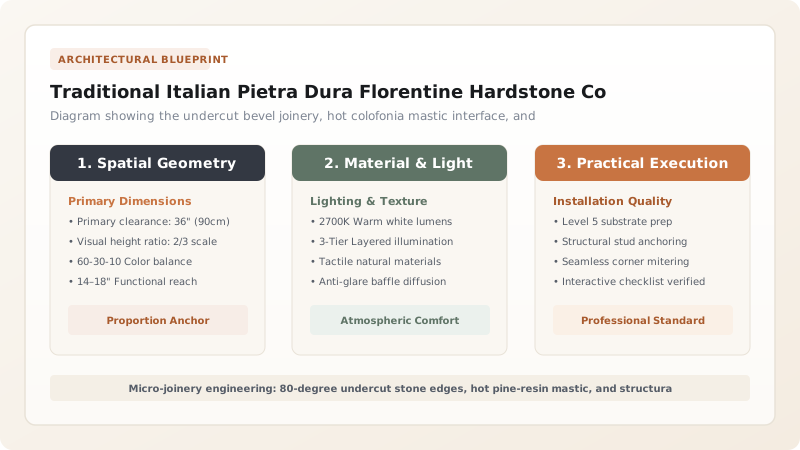
The Medici Legacy and the Birth of Commesso in Renaissance Florence
In 1588, Grand Duke Ferdinando I de' Medici formalized Florence’s centuries-old lapidary workshops by founding the Opificio delle Pietre Dure (Workshop of Semi-Precious Stones). Unlike ancient Roman opus sectile, which used soft marbles (Mohs 3) laid in geometrical pavements, the Medici sought to 'paint in stone' (pittura di pietra) using the world’s hardest and most vibrant minerals.
Known natively as Commesso Fiorentino (from the Latin committere, meaning 'to join together seamlessly'), the technique creates pictorial masterpieces—portraits, landscapes, and intricate floral bouquets—that are eternally immune to fading, discoloration, or environmental aging, outlasting oil paint by millennia.
Material Science: Semi-Precious Hardstones and Chromatic Sourcing
True Pietra Dura utilizes stones rated at Mohs 6 to 7. The primary palette consists of Chalcedony (translucent microcrystalline quartz), Jasper from Barga and Sicily (rich reds, yellows, and olive greens), Lapis Lazuli from Badakhshan (deep celestial ultramarine with pyrite flecks), and petrified fossil woods.
Master artisans never paint or dye stone. Instead, the artist acts as an optical prospector, searching raw mineral slabs for natural geological variations—veins, zoning, crystal inclusions, and color gradients—that perfectly correspond to the shadows on a flower petal or the plumage of a bird.
Mechanical Execution: The Archietto Bow and Beveled Wire Sawing
Cutting stones that scratch hardened steel requires specialized mechanical tooling. The classic Florentine tool is the Archietto—a flexible, curved bow crafted from seasoned chestnut or hazel branches, strung with a thin annealed iron wire (0.2mm to 0.4mm diameter) tensioned by twisting cords.
The artisan clamps the 2mm-thick stone slice in a wooden hand-vise and works the bow back and forth while an assistant or continuous drip feeds an abrasive slurry of water and fine emery powder (or silicon carbide). Crucially, the stone is cut at a slight bevel (75 to 80 degrees) rather than square. This undercut allows adjacent stones to wedge together on the front face with microscopic, invisible hair-joints while leaving a triangular rear groove to receive adhesive.
Mastic Bedding, Slate Backing, and Museum-Grade Conservation
Individual stone pieces are trial-fitted and assembled upside down. To unite the complex mosaic into a permanent monolithic slab, it is bonded to a flat structural backing slab of black slate from Lavagna (ardesia), renowned for its dimensional flatness and zero thermal expansion.
The traditional adhesive is Mastice di Colofonia—a hot blend of purified pine rosin (colofonia) and yellow beeswax (3:1 ratio). Poured molten at 110°C, it flows into every microscopic undercut. Conservation protocols prohibit modern epoxies; aged resin mastic remains 100% reversible via gentle heat spatulas, allowing conservators to dismantle and re-align shifted stones without chipping fragile jasper edges.
Pietra Dura Mineral Classification & Cutting Specifications
Use this reference table to calculate exact physical dimensions, ratios, and specifications before purchasing:
| Mineral Species | Mohs Hardness | Visual Chromatic Function | Wire Sawing Gauge | Abrasive Grit Mesh |
|---|---|---|---|---|
| Lapis Lazuli (Badakhshan) | 5.5 – 6.0 | Deep celestial blues & drapery folds | 0.25mm annealed iron wire | 400-mesh fine emery slurry |
| Barga Jasper (Tuscany) | 6.5 – 7.0 | Warm crimson, ochre, & floral leaves | 0.30mm soft iron wire | 280-mesh silicon carbide |
| Volterra Chalcedony | 6.5 – 7.0 | Translucent skin tones & water effects | 0.20mm micro-gauge wire | 500-mesh optical emery |
| Ardesia Black Slate (Lavagna) | 2.5 – 3.0 | Structural backing slab & black borders | Flat diamond gang-saw | 120-mesh coarse leveling grit |
Practical Constraints
Every successful decoration project must account for physical and environmental constraints:
Extreme Scarcity and Cost of Gem-Quality Raw Hardstones
Top-tier Afghan lapis lazuli and rare Tuscan jaspers command exorbitant prices, requiring 100% yield efficiency during slicing.
Months of Hand Labor for Miniature Tabletop Panels
A complex 50cm × 50cm commesso panel containing 1,500 hand-cut stone pieces requires 800 to 1,200 hours of master lapidary work.
Execution Blueprint & Craftsmanship Sequence
Execute this professional sequence to achieve flawless results without backtracking:
Full-Scale Colored Cartoon (Modello)
Paint a master gouache cartoon on heavy card; dissect the design into individual contour templates numbered by color and grain orientation.
Mineral Slicing and Grain Selection
Slice raw hardstone nodules into 2.5mm thin wafers using diamond laps; align paper templates over natural mineral veins to capture realistic shading.
Paper Template Gluing and Vise Clamping
Glue individual paper pattern segments onto the stone slice using bone glue; clamp the piece firmly in a wooden bench-peg vise (morsa da banco).
Archietto Beveled Wire Sawing
Cut along paper outlines using the chestnut bow saw, feeding wet emery slurry while holding the wire at an 80-degree undercut angle.
Edge Filing and Zero-Tolerance Dry-Fitting
Fine-hone the beveled stone edges with diamond needle files until adjacent stones snap together with absolute zero visible seam gap.
Hot Colofonia Mastic Bedding onto Slate
Warm the black slate backing; pour molten colofonia rosin and beeswax mastic, pressing the assembled stone commesso firmly into the bed until cooled.
Common Mistakes & Countermeasures
Avoid these costly errors that compromise aesthetics, ergonomics, and budget:
Sawing Stone Edges at a 90-Degree Square Angle
Using Permanent Epoxy Adhesives for Bedding
Using Soft Marbles Instead of Mohs 6–7 Hardstones
Project Execution Checklist
Track your physical progress. Checkboxes persist automatically on this device:
Frequently Asked Questions
What is the difference between Roman Opus Sectile and Florentine Commesso?
Roman Opus Sectile uses relatively soft marble and porphyry slices (Mohs 3–5) cut with straight saws into geometric pavements. Commesso Fiorentino uses semi-precious hardstones (Mohs 6–7) wire-cut into complex pictorial imagery with zero visible joints.
Why is black slate from Lavagna used as the backing?
Lavagna slate has a negligible thermal expansion coefficient, fine-grained cleavage that allows perfectly flat planes, and high flexural strength that prevents heavy marble tabletops from bowing over centuries.
How are Commesso stone panels polished to their mirror shine?
After the mastic cures, the entire surface is hand-lapped with progressively finer silicon carbide and diamond pastes (from 400 down to 10,000 grit) on zinc or cast-iron laps, finishing with tin oxide on felt pads.


