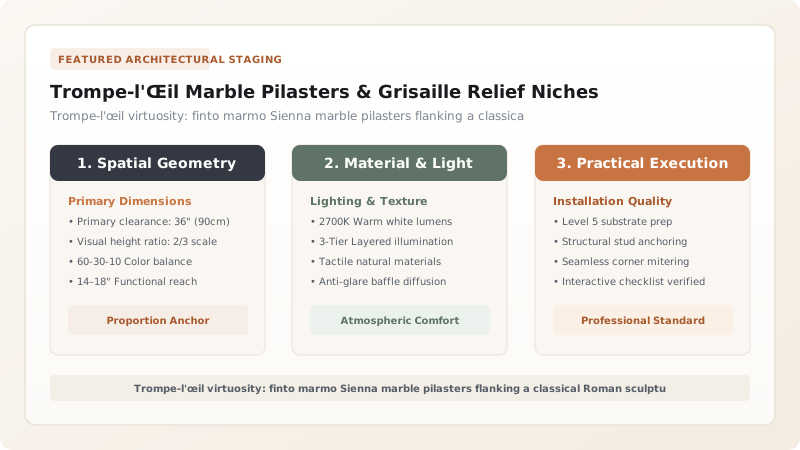
Trompe-l'œil marble pilasters and grisaille relief niches are the signature illusionistic wall treatments of Lucchese villa fresco salons. Using finto marmo feather-veining and glazing techniques, artisans replicated rare metamorphic stones (Giallo di Siena, Verde Alpi, Breccia Medicea) on flat plaster. Flanking these pilasters, arched niches containing classical statues and bas-reliefs were painted in monochrome grisaille, using rigorous chiaroscuro modeled on actual room window lighting.
At a Glance: Key Takeaways
- Faux Stone Technique: Finto Marmo (Illusionistic Painted Metamorphic Marble)
- Sculptural Illusion: Grisaille / Chiaroscuro Bas-Reliefs & Free-Standing Statues
- Marble Varieties Mimicked: Giallo di Siena, Verde Alpi, Carrara Statuario & Breccia
- Application Tools: Goose-Feather Veiners, Badger Blenders & Flat Fitch Brushes
- Shadow Mechanics: Directional Chiaroscuro Calibrated to Real Salon Windows
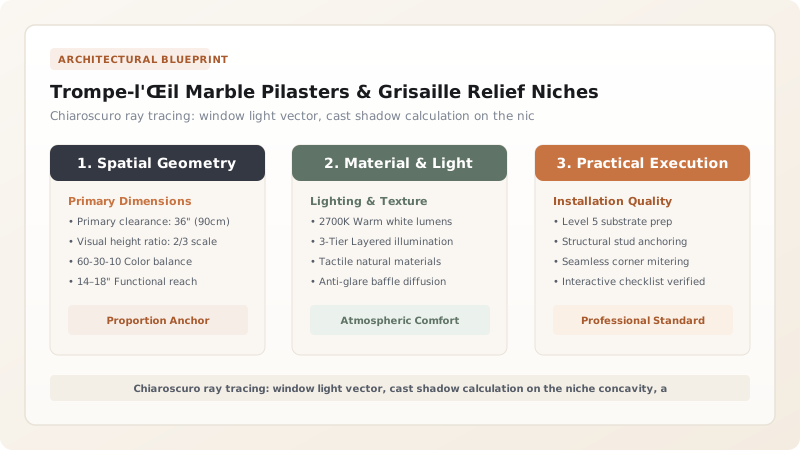
Geological Illusion: The Art and Philosophy of Finto Marmo
In the grand salon decoration of Lucchese countryside villas, finto marmo (imitation marble) was never regarded as a cheap substitute for natural stone; rather, it was celebrated as a supreme demonstration of human artistic triumph over nature. Renaissance and Baroque aesthetic treatises argued that while nature produced stone through blind volcanic and tectonic forces, the master painter recreated stone through intellectual mastery, selective taste, and optical virtuosity.
Villa architects capitalized on faux marble for compelling practical reasons. Cladding the upper-story reception halls of grand villas like Villa Mansi or Villa Torrigiani in hundreds of tons of solid marble revetment would have exerted catastrophic structural loads on timber-framed ceilings and masonry foundations. Painted in buon fresco directly on the light lime-and-pozzolana plaster, finto marmo allowed decorators to incorporate the rarest, most prized stones of the Mediterranean—from the vivid golden-yellow metamorphic veins of Giallo di Siena to the deep, serpentine crystalline matrix of Verde Alpi and the royal purples of Breccia Medicea—without adding deadweight to the building.
Feather Veining and Wet-on-Wet Blending Techniques
Executing finto marmo in buon fresco requires extraordinary manual dexterity and an intimate understanding of geological crystallization. The artisan begins by troweling a smooth intonaco tinted to the primary ground color of the desired marble. While the plaster is still fresh and cool, the master uses an arsenal of specialized tools: sea sponges, stiff bristle fitches, and most famously, natural goose and turkey feathers.
The tip of a trimmed feather is dipped into a thin dispersion of raw umber, vine black, or hematite red ground in distilled water. Holding the feather lightly between thumb and forefinger, the artist drags and rotates the barbules across the wet plaster with subtle, trembling wrist motions. Because the feather's filaments flex independently, they deposit branching, bifurcating fissures that replicate the tectonic fault lines of natural stone. Immediately following the feather, the painter sweeps the wet marks with a dry, silky badger-hair softening brush (pennello da sfumare), feathering the vein edges into the damp ground to create the illusion of translucent, sub-surface depth.
Grisaille Sculptural Niches: The Mastery of Monochromatic Volume
Between the painted faux marble pilasters, Lucchese fresco cycles frequently feature simulated architectural recesses housing free-standing classical statues of mythological deities, muses, and allegorical virtues. These sculptural illusions are rendered in grisaille—painting executed entirely in monochrome gradations of grey, white, and brown.
Grisaille was revered as the ultimate test of a painter's understanding of chiaroscuro (the distribution of light and shadow). Stripped of the emotional distraction of chromatic color, the artist relied purely on value contrast to deceive the human eye. The recessed niche was painted with deep, graded shadows that simulated a concave hemispherical vault. Within this hollow, the figure was built from mid-tone neutral greys (blended from slaked lime and vine black), progressively darkening into deep cast shadows in the drapery folds and culminating in crisp, specular highlights of pure white lime putty placed along the brow, shoulders, and fingertips.
Harmonizing Real and Painted Light: The Physics of Optical Deception
The definitive secret behind the startling realism of Lucchese villa trompe-l'œil is the absolute calibration between painted illumination and real natural lighting. Before mixing a single pigment, the master painter surveyed the salon's architectural fenestration, noting the precise orientation of the tall exterior windows and the angle of natural Tuscan sunlight entering the room.
All painted shadows within the decorative scheme—the deep shadows cast by faux marble column capitals, the dark modillions beneath projecting cornices, and the silhouettes cast by grisaille statues onto the curved backs of their niches—were rendered with light sources strictly matching the room's actual windows. If the room was illuminated by windows on the south wall, painted shadows on the north wall fell consistently toward the north. Furthermore, the painter modulated the color temperature of the shadows: warm umber washes simulated the ambient bounce light of warm terracotta floors, while cool grey-blue undertones mimicked the reflected illumination of the open sky. This seamless optical harmony between real and simulated illumination rendered the architectural deception complete, leaving visitors marveling at walls that appeared made of solid, sculptural stone.
Faux Marble Varieties, Pigment Formulations & Grisaille Values
Use this reference table to calculate exact physical dimensions, ratios, and specifications before purchasing:
| Mineral / Finish | Base Coat Formulation | Veining Pigments | Glaze Medium | Architectural Location |
|---|---|---|---|---|
| Giallo di Siena (Yellow) | Raw sienna + white lime putty | Burnt umber & raw sienna veins | Dilute lime water with trace ox gall | Pilaster shaft panels and frieze fields |
| Verde Alpi (Serpentine Green) | Terra verde + vine black | White lime highlights & lamp black cracks | Pure lime milk wash | Architrave accents and fireplace surrounds |
| Breccia Medicea (Purple/Red) | Rose earth + chalk white | Dark hematite, ochre & violet earths | Thin pozzolanic slip | Dado plinths and lower wall wainscoting |
| Grisaille Statue in Niche | Bone black + slaked lime (Neutral grey) | Concentrated ivory black for cast shadows | Layered wet-in-wet buon fresco | Flanking wall niches between pilasters |
Practical Constraints
Every successful decoration project must account for physical and environmental constraints:
Curvature Distortion Across Vaulted Niche Recesses
Painting an arched niche on a flat wall requires extreme perspective distortion to look concave. Mitigation: Paint deep graded semicircular cast shadows along the upper arch that simulate a deeply recessed hemispherical dome.
Rapid Pigment Absorption on Polished Lime Plaster
Veining glazes dry rapidly on warm plaster, preventing smooth blending of delicate mineral veins. Mitigation: Keep the surface misted with distilled lime-water and add a drop of natural ox gall to reduce liquid surface tension.
Execution Blueprint & Craftsmanship Sequence
Execute this professional sequence to achieve flawless results without backtracking:
Laying Out Architectural Niches
Snap vertical plumb lines for pilaster margins and draw arched niche profiles using a beam compass.
Base Coat Application for Faux Marble
Trowel tinted lime-marble intonaco to form the ground color (cream for Siena, pale sage for Verde Alpi).
Feather Veining Execution
Dip a trimmed goose quill feather into liquid raw umber and drag it across the wet plaster with subtle trembling wrist motions.
Badger Hair Softening
Immediately soften the wet veining with a dry, soft badger-hair blender, blurring vein margins into the ground stone.
Spattering and Brecciation
Flick fine mineral pigment droplets across the surface with a stiff brush to replicate natural fossilized aggregate and crystals.
Painting the Arched Niche Recess
Paint the deep concave shadow of the niche using graded washes of raw umber, darkening toward the inner recess.
Grisaille Statue Blocking
Block in the silhouette of the classical statue (Apollo, Diana, Minerva) using a mid-tone neutral grey mix of lime and bone black.
Chiaroscuro Modeling and Specular Highlights
Paint deep shadows on the side opposite the window, finishing with pure white lime paste highlights on the nose, drapery folds, and brow.
Common Mistakes & Countermeasures
Avoid these costly errors that compromise aesthetics, ergonomics, and budget:
Painting shadow angles that conflict with the actual window light in the salon
Drawing faux marble veining in repetitive, parallel, or artificial lightning-bolt patterns
Using pure black pigment for grisaille sculpture shadows
Project Execution Checklist
Track your physical progress. Checkboxes persist automatically on this device:
Frequently Asked Questions
Why were walls painted with faux marble (finto marmo) instead of using real stone slabs?
While real marble was used for ground-floor thresholds and door frames, cladding entire second-floor grand salons in solid marble would have imposed immense structural deadweight on timber floor beams. Finto marmo provided palatial opulence without structural risk, while allowing artists to feature exotic stones quarried hundreds of miles away.
Why is a goose feather used to paint marble veining?
The soft, flexible barbules of a goose or duck feather hold a reservoir of liquid pigment while responding organically to the slightest wrist vibration. Dragging and twisting a feather creates erratic, branching fissures with soft, feathery margins that mirror geological marble veins far better than rigid brushes.
How does grisaille create the illusion that a painted statue is projecting from the wall?
Grisaille relies on rigorous chiaroscuro (light and dark modeling). By meticulously painting cast shadows cast by the statue's limbs onto the curved back of the painted niche—matching the direction of natural daylight from the room's windows—the human brain perceives the flat painting as a three-dimensional stone sculpture.