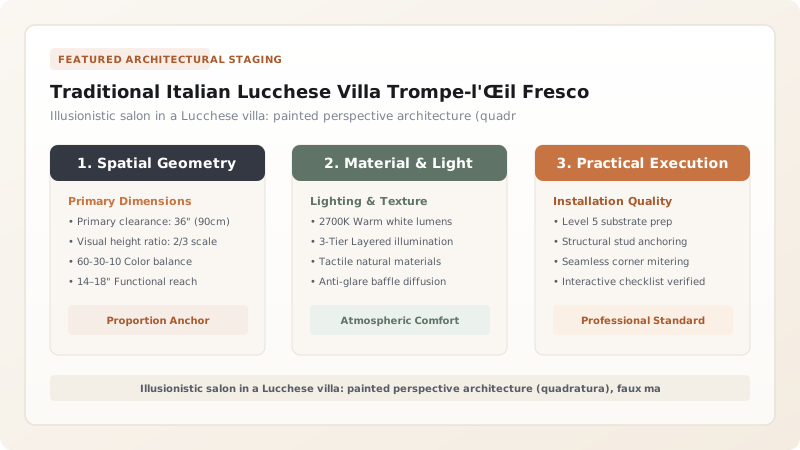
Traditional Italian Lucchese villa trompe-l'œil fresco salons represent the pinnacle of 17th- and 18th-century illusionistic architectural painting (quadratura) in the aristocratic countryside estates of Lucca, Tuscany. Painted in buon fresco on slaked lime and pozzolanic volcanic intonaco plaster, these salons visually dissolve planar walls and vaulted ceilings into colonnaded loggias, faux marble pilasters, grisaille relief sculptures, and open Tuscan skies using rigorous mathematical perspective.
At a Glance: Key Takeaways
- Artisan Heartland: Piana di Lucca & Monti Pisani (Villas of Lucca, Tuscany)
- Illusion Genre: Quadratura (Painted Perspective Architecture & Trompe-l'Œil)
- Plaster Medium: Aged Slaked Lime Putty (Grassello di Calce) & Pozzolana Sand
- Painting Chemistry: Buon Fresco Carbonation (Calcium Hydroxide to Calcite)
- Architectural Elements: Faux Marble Pilasters, Coffered Vaults & Grisaille Niches
In-Depth Guides in this Directory
Explore specialized subtopic blueprints, technical dimensions, and execution checklists:
Quadratura Architectural Perspective Plaster Gridding in Tuscan Salons
Technical guide to quadratura perspective systems, viewpoint layout, chalk string snapping, and plaster gridding in Lucchese fresco salons.
Buon Fresco Pozzolana-Lime Intonaco & Color Saturation in Lucchese Villas
Technical guide to buon fresco chemistry, aged slaked lime, pozzolana intonaco plaster, and pigment saturation in historic Tuscan villas.
Trompe-l'Œil Marble Pilasters & Grisaille Relief Niches on Tuscan Villa Walls
Guide to painting trompe-l'œil marble pilasters (finto marmo) and grisaille relief sculpture niches in historic Lucchese villa salons.
Aristocratic Splendor of the Lucchese Countryside Villas
In the undulating hills surrounding the ancient walled city of Lucca in northern Tuscany, the 16th, 17th, and 18th centuries witnessed an unprecedented flourishing of aristocratic country villa architecture. Wealthy Lucchese silk merchants and patrician families—such as the Mansi, Torrigiani, Garzoni, and Pfanner dynasties—invested their fortunes in monumental rural estates that served as centers of agricultural estate management and magnificent summer entertaining.
At the architectural heart of these residences lay the salone centrale (grand reception hall), soaring two stories in height and crowned by barrel or coved vaults. To transform these massive masonry enclosures into breathtaking theatrical spaces, patrons commissioned master fresco painters to execute comprehensive trompe-l'œil decorative cycles. Rather than hanging framed canvases, artists covered every square foot of plaster with painted illusions that visually shattered the physical boundaries of the room, dissolving solid brick walls into sun-drenched classical colonnades, open loggias, and celestial vistas.
The Science of Quadratura: Perspective, Geometry, and the Central Viewpoint
The technical foundation of Lucchese salon painting is quadratura—the art of painted illusionistic architecture governed by strict mathematical perspective. Originating with Renaissance treatises by Leon Battista Alberti and perfected by Andrea Pozzo in his 1693 treatise Perspectiva Pictorum et Architectorum, quadratura required the painter to possess the dual masteries of a fine artist and an architectural engineer.
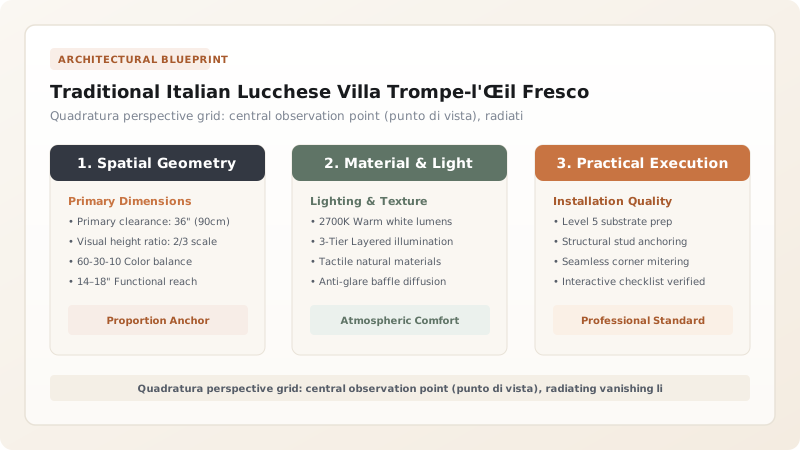
To create an illusion that appears totally convincing to a standing observer, the quadratista established a single mathematical viewing point (punto di vista) on the salon floor—typically situated at eye level at the central entrance portal. From this point, radial perspective strings were stretched across the room to calculate the exact vanishing lines, foreshortened entablatures, and tapered column shafts. When viewed from this sweet spot, the flat plaster walls and curved ceiling vaults appear to open completely: painted Corinthian columns appear to support soaring marble architraves that extend thirty feet into the sky, creating a breathtaking optical deception.
Chemical Mastery of Buon Fresco: Lime Intonaco and Carbonation
Unlike northern European murals executed in oil on canvas or tempera on dry plaster (secco), Lucchese villa salons were painted strictly in buon fresco (true fresco). Buon fresco is not a paint layer applied onto a wall; it is an inorganic chemical transformation that fuses the pigment into the stone wall itself.
The process begins with aged slaked lime putty (grassello di calce), slaked in water pits for multiple years to achieve ultra-fine crystalline structure, mixed with washed river sand and volcanic pozzolana. The artisan trowels a fine finishing coat (intonaco) over only as much area as can be painted in a single day (a giornata). While this plaster remains wet, the artist paints using finely ground mineral pigments suspended in pure distilled water. As the damp plaster dries, calcium hydroxide in the lime absorbs atmospheric carbon dioxide, converting chemically into calcium carbonate (calcite). The pigment particles are permanently encased within this crystalline calcite rock lattice, creating colors that never flake, yellow, or peel across centuries.
Trompe-l'Œil Vocabulary: Faux Marble, Grisaille, and Atmospheric Illumination
Within the quadratura framework, Lucchese painters employed an opulent repertoire of illusionistic finishes. Real carved marble was prohibitively expensive and too heavy for second-story salon walls; in its place, master decorators painted trompe-l'œil marble (finto marmo) with microscopic fidelity, replicating the rich green crystalline breccias of Verde Alpi, the golden veins of Giallo di Siena, and the delicate smoky patterns of Carrara statuario.
Between the painted pilasters, artists framed faux stone niches housing monumental sculptures painted in grisaille—monochromatic gradations of grey, bone black, and chalk white that simulate carved Roman marble statues and relief friezes. Crucially, the painter calculated the direction and warm color temperature of the shadows to match the real natural sunlight entering through the salon's actual tall windows. This harmony between real and painted light creates an uncanny sensory experience: shadows cast by painted cornice brackets align perfectly with real architectural shadows, rendering the illusion of three-dimensional stone complete.
Lucchese Fresco Salon Elements, Plaster Stratigraphy & Optical Effects
Use this reference table to calculate exact physical dimensions, ratios, and specifications before purchasing:
| Salon Zone | Plaster Layer | Pigment Formula | Perspective / Illusion Technique | Curing Mechanism |
|---|---|---|---|---|
| Vaulted Ceiling Center | Fine marble-dust intonaco (2 mm) | Lapis lazuli, ultramarine & titanium earth | Sotto in sù (Looking upward from below) | Carbonation to calcium carbonate matrix |
| Upper Cornice & Architrave | Pozzolana lime intonaco (3 mm) | Grisaille earth tones & burnt umber | Projecting trompe-l'œil modillions with cast shadows | Monolithic fusion with arriccio ground |
| Perimeter Wall Pilasters | Polished slaked lime plaster | Yellow Siena & Verde Alpi faux marble glazes | Linear quadratura aligned with salon floor axes | Calcite crystalline lock |
| Grisaille Statue Niches | Smooth intonachino finish | Bone black, white lime & raw sienna | Chiaroscuro shadow modeling simulating 3D marble | Deep chemical carbonation |
Practical Constraints
Every successful decoration project must account for physical and environmental constraints:
Rising Capillary Dampness in Historic Tuscan Villa Masonry
Ground moisture carrying soluble salts causes sub-florescence that spalls delicate intonaco fresco layers. Mitigation: Install perimeter perimeter drainage around villa foundations and apply lime-pozzolana sacrificial dehumidifying plasters at wall bases.
Strict 8-Hour Chemical Curing Window for Buon Fresco
Once the wet lime plaster begins to carbonate, the window for pigment bonding closes permanently. Mitigation: Carefully demarcate manageable daily plaster patches (giornate) matching the exact painting workload of a single session.
Execution Blueprint & Craftsmanship Sequence
Execute this professional sequence to achieve flawless results without backtracking:
Substrate Preparation and Arriccio
Scrape historic stone/brick walls clean of dirt. Apply a 15 mm rough scratch coat (arriccio) of lime putty and coarse river sand.
Establishing Geometric Perspective
Mark the central viewing point on the salon floor. Project vanishing lines onto the walls using chalk snap lines and plumb bobs.
Master Cartoon Drafting (Sinopia)
Draft full-scale architectural drawings (columns, entablatures, loggias) on heavy rag paper and perforate lines for pounce transfer.
Laying the Giornata Intonaco
Trowel a thin 3 mm layer of fine slaked lime and marble dust plaster (intonaco) over only the section to be painted that day.
Inscribing Architectural Lines
Transfer the cartoon lines using charcoal dust bags, then incise structural lines directly into the soft plaster with a steel stylus.
Buon Fresco Pigment Application
Grind mineral pigments in pure distilled water and brush onto the damp plaster, working from light sky washes down to deep shadows.
Modeling Faux Marble and Grisaille
Paint trompe-l'œil marble veining, simulated stone fluting, and grisaille statues using feathered chiaroscuro techniques.
Edge Beveling and Carbonation
Cut away excess unpainted intonaco at a 45-degree bevel, sponge the perimeter seam smooth, and allow 28 days for full calcite curing.
Common Mistakes & Countermeasures
Avoid these costly errors that compromise aesthetics, ergonomics, and budget:
Applying buon fresco pigments onto dry or partially carbonated intonaco plaster
Failing to maintain a unified mathematical perspective vanishing point across all four salon walls
Using organic lake pigments or lead-based colors that react with alkaline lime
Project Execution Checklist
Track your physical progress. Checkboxes persist automatically on this device:
Frequently Asked Questions
What is the difference between quadratura and standard mural painting?
Quadratura is a specialized branch of illusionistic architectural painting that uses rigorous mathematical linear perspective to extend real architectural spaces into imaginary painted spaces. While standard murals depict flat scenes within frames, quadratura integrates directly with the room's actual pilasters, moldings, and lighting angles to deceive the viewer's eye completely.
Why is slaked lime (grassello di calce) aged for years before being used in fresco intonaco?
Aging slaked lime putty in outdoor pits for 2 to 5 years allows the microscopic calcium hydroxide crystals to fracture into ultra-fine hexagonal platelets. This aged lime achieves exceptional plasticity, buttery workability, and high density without shrinkage cracking when troweled onto villa walls.
How does buon fresco differ from fresco secco?
Buon fresco is painted directly onto wet, freshly troweled lime plaster (intonaco); the pigment particles are chemically locked into the crystalline matrix of calcium carbonate as the plaster cures. Fresco secco is painted onto dry plaster using organic binders (egg, glue, or oil), making it vulnerable to flaking and moisture damage.
Why are grisaille relief paintings executed in monochrome tones?
Grisaille utilizes shades of grey, umber, and white to simulate carved three-dimensional stone or marble sculptures and bas-reliefs. By omitting color and strictly modeling light and shadow (chiaroscuro) corresponding to the salon's actual window light, the artist creates a convincing optical illusion of solid stone.