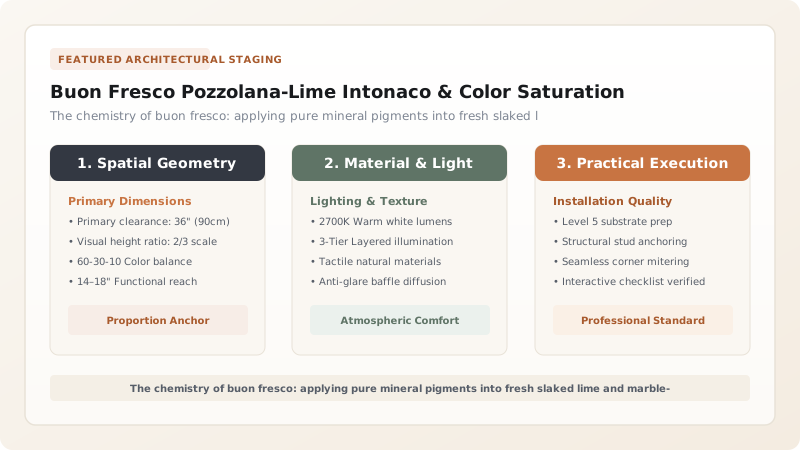
Buon fresco pozzolana-lime intonaco is the chemical and material foundation of durable Italian villa murals. Aged slaked lime putty (grassello di calce) is blended with volcanic pozzolana sand and pulverized marble to form the wet finishing plaster (intonaco). Pure mineral pigments mixed with distilled water are applied while the plaster is fresh. As the lime reacts with atmospheric carbon dioxide, it forms insoluble calcium carbonate, locking pigments permanently within a luminous crystal matrix.
At a Glance: Key Takeaways
- Plaster Binder: Aged Slaked Lime Putty (Grassello di Calce, Aged 24–36 Months)
- Hydraulic Aggregate: Volcanic Pozzolana Sand & Pulverized Carrara Marble Dust
- Painting Window: Giornata (6 to 8 Hours on Fresh, Wet Intonaco Plaster)
- Chemical Matrix: Calcite (CaCO3) Formed via Atmospheric Carbonation
- Pigment Stability: 100% Alkali-Resistant Natural Inorganic Earth Oxides
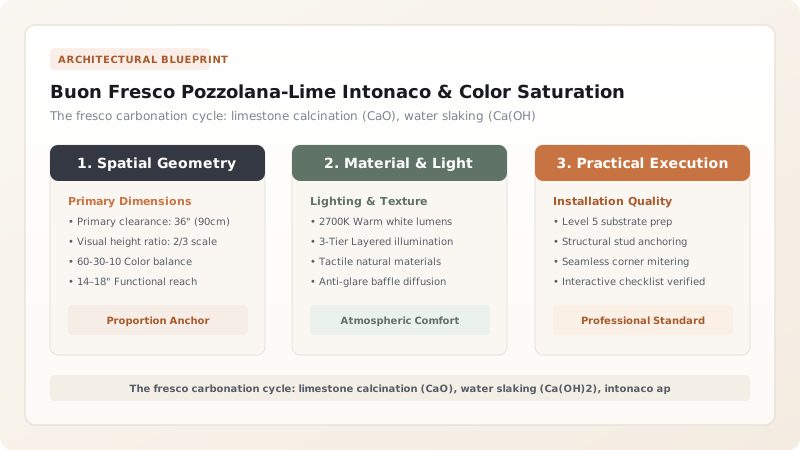
Chemistry of the Lime Cycle in Lucchese Fresco Plaster
The extraordinary permanence of the frescoes gracing Lucchese countryside villas is governed by one of chemistry's most elegant natural processes: the lime cycle. Unlike modern synthetic paints that dry through the evaporation of chemical solvents, leaving a plastic film on top of a wall, true fresco (buon fresco) transforms into stone.
The cycle begins with high-purity calcium limestone (calcium carbonate, CaCO3) quarried from the Apuan Alps. Fired in wood-burning kilns at 900°C, carbon dioxide is driven off, producing quicklime (calcium oxide, CaO). When drowned in water (slaked), it violently converts into calcium hydroxide (Ca(OH)2), known as grassello di calce (slaked lime putty). When troweled onto the wall as wet finishing plaster (intonaco) and painted with water-suspended pigments, the calcium hydroxide reacts with carbon dioxide in the air. This process of carbonation chemically converts the plaster back into crystalline calcite, permanently locking the pigment particles inside a transparent rock matrix.
Aggregate Science: Pozzolana Sand and Carrara Marble Dust
Pure lime putty shrinks significantly as it dries, which would cause severe shrinkage crazing if used alone. To formulate a stable, crack-free intonaco, Lucchese plasterers combined aged lime with carefully calibrated aggregates. The secret to regional plaster durability was the inclusion of pozzolana—a fine volcanic ash quarried from regional volcanic deposits.
Pozzolana contains reactive amorphous silica and alumina. In the presence of water, it reacts chemically with the calcium hydroxide in the lime (the pozzolanic reaction), forming insoluble calcium silicate hydrates that give the plaster hydraulic properties: faster set, high density, and superior water resistance. For the top finishing layer (intonachino), artisans blended equal parts of lime putty with micro-fine pulverized Carrara marble dust (polvere di marmo). The translucent white marble crystals reflect light from within the plaster matrix, giving buon fresco its signature glowing, porcelain-like optical luminosity.
The Giornata: Rhythm, Seams, and the Carbonation Window
Painting in buon fresco imposes absolute temporal discipline upon the artist. The pigment must be applied while the intonaco is still wet and chemically active. Once the plaster begins to dry and form a surface crust of calcium carbonate, the carbonation window closes: pigments applied after this point will simply sit on the dry surface as loose powder and dust away.
Because an artist can only paint a limited area before the plaster sets (typically an 8- to 10-hour window), the master divides the salon into discrete daily patches called giornate (day's work). The painter plans each giornata along natural architectural boundaries—such as the shadow line of a column, a plaster molding, or an entablature break. At the end of the day, any unpainted intonaco is carefully sliced away at a 45-degree bevel with a sharp plaster knife. The next morning, the adjacent patch is troweled on, matching the beveled seam so seamlessly that the joint becomes invisible once painted.
Pigment Mineralogy and Optical Saturation Mechanics
Because wet slaked lime is fiercely alkaline (with a pH of approximately 12 to 13), only a select group of pigments can survive in buon fresco. All organic dyes and vegetable colors decompose instantly in contact with wet lime. Master fresco painters restricted their palette to alkali-resistant inorganic minerals and earth oxides.
Yellows and reds were derived from natural iron oxide earths (giallo ocra, rosso cinabrese, and burnt sienna). Greens were provided by terra verde (celadonite and glauconite silicates), famously quarried near Verona. Blacks were ground from calcined peach stones (nero di vite) or ivory bone. The ultimate challenge was blue: natural azurite and lapis lazuli could not always be applied in buon fresco without chemical degradation. To solve this, 18th-century Lucchese artists employed smalt (a ground cobalt-potassium glass frit) or applied fine lapis lazuli a secco with a tempera binder over cured intonaco, achieving saturated, lightfast skies that have retained their radiant celestial depth across three centuries.
Fresco Pigments, Chemical Formulations & Lightfast Stability on Lime
Use this reference table to calculate exact physical dimensions, ratios, and specifications before purchasing:
| Pigment Name | Chemical / Mineral Composition | Color Value | Alkali Resistance (Lime) | Longevity Rating |
|---|---|---|---|---|
| Terra Verde (Green Earth) | Celadonite / Glauconite silicate | Translucent sage green | Immune to lime alkali | Centuries (Permanent) |
| Giallo Ocra (Yellow Ochre) | Hydrated iron oxide (FeO(OH)) | Warm golden earth tone | Completely stable | Permanent (ASTM Class I) |
| Rosso Cinabrese / Morellone | Hematite / Ferric oxide (Fe2O3) | Deep Venetian terracotta red | Completely stable | Permanent (ASTM Class I) |
| Smalt / Cobalt Frit | Potassium silicate glass with cobalt | Brilliant azure sky blue | High (Replaced fugitive azurite) | Permanent in true fresco |
Practical Constraints
Every successful decoration project must account for physical and environmental constraints:
Rapid Surface Carbonation During Hot Tuscan Summer Days
High temperatures and dry air accelerate intonaco drying, shortening the workable painting window to under 4 hours. Mitigation: Schedule fresco plastering and painting in the early morning hours, hang damp burlap curtains over windows, and mist walls with lime-water.
Moisture Wicking Through Historic Exterior Villa Walls
Rain penetration through exterior masonry washes soluble salts into the intonaco, causing salt crystallization (efflorescence). Mitigation: Waterproof exterior facade lime renders and ensure villa gutters and downspouts are impeccably maintained.
Execution Blueprint & Craftsmanship Sequence
Execute this professional sequence to achieve flawless results without backtracking:
Lime Putty Sourcing and Aging
Procure pure calcium lime putty (grassello di calce) aged for a minimum of 24 months in subterranean slaking pits.
Intonaco Compounding
Mix 1 part aged lime putty with 1 part washed river sand and 1 part pulverized Carrara white marble dust (0.2–0.5 mm grain).
Pre-Wetting the Substrate
Saturate the cured arriccio base coat with distilled water until capillary suction is fully neutralized.
Troweling the Giornata
Apply a uniform 3 mm intonaco coat over the day's painting area, smoothing with a stainless steel trowel and wooden float.
Pigment Preparation
Mull dry inorganic mineral pigments with distilled water on a granite slab until achieving silky, non-gritty liquid dispersions.
Applying Foundational Washes
Brush broad transparent watercolor-like washes of yellow ochre and green earth into the damp plaster to establish undertones.
Building Tonal Saturation
Layer richer, more concentrated pigment washes over the drying plaster, building deep shadows and sharp architectural accents.
Trimming and Curing
Carefully bevel the unpainted perimeter of the giornata at a 45-degree angle. Allow the painted surface to carbonate naturally for 28 days.
Common Mistakes & Countermeasures
Avoid these costly errors that compromise aesthetics, ergonomics, and budget:
Using fast-setting Portland cement or gypsum plaster for fresco grounds
Painting on intonaco that has formed a dry surface crust (calcification)
Using tap water containing dissolved chlorine or iron to mix fresco pigments
Project Execution Checklist
Track your physical progress. Checkboxes persist automatically on this device:
Frequently Asked Questions
Why is volcanic pozzolana added to fresco lime plaster?
Pozzolana is a fine volcanic ash rich in reactive amorphous silica and alumina. When mixed with slaked lime and water, it triggers a pozzolanic reaction that forms calcium silicate hydrates, significantly increasing plaster compressive strength, density, and resistance to moisture.
What chemical transformation locks the pigment into the wall in buon fresco?
The transformation is carbonation: Ca(OH)2 (calcium hydroxide in the wet plaster) reacts with CO2 (carbon dioxide in ambient air) to form CaCO3 (calcium carbonate / limestone). The pigment particles are physically trapped inside the newly crystallized limestone matrix.
Can oil paint or acrylic be added to a buon fresco?
No. Oil and acrylic rely on organic polymer binders that prevent carbon dioxide from reacting with the lime, disrupting the carbonation cycle and causing the plaster to disintegrate and peel.