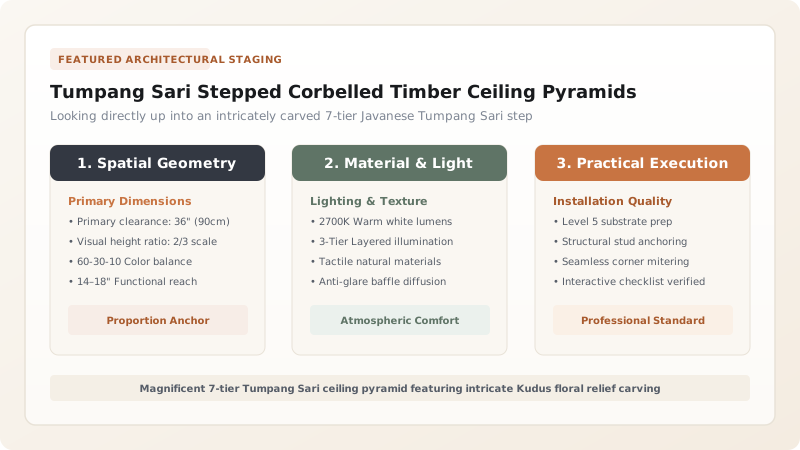
The Tumpang Sari is the magnificent inverted stepped pyramid ceiling structure crowning the interior of a traditional Javanese Joglo. Resting directly atop the four Soko Guru pillars, it consists of 3, 5, 7, or 9 concentric tiers of intricately carved teak beams corbelled progressively inward toward a central keystone (dada peksi). Combining Hindu-Javanese cosmic numerology with advanced cantilever joinery, the Tumpang Sari functions as both a compressive structural vault and an acoustic resonator for gamelan music and ceremonial gatherings.
At a Glance: Key Takeaways
- Ceiling Architecture: Inverted stepped timber pyramid (Tumpang Sari / 'overlapping layers')
- Sacred Tier Count: Odd numbers strictly: 3, 5, 7, or 9 tiers based on royal/aristocratic rank
- Central Keystone Beam: Dada Peksi (literally 'chest of the bird') at the ceiling apex
- Carving Motif: Lung-lungan (foliate creepers), Makara water dragons, and lotus rosettes
- Acoustic Role: Natural parabolic acoustic diffuser and amplifier for gamelan gongs
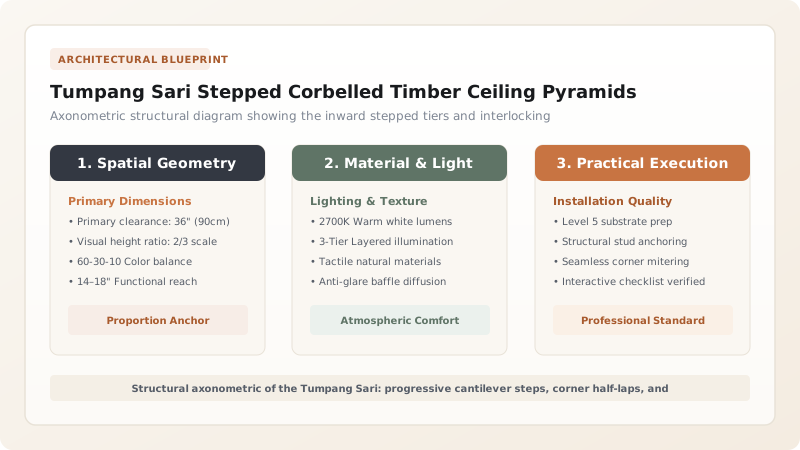
The Inverted Ziggurat: Architectural Geometry of the Tumpang Sari
When standing beneath the center of a grand Javanese Joglo, looking upward is an experience of spiritual vertigo. Rising above the four monumental Soko Guru pillars is not a flat ceiling or a simple plaster dome, but a colossal, inverted stepped pyramid sculpted entirely of dark, resonant teak wood: the Tumpang Sari (literally 'overlapping layers' or 'nested tiers').
Constructed from concentric square rings of massive timbers, each tier of the Tumpang Sari steps inward by approximately 75 to 100 mm beyond the tier immediately below it. As the eye ascends through the receding rectangular frames, the space appears to expand infinitely upward into the shadows of the soaring roof apex. This architectural illusion of vertical transcendence was deliberately engineered by Javanese master builders (Empu) to evoke Mount Meru—the sacred cosmic mountain of Hindu-Javanese mythology—inverted so that its divine apex descends directly into the human domestic realm.
Sacred Numerology & Aristocratic Codification
In traditional Javanese feudal society under the Mataram Sultanate, the number of tiers in a Tumpang Sari was strictly regulated by sumptuary laws (pranatan). A commoner was forbidden from erecting a multi-tiered ceiling under penalty of royal displeasure. The tiers were strictly mandated in odd numbers, each possessing specific cosmological and social significance.
A 3-tier Tumpang Sari was permitted for village chiefs, wealthy merchants, and minor gentry. A 5-tier ceiling denoted regional regents (Bupati) and senior aristocrats. A 7-tier pyramid was reserved for princes of royal blood (Pangeran) and major palaces. Finally, the supreme 9-tier Tumpang Sari—a staggering monument of woodworking comprising hundreds of interlocking carved beams—was the exclusive prerogative of the reigning sovereign: the Sultan of Yogyakarta and the Sunan of Surakarta, representing the nine celestial heavens and the nine Wali Sanga saints who brought Islam to Java.
Structural Cantilever Mechanics & The Dada Peksi Apex
Beyond its decorative and spiritual glory, the Tumpang Sari is a masterclass in compressive timber engineering. The entire assembly acts as a horizontal corbelled vault. The lowest, heaviest tier rests squarely across the four primary tie-beams (blandar and pengeret) of the Soko Guru. Each subsequent tier rests its outer edges on the inner half of the beam below, locked at all four corners with precision half-lap joints pinned with vertical hardwood dowels.
Because the beams are loaded in pure downward compression, the cantilevered steps transfer roof loads smoothly outward into the massive vertical columns. At the very summit of the pyramid, bridging the final rectangular void, sits the dada peksi (chest of the bird). Sculpted with the solar disc of Surya Majapahit or the protective mask of Banaspati, this monolithic timber acts as the structural keystone, locking the opposing corbelled beams in place and preventing the upper roof pyramid from shifting during tropical wind storms.
Master Kudus Woodcarving & Acoustic Harmonic Halo
The artisanal glory of the Tumpang Sari belongs to the legendary master carvers of Kudus in northeastern Java. Using hand-forged steel gouges and mallets, carvers transform the dark teak into an undulating lace of botanical motifs. The dominant relief is lung-lungan—intertwined spiraling vines, lotus buds, and blooming water lilies that symbolize the uninterrupted flow of divine life energy across generations.
In the royal Kratons, this intricate relief carving is accented with prada—pure gold leaf applied over traditional tree resin lacquer. When the royal court gathers beneath the Tumpang Sari for sacred Bedhaya dances, the acoustic effect is sublime. The stepped corbelled tiers prevent flutter echoes, functioning as a natural acoustic horn. The deep, low-frequency vibrations of the giant bronze Gong Ageng and the delicate metallic melodies of the Gamelan resonate through the carved teak chambers, producing a lush, warm acoustic halo that envelops listeners in an ethereal, otherworldly soundscape.
Tumpang Sari Hierarchical Tier System & Social Codification
Use this reference table to calculate exact physical dimensions, ratios, and specifications before purchasing:
| Tier Classification | Number of Stepped Layers | Traditional Ownership Rank | Decorative Complexity | Acoustic Quality |
|---|---|---|---|---|
| Tumpang Sari Sembilan (9 Tiers) | 9 concentric tiers | Sultan / Susuhunan (Royal Kratons) | Full polychrome with pure gold leaf (prada) | Monumental reverberation; deep gong resonance |
| Tumpang Sari Pitu (7 Tiers) | 7 concentric tiers | Crown Princes & Senior Royalty (Pangeran) | Intricate Kudus-style openwork floral carving | Rich acoustic warmth for palace chamber orchestras |
| Tumpang Sari Lima (5 Tiers) | 5 concentric tiers | High Aristocracy & Governors (Bupati / Priyayi) | Continuous relief carving along all exposed faces | Clear vocal clarity for administrative councils |
| Tumpang Sari Tiga (3 Tiers) | 3 concentric tiers | Lesser Nobility & Wealthy Landowners | Simple beveled edges with carved corner rosettes | Intimate, warm domestic acoustics |
| Polos / Tanpa Tumpang Sari | 0 to 1 plain tier | Village commoners and agrarian class | Uncarved plain square beams | Basic functional post-and-beam ceiling |
Practical Constraints
Every successful decoration project must account for physical and environmental constraints:
Colossal accumulative dead weight of multiple solid teak corbel tiers
A 9-tier Tumpang Sari can weigh over 3 metric tons hanging above the central living space Mitigation: Calibrate horizontal lap joints so that dead weight is transferred into pure downward column compression
Vulnerability of deeply carved crevices to nesting dirt-dauber wasps and spiders
Insect mud nests accumulate in relief carvings, disfiguring fine timber details over time Mitigation: Treat carved surfaces with natural clove oil and sweep regularly with soft feather dusters
Execution Blueprint & Craftsmanship Sequence
Execute this professional sequence to achieve flawless results without backtracking:
Tier Geometry & Dimensioning
Calculate the progressive reduction in rectangular dimensions from the base 4x4 m frame up to the 1x1 m apex opening.
Master Kudus Woodcarving
Carve undulating lung-lungan floral vines, Makara heads, and rosettes across all beam faces in workshop benches.
Corner Lap-Joint Cutting
Cut interlocking half-lap corner joints with internal locating mortises on all four beams of each concentric tier.
First Tier Bedding
Lay the first, largest tier directly over the Blandar tie-beams, ensuring plumb alignment with the Soko Guru axes.
Progressive Inward Corbel Stacking
Stack tiers two through eight successively, stepping each layer inward by 85 mm and pinning corners with hardwood dowels.
Dada Peksi Keystone Placement
Lower the central monumental keystone beam (dada peksi) into the summit aperture, locking the corbelled tiers into place.
Gold Leaf (Prada) Guilding
Apply natural lacquer sizing to raised petal reliefs and burnish pure gold leaf flakes (prada) to highlight sacred focal points.
Final Oil Polishing & Commissioning
Buff all exposed carved wood with raw candlenut oil, checking structural clearances before erecting upper roof rafters.
Common Mistakes & Countermeasures
Avoid these costly errors that compromise aesthetics, ergonomics, and budget:
Building a Tumpang Sari with an even number of tiers (such as 4, 6, or 8 layers)
Carving reliefs deeply into thin structural beams without verifying bending capacity
Painting carved teak ceiling reliefs with thick modern synthetic gloss enamel paints
Project Execution Checklist
Track your physical progress. Checkboxes persist automatically on this device:
Frequently Asked Questions
Why does the Tumpang Sari always have an odd number of tiers?
In Javanese numerology, odd numbers (ganjil) represent life, dynamic growth, masculinity, and divine transcendence, whereas even numbers represent static completion or death. The odd tiers—specifically 3, 5, 7, or 9—reflect cosmic stages of spiritual ascension toward the divine center.
What is the function of the 'Dada Peksi' keystone beam?
Dada Peksi translates literally to 'the chest of the bird'. It is the central, highly decorated horizontal timber that bridges the very top opening of the Tumpang Sari pyramid. Structurally, it acts as a compressive tie that prevents the inward-leaning corbelled beams from shifting; spiritually, it represents the soaring solar eagle Garuda sheltering the household.
How does the Tumpang Sari ceiling enhance gamelan music?
The inverted stepped pyramid forms an acoustic horn or stepped diffuser. When bronze gamelan gongs and metallophones are played beneath it, sound waves do not bounce flatly off a ceiling. Instead, the multi-tiered corbelled steps scatter and diffuse high-frequency harmonics while amplifying deep resonant bass tones, producing a warm, immersive acoustic halo.