
Kerala Thachu Shastra proportions hinge on the master Kolu (divided into 24 viral, or finger units) and the mathematical Ayadi formulas codified in the Manushyalaya Chandrika. By evaluating the structural perimeter through remainder calculations (Yoni 1 to 8), carpenters ensure auspicious structural proportions that harmonize with regional winds and solar angles. Material selection strictly mandates heartwood from mature indigenous species: Malabar Teak (Tectona grandis) for massive load-bearing beams and Anjili (Artocarpus hirsutus) for resilient roof rafters, with timbers cured through extended water immersion to eliminate sap starches and wood-boring beetle attractants.
At a Glance: Key Takeaways
- Auspicious Formulas: Ayadi Shadvarga (Yoni, Aaya, Vyaya, Nakshatra, Vaya, Tithi)
- Measurement System: 1 Kolu = 24 Viral = 192 Yava (~72 cm standard stick)
- Proportion Rule: Uttaram beam height = 1.25x breadth; Kazhukol spacing = 1 Kolu
- Timber Curing Protocol: 3-month river ponding (water leaching) + 1-year shadow air seasoning
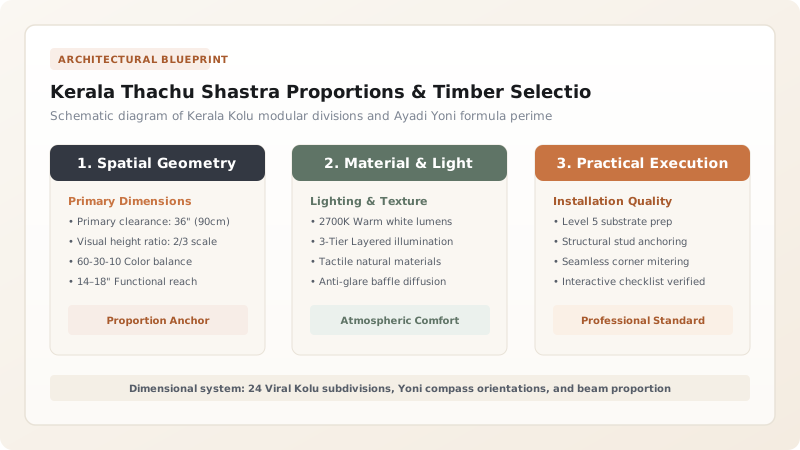
The Kolu Yardstick: Subdivisions and Ayadi Shadvarga Mathematics
In the Thachu Shastra tradition, measurements are not arbitrary linear quantities but living geometric ratios. The foundational instrument is the Kolu rod (traditionally carved from dense rosewood or brass-shod teak). One Kolu consists of 24 viral (each approximately 30 mm, derived from the width of the master patron's thumb joint), and each viral is subdivided into 8 yava (barley grains).
Before breaking ground, the Moothasari calculates the Ayadi Shadvarga (the six canonical perimeter tests). By dividing the building perimeter by specific integers, mathematical remainders reveal the Yoni (directional vitality), Aaya (income/longevity), and Vyaya (expenditure). Odd Yoni numbers (specifically Yoni 1 for east-facing, Yoni 3 for south-facing, Yoni 5 for west-facing, and Yoni 7 for north-facing) must be achieved to ensure architectural stability and positive life-energy.
Sacred Dendrology: Classification of Malabar Teak, Anjili, and Jackfruit
The forests of the Western Ghats produce some of the finest hardwoods on earth. Thachu Shastra prescribes specific species for specific structural roles based on their physical and spiritual attributes:
- Thekku (Malabar Teak, Tectona grandis): Classified as a royal hardwood (Raja-vriksha). Extremely rich in natural teak oil and silica, it is reserved for the primary uttaram ring beams, foundation sills, and heavy courtyard verandah columns.
- Anjili (Wild Jack, Artocarpus hirsutus): Exceptional tensile strength and elasticity. Because it does not deform under cyclic monsoon downpours and resists subterranean termites, it is the premier timber for roof trusses and long curved rafters.
- Plavu (Jackfruit Wood, Artocarpus heterophyllus): Prized for its radiant golden yellow hue and dense grain, used extensively for carved gables, decorative door jambs, and temple ceilings.
Hydro-Curing Mastery: River Ponding and Natural Desugarization
One of the great secrets of Kerala's centuries-old timber survival is the water curing protocol (vellathil idal). Freshly felled green logs are stripped of bark and immediately submerged in slow-flowing river estuaries or freshwater ponds for three to six months.
This prolonged immersion accomplishes a crucial biochemical transformation: water dissolves and flushes out all water-soluble starches, sugars, and sap liquids that attract wood-boring insects (ghoon) and fungal decay. Once retrieved, the desugared logs are stacked vertically in shaded sheds to allow capillary moisture to drain freely, followed by horizontal air-drying for one year before conversion.
Classical Joinery: Mortise, Tenon, and Palmyra Locking Pegs
Thachu Shastra forbids the use of ferrous metals in structural timber connections. Iron nails rust rapidly under tropical maritime salt air, staining timber and fracturing wood fibers as rust expands. Instead, Kerala carpenters engineered a repertoire of sophisticated self-locking timber joints.
Beams are spliced using the Meen-chiri (fish-tail lap dovetail) and Aan-koodu (male-female stepped tenon). To lock these joints, carpenters drive dried rectangular pegs carved from Karimpana (Black Palmyra Palm, Borassus flabellifer). Palmyra wood possesses extraordinary longitudinal shear strength and hardness; when driven into softer teak or anjili mortises, it grips the fibers permanently without risk of rust-induced rot.
Kerala Traditional Timber Selection & Application Guide
Use this reference table to calculate exact physical dimensions, ratios, and specifications before purchasing:
| Wood Species | Botanical Name | Density (kg/m³) | Specific Structural Application | Key Chemical / Mechanical Advantage |
|---|---|---|---|---|
| Thekku (Teak) | Tectona grandis | 650-700 | Pillars, Uttaram ring beams, Thresholds | Natural tectoquinone oil repels termites and fungi |
| Anjili (Wild Jack) | Artocarpus hirsutus | 580-620 | Curved Kazhukol rafters, Ceiling joists | Exceptional elasticity; zero warping in monsoon cycles |
| Plavu (Jackfruit) | Artocarpus heterophyllus | 640 | Carved gables (Mukhamandapam), Doors | Fine golden texture; easy to chisel intricate relief |
| Karimpana (Palmyra) | Borassus flabellifer | 850-950 | Locking pegs (Aani), Wall laths | Iron-like hardness; complete immunity to rot |
Practical Constraints
Every successful decoration project must account for physical and environmental constraints:
Strict Forest Department Quotas on Sourcing Old-Growth Teak
Authentic ancient-growth Malabar teak is legally restricted and cost-prohibitive for large-scale heritage restoration. Solution: Utilize certified sustainable plantation-grown teak for interior framing, and reserve heritage salvage timber for primary structural beams.
Loss of Traditional Moothasari Hereditary Mathematical Guilds
Contemporary carpenters struggle to calculate complex Ayadi formulas and Kolu modular subdivisions accurately. Solution: Standardize Sanskrit architectural software tools and digital CAD models calibrated to canonical Manushyalaya Chandrika rules.
Execution Blueprint & Craftsmanship Sequence
Execute this professional sequence to achieve flawless results without backtracking:
Perimeter Yoni Calculation and Kolu Sizing
Calculate client anthropometry to set master Kolu rod; compute building perimeter to guarantee odd-numbered Yoni remainder.
Forest Timber Selection and Sacred Harvest
Mark mature trees on north-facing slopes during dry winter; fell avoiding hollow trunks or lightning-struck trees.
River Ponding and Desugarization
Submerge de-barked logs in clean running river water for 90 to 120 days to leach out soluble sap sugars and starches.
Vertical Drainage and Shadow Seasoning
Stand leached logs vertically for 30 days to drain pore water; stack horizontally on raised skids under shaded thatch for 12 months.
Pit Sawing and Hand Dressing to Kolu Modules
Saw seasoned balks using two-man rip saws; dress with hand adzes and wooden smoothing planes to exact canonical proportions.
Palmyra Peg Fabrication and Dry-Fit Verification
Carve tapered rectangular locking pegs from seasoned black palmyra palm; dry-assemble beam joints to ensure hairline tolerances.
Common Mistakes & Countermeasures
Avoid these costly errors that compromise aesthetics, ergonomics, and budget:
Failing to Water-Cure Green Timber Before Conversion
Mixing Wood Species with Incompatible Shrinkage Rates in One Joint
Project Execution Checklist
Track your physical progress. Checkboxes persist automatically on this device:
Frequently Asked Questions
What happens if a building does not conform to the Yoni formula?
In Thachu Shastra, a building with an inauspicious Yoni (even remainders like Yoni 2, 4, 6, 8) is considered structurally disharmonious. Beyond metaphysical beliefs, the Yoni formulas are rigorous mathematical proportion checks that ensure the building's length-to-width ratios distribute wind loads and earthquake shear forces symmetrically.
Why is water immersion better than modern kiln drying for Kerala timber?
Kiln drying removes moisture rapidly, but leaves the sap starches, sugars, and proteins trapped inside the dried wood cells. When placed in Kerala's humid monsoon air, these rehydrated starches become a feeding ground for mold and borers. River immersion washes away the starches completely, making the timber naturally insect-proof forever.
How do carpenters verify that teak heartwood is fully mature?
Master carpenters examine the end-grain growth rings and color: mature teak heartwood exhibits a rich golden-brown to dark chocolate hue with tight annual rings and an unmistakable greasy, leather-like aroma caused by high natural tectoquinone oil concentrations.
Can coconut wood be used in Thachu Shastra construction?
Coconut timber (Thengu) is never used for primary structural pillars or roof beams because its spongy central pith rots quickly. However, dense exterior wood from the base of 80-year-old coconut palms is sometimes used for secondary ceiling battens and decorative partition screens.


