
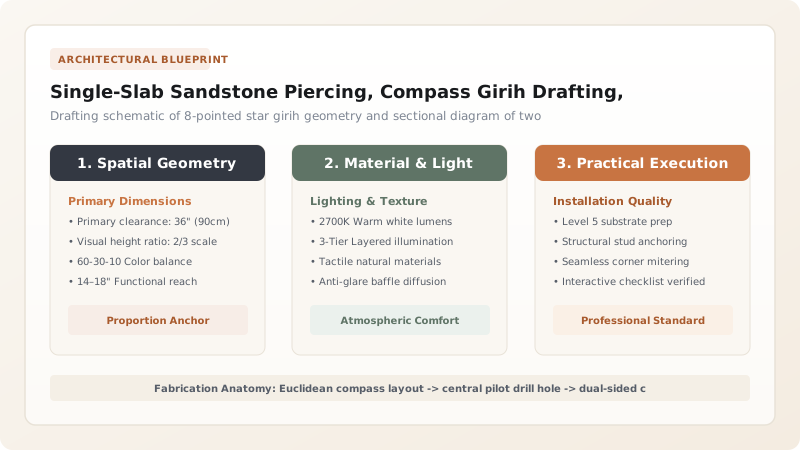
Carving a monolithic stone jaali is one of the most demanding subtractive arts in world architecture. Starting with a single, flawless slab of quartz-cemented red sandstone or marble (35–45mm thick), the master silawat drafts complex non-periodic geometric tessellations (girih) based on 8-, 10-, or 12-pointed stars using only Euclidean compass and straightedge geometry. After transferring the cartoon via charcoal pounce bags, pilot holes are drilled with water-lubricated bow-drills. The artisan then chisels away up to 50% of the stone's solid volume, working symmetrically from both opposing faces to meet in the exact center. Each negative aperture is finished with 45-degree hand-beveled chamfers, ensuring structural continuity across delicate 4mm stone ribs.
At a Glance: Key Takeaways
- Monolithic Integrity: Single uninterrupted stone slab eliminating mortar joints inside the fretwork field.
- Girih Geometric Drafting: Euclidean compass-and-ruler construction generating star decagrams and interlocking strapwork.
- Bow-Drill Pilot Holes (Kamani): Hand-powered bow drills piercing starter sockets without micro-percussion fractures.
- Opposing Dual-Faced Chiseling: Carving 50% from the front and 50% from the back to prevent rear edge blowouts.
- Relief Chamfer Beveling: 45° angled cutting along opening borders to funnel light and reinforce slender stone ribs.
- Carborundum Water-Honing: Smoothing chiseled apertures with contoured abrasive stones and river sand slurries.
1. Islamic Girih Mathematics and Euclidean Compass Construction
The patterns of classical jaali screens are not arbitrary decorative flourishes; they are rigorous mathematical manifestations of Islamic sacred geometry (girih). Master builders drafted these patterns using only a compass, straightedge, and piece of string, without numerical measurement.
By dividing a circle into equal arcs, artisans construct the five fundamental girih tiles: the regular decagon, elongated hexagon, bow-tie, rhombus, and regular pentagon. For jaalis, 8-pointed stars (khatam) and 12-pointed rosettes are favored because their orthogonal and diagonal symmetry axes distribute structural tension evenly across the stone slab. Every stone rib acts as a miniature arch, transferring dead-weight from the upper frame around the open voids to the bottom sill.
2. Bow-Drill Pilot Perforations and Opposing Dual-Faced Chiseling
Attempting to punch a chisel directly through a 40mm stone slab would shatter the brittle stone instantly. The subtractive piercing sequence follows a strict traditional discipline:
- Kamani Bow-Drilling: A steel drill rod fitted with a triangular diamond or carbide tip is spun using a horsehair bow string. Spring water is dripped continuously into the hole. The drill bores a 6mm pilot hole through the centroid of each negative star and polygon without causing impact shock.
- Dual-Faced Chisel Attack: The stone slab is laid horizontally on a bed of damp river sand. The artisan chisels out the negative void from the top face to a depth of exactly 20mm.
- Flipping and Meeting: The massive stone slab is carefully flipped over. The artisan chisels down from the reverse face until the cavities meet in the middle. This dual-sided approach prevents the explosive rear-face spalling ('blowout') that occurs when cutting through from one side only.
3. Internal Relief Beveling and Abrasive Water Honing
Once the apertures are opened, the raw cut edges are rough and straight. A straight-cut aperture creates harsh, distracting shadow lines and traps dirt. Master silawats introduce relief beveling.
Using miniature curved gouges (tanki), the artisan cuts a continuous 45-degree chamfer around every opening on both faces. This triangular cross-section increases the mechanical strength of the stone ribs by creating an I-beam-like profile. Finally, custom-carved slips of hard sandstone or carborundum stone lubricated with water and fine quartz slurry are stroked through every aperture, polishing the chiseled stone to a silky, touchable finish that sheds desert dust during wind storms.
Stone Jaali Tooling and Carving Parameter Standards
Use this reference table to calculate exact physical dimensions, ratios, and specifications before purchasing:
| Execution Phase | Traditional Tool | Dimensional Metric | Critical Craft Rule | Failure Consequence |
|---|---|---|---|---|
| Surface Honing | Carborundum block + water | Plane flatness within 0.5mm | Must hone both faces before layout | Pattern distortion across uneven face |
| Girih Layout | Brass dividers & steel scriber | Lines scribed 0.5mm deep | Verify star point closures with loupe | Asymmetric structural rib widths |
| Pilot Boring | Kamani bow-drill with water feed | 6–8mm diameter bore | Drill perfectly perpendicular to slab | Drill drift off-center ruins rib integrity |
| Rough Piercing | Hardened steel flat chisel (chheni) | Work from both sides to 20mm depth | Never strike chisel toward thin ribs | Catastrophic stone rib fracture |
| Chamfer Beveling | Beveled trimming chisel (tanki) | 45° chamfer, 3mm wide | Maintain uniform bevel width by eye | Uneven light dispersion & glare hot-spots |
| Slit Honing | Hardwood slips + quartz slurry | Polish down to 400-grit feel | Wash away slurry to inspect micro-fissures | Rough edges catch wind-blown grit |
Practical Constraints
Every successful decoration project must account for physical and environmental constraints:
Irreparability of Carving Fractures
Silicosis Respiratory Health Hazard
Field Procedure for Carving Monolithic Pierced Sandstone Lattices
Execute this professional sequence to achieve flawless results without backtracking:
Slab Thickness Calipering
Measure stone slab at 12 points with dial calipers; ensure thickness is uniform 40mm ±1mm with zero wedge taper.
Scribing Perimeter Structural Border
Scribe a 75mm wide solid border around the entire slab perimeter to serve as the structural mounting frame.
Geometric Layout and Pounce Dusting
Snap chalk reference axes; transfer the pricked paper girih cartoon using fine charcoal dust, fixing lines with shellac wash.
Pilot Hole Bow-Drilling
Bore 6mm pilot holes through every negative space using water-cooled bow drills, working on a rubberized support mat.
Face 1 Subtractive Chiseled Cavities
Chisel 20mm deep relief recesses on Face 1 with flat chisels, leaving 5mm margins around all scribed structural ribs.
Slab Reversal and Face 2 Breakthrough
Flip slab onto a sand bed; chisel matching recesses on Face 2 until voids breakthrough cleanly without spalling.
Hand Chamfering and Final Honing
Chamfer all internal edges at 45 degrees; hand-hone every aperture with water-stone slips until smooth as silk.
Common Mistakes & Countermeasures
Avoid these costly errors that compromise aesthetics, ergonomics, and budget:
Attempting to drill pilot holes dry without continuous water cooling
Pounding chisels toward the center of thin stone ribs
Carving on a rigid concrete bench without sand cushioning
Project Execution Checklist
Track your physical progress. Checkboxes persist automatically on this device:
Frequently Asked Questions
How thin can the stone ribs of a hand-carved jaali be?
In high-grade quartz-cemented red sandstone (like Dholpur or Sikri stone), master silawats can achieve ribs as slender as 3 to 4mm in thickness. In softer limestone, ribs are kept between 6 and 10mm to prevent breakage under wind loads.
Why did Mughal emperors prefer monolithic jaalis over pieced screens?
A monolithic screen possesses unbroken structural continuity. Under thermal expansion in 48°C desert heat, a monolithic slab expands uniformly, whereas screens built from small pieces held by mortar develop cracked joints and loose fragments that rattle and fail in dust storms.
What is the function of the 45-degree chamfer on the inner apertures?
The chamfer performs three functions: (1) It structurally thickens the core of the rib, increasing its flexural strength; (2) It softens shadow edges, preventing blinding glare; (3) It creates a smooth, aerodynamic funnel that accelerates passing breezes via the Venturi effect.


