
Classical Florentine Pietra Dura (known in Italy as Commesso Fiorentino or 'stone marquetry') represents the absolute summit of Renaissance decorative lapidary arts. Founded in Florence in 1588 by Grand Duke Ferdinando I de' Medici with the establishment of the Opificio delle Pietre Dure, the craft constructs breathtaking pictorial mosaics and table tops out of semi-precious hardstones (Mohs hardness 6 to 7), including lapis lazuli, Sicilian jasper, Persian chalcedony, agate, and amethyst. Utilizing friction wire saws charged with emery abrasives, artisans cut stone veneers 3mm to 4mm thick with reverse-beveled edges, joining thousands of pieces with invisible hairline seams using a hot mastic of colophony pine resin and beeswax.
At a Glance: Key Takeaways
- Commesso Fiorentino Technique: Fitting precision-sawn hardstone veneers together so tightly that joints are imperceptible to the naked eye.
- Semi-Precious Hardstones (Pietre Dure): Lapis lazuli, agate, red Sicilian jasper, malachite, chalcedony, and porphyry.
- Chestnut Bow Wire Saw (Archetto): Flexible bow saw strung with soft iron wire charged with water and corundum/emery slurry.
- Reverse-Beveled Edge Miter (Taglio a Smusso): Filing stone borders at 5°–8° reverse bevels to ensure razor-sharp face contact.
- Colophony-Beeswax Hot Mastic: Heated thermoplastic adhesive bonding stone veneers firmly to a slate (lavagna) backing bed.
- Diamond & Lead Plate Polishing: Hand-lapping stone assemblies to a glass-smooth mirror finish that never fades or discolors.
In-Depth Guides in this Directory
Explore specialized subtopic blueprints, technical dimensions, and execution checklists:
Wire Saw Friction Cutting and Agate Slicing
Lapidary manual for Florentine commesso sawing: the chestnut archetto bow saw, soft iron wire dynamics, corundum slurry lubrication, and slicing agate nodules.
Hairline Mitered Bevels and Colophony-Wax Mastic
Technical manual for Florentine commesso assembly: reverse bevel miter filing (taglio a smusso), colophony pine resin-beeswax mastic, heated iron bedding, and slate backing.
Lapis Lazuli and Jasper Marquetry Conservation
Museum conservation manual for Renaissance Pietra Dura: diagnosing mastic failure, micro-consolidation of fractured lapis lazuli, ultrasonic cleaning, and optical repolishing.
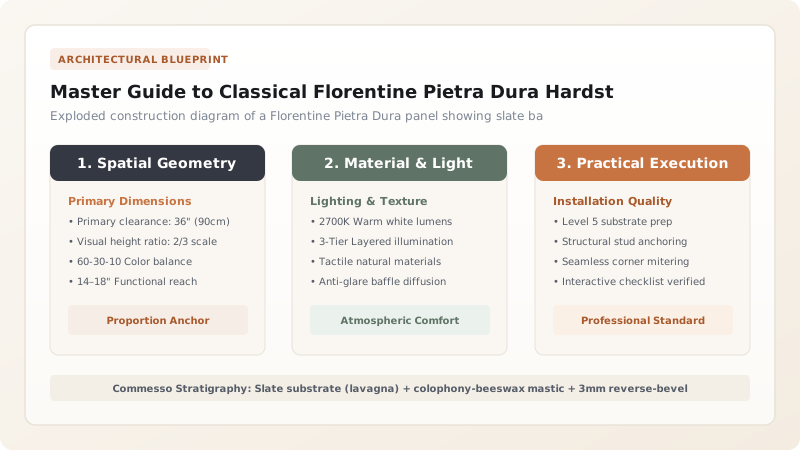
1. Imperial Origins: The Medici Dream of Eternal Painting
During the High Renaissance, oil paintings and frescoes were celebrated for their beauty, but grand dukes lamented their tragic impermanence: paint fades, varnishes yellow, and damp plaster flakes. Grand Duke Ferdinando I de' Medici sought an artistic medium that would endure for eternity—pittura per l'eternità (painting for eternity).
In 1588, he founded the Opificio delle Pietre Dure in Florence, gathering Europe's finest lapidaries, sculptors, and mineralogists. Rather than painting with brush and pigment, masters 'painted' with nature's most durable gemstones, selecting stones whose natural striations, mineral veins, and color gradients perfectly mimicked flower petals, feathered birds, and velvet drapery.
2. Mineral Science: Pietre Tenere versus Pietre Dure
In the hierarchy of stone, there is a fundamental distinction between soft stones (pietre tenere, like marble and alabaster, Mohs hardness 3 to 4) and true hardstones (pietre dure, Mohs hardness 6 to 7):
- Lapis Lazuli (Afghanistan / Badakhshan): Dense lazurite with golden flecks of iron pyrite, providing royal ultramarine blues.
- Jaspers (Diaspri): Microcrystalline quartz saturated with iron oxides, quarried from Barga, Sicily, and Bohemia in rich reds, greens, and yellows.
- Chalcedony & Agate: Translucent cryptocrystalline silica featuring banded concentric layers that depict shading and water reflections.
Because these stones cannot be cut with steel chisels or knives, they must be abraded with minerals harder than themselves, using emery, corundum, or diamond powder.
3. The Lapidary Secret: Taglio a Smusso (Reverse Bevel)
The miracle of a Florentine commesso is that looking at the finished panel, no joint lines are visible; the stones appear to melt into one another like liquid glass. This optical perfection is achieved through the taglio a smusso (reverse-beveled cut).
Using a traditional chestnut bow strung with soft iron wire (archetto), the lapidary cuts the stone at a deliberate 5° to 8° inward undercut angle. The top finished surface of the stone touches its neighbor with knife-edge microscopic precision (0.00mm tolerance), while a small trapezoidal void is left underneath. This hidden void accommodates the hot colophony-beeswax mastic, locking the adjoining gemstones in an unbreakable mechanical and chemical grip.
Florentine Commesso Hardstone Mineral Classification
Use this reference table to calculate exact physical dimensions, ratios, and specifications before purchasing:
| Gemstone / Mineral | Italian Name | Mohs Hardness | Natural Color / Visual Texture | Decorative Subject |
|---|---|---|---|---|
| Lapis Lazuli | Lapislazzuli | 5.5 - 6.0 | Intense ultramarine blue with pyrite stars | Celestial skies, draperies, jewel birds |
| Sicilian Jasper | Diaspro di Sicilia | 6.5 - 7.0 | Vivid blood-red, yellow & green breccia | Autumn foliage, fruit skins, flower petals |
| Volterra Chalcedony | Calcedonio | 6.5 - 7.0 | Translucent milky gray to pale violet | Water drops, glass vases, delicate flesh tones |
| Green Malachite | Malachite | 3.5 - 4.0 | Concentric banded forest green | Leaf shading & architectural borders |
| Lavagna Slate | Ardesia di Lavagna | 2.5 - 3.0 | Velvety matte black metamorphic stone | Structural backing slab & dark backgrounds |
Artisanal & Hardness Constraints
Every successful decoration project must account for physical and environmental constraints:
Tremendous Labor Intensity
Assembling a single 30cm decorative floral table panel requires 400 to 600 hours of microscopic wire-saw cutting and hand-lapping.
Extreme Material Rarity
Prime lapis lazuli and historic Sicilian jaspers have become vanishingly rare, requiring lapidaries to source antique rough mineral collections.
Protocol for Cutting, Fitting, and Polishing a Florentine Pietra Dura Panel
Execute this professional sequence to achieve flawless results without backtracking:
Full-Color Model Cartoon Drafting
Paint 1:1 master watercolor cartoon; trace onto vegetable parchment; dissect cartoon into individual numbered paper pattern facets.
Stone Slicing & Grain Selection
Slice rough gemstone boulders into 3mm thick wafers (fette) using diamond lapidary saws; select stone slices whose natural grain matches shading.
Wire Saw Archetto Profiling
Glue paper pattern onto stone wafer; saw outline using chestnut bow wire saw charged with water and 400-grit silicon carbide slurry at an 8° undercut.
Diamond File Precision Fitting
Trial-fit adjacent stone facets under a magnifying loupe; refine edges with diamond needle files until zero light passes through the joint.
Hot Mastic Bedding & Assembly
Heat a slate backing plate (lavagna); melt colophony pine resin and beeswax (80/20 ratio); bed stone facets firmly with heated bronze irons.
Progressive Lapping & Mirror Polishing
Lap surface dead flat on cast-iron wheel with graded diamond powders (220 to 3000 grit); buff to flawless diamond luster with tin oxide on felt.
Common Mistakes & Countermeasures
Avoid these costly errors that compromise aesthetics, ergonomics, and budget:
Cutting stones with perfectly vertical 90-degree edges instead of reverse bevels
Using modern brittle cyanoacrylate (superglue) or rigid epoxy to mount the stones
Project Execution Checklist
Track your physical progress. Checkboxes persist automatically on this device:
Frequently Asked Questions
What is the difference between Pietra Dura and classical Roman mosaic?
Classical Roman mosaic (opus tessellatum) creates images by assembling thousands of tiny, uniform, square stone cubes (tesserae), creating a pixellated image separated by visible mortar joints. Florentine Pietra Dura (commesso) cuts stones into custom, fluid, puzzle-like shapes that follow the natural contours of flowers and figures, joined with invisible hairline joints so no grout is seen.
How do lapidaries create shadows and three-dimensional depth with solid stone?
Lapidaries do not paint or tint the stones. They spend days searching through hundreds of natural sliced mineral wafers to find stones that naturally feature organic color gradients, cloudy inclusions, or banding. By carefully positioning the cutting template over these natural transitions, a petal or leaf naturally grades from deep shadow to bright highlight within a single piece of stone.


