
Wire Saw Friction Cutting and Agate Slicing represents the fundamental mechanical craft of the Florentine lapidary. Because semi-precious hardstones (agates, jaspers, chalcedonies) reach Mohs hardness 7, steel saw teeth cannot cut them. Artisans employ the traditional chestnut bow wire saw (archetto), strung with soft annealed iron wire under high tension. Doused continuously with an abrasive slurry of water and silicon carbide or corundum, the iron wire acts as a flexible carrier, dragging microscopic abrasive grains across the stone to cut intricate, hair-thin curvilinear silhouettes with sub-millimeter precision.
At a Glance: Key Takeaways
- Chestnut Wood Bow Saw (Archetto): Flexible bow carved from seasoned chestnut or cherry wood maintaining constant wire tension.
- Soft Annealed Iron Wire: Ductile 0.20mm–0.35mm wire embedding abrasive grains into its surface to abrade hardstone.
- Silicon Carbide & Corundum Slurry: Graded mineral abrasive powders (320 to 600 mesh) suspended in water.
- Rotational Slicing of Agate Nodules: Diamond-charged continuous rim slabbing saws slicing mineral boulders into 3mm wafers.
- Micro-Curvilinear Turning Radius: Iron wire allowing 360-degree direction changes to cut sharp floral stamens and thorns.
- Frictional Heat Dissipation: Continuous water dripping preventing thermal shock micro-fracturing in fragile cryptocrystalline gems.
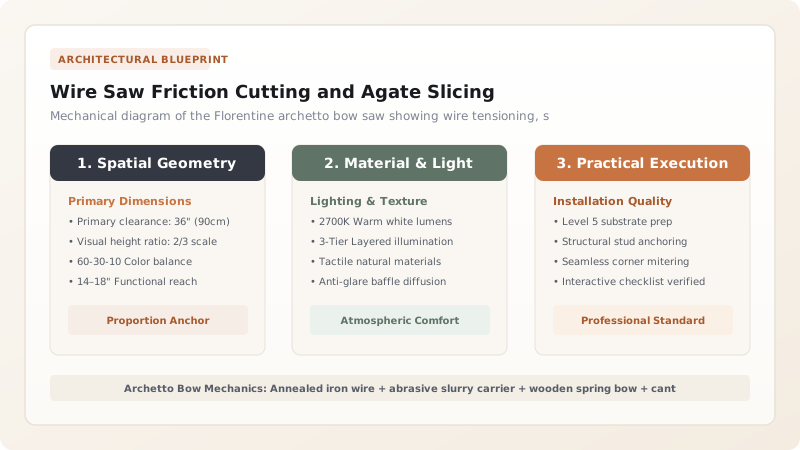
1. Tool Mechanics: The Chestnut Archetto and Iron Wire
To cut hardstones measuring 7 on the Mohs scale, modern industry uses diamond laser cutters. In classical Florence, artisans engineered a beautifully simple, low-tech tool that remains unmatched for delicate artistic sensitivity: the archetto (bow saw).
Carved from naturally resilient, springy wood—typically seasoned chestnut, cherry, or hazelnut—the bow spans approximately 60cm. Strung across its tips is a strand of soft annealed iron wire measuring 0.25mm to 0.35mm in diameter. The wire has no teeth; its softness is its greatest virtue, allowing hard abrasive mineral grains to embed themselves temporarily into the iron surface, transforming the wire into a flexible, microscopic cutting file.
2. Friction Physics: Slurry Tribology and Heat Dissipation
The wire alone cannot cut stone; rubbing dry iron against jasper merely heats and snaps the wire. The cutting action is performed entirely by the abrasive slurry.
The artisan mixes finely powdered emery, corundum, or silicon carbide (carborundum, 400 to 600 mesh) with clean water into a thin paste. With the left hand, the artisan drips slurry continuously onto the cut with a small brush or quill, while the right hand moves the archetto in smooth, rhythmic, full-length strokes. The moving wire drags the sharp microscopic mineral crystals through the kerf, grinding away the stone through micro-fracturing. The water carries away stone dust and cools the cut, preventing thermal shock that would crack delicate agates.
3. Primary Preparation: Slabbing Agates into 3mm Wafers
Before fine decorative sawing can begin, raw mineral nodules and geode boulders must be sliced into thin, flat wafers known as fette (slices). Raw agates possess an irregular, rough exterior crust (cortex).
The stone is mounted in a lapidary vise and cut on a continuous-rim copper or bronze disk saw charged with diamond paste and light mineral oil. The boulder is sliced into parallel wafers measuring strictly 3.0mm to 3.5mm in thickness. Thinner wafers would be too fragile to handle and polish; thicker wafers waste precious gemstone material and dramatically increase sawing time with the archetto.
Lapidary Wire Saw Operating & Abrasive Parameters
Use this reference table to calculate exact physical dimensions, ratios, and specifications before purchasing:
| Cutting Operation | Wire Diameter (mm) | Abrasive Grit & Type | Lubrication Medium | Cutting Speed / Rate |
|---|---|---|---|---|
| Primary Wafer Slabbing | 0.8mm bronze blade | 120-grit diamond powder | Light mineral oil / water | 10 - 15 mm²/min |
| Broad Outline Sawing | 0.35mm annealed iron wire | 320-mesh silicon carbide | Water + 5% glycerin | 2 - 3 linear mm/min |
| Fine Detail & Filigree | 0.22mm soft piano wire | 600-mesh optical corundum | Pure distilled water | 0.8 - 1.5 linear mm/min |
| Reverse Bevel Trimming | Diamond-plated needle file | 400-grit electroplated | Dry or misted water | Manual micro-tuning |
Physical & Sensory Constraints
Every successful decoration project must account for physical and environmental constraints:
Ergonomic Strain
Operating the archetto for 8 hours daily requires high wrist stamina and bilateral motor coordination between the sawing arm and slurry-dripping hand.
Wire Wear and Snapping
A standard iron wire lasts only 20 to 30 minutes of cutting before wearing through; lapidaries must change wires dozens of times per day.
Protocol for Sawing a Hardstone Facet with an Archetto
Execute this professional sequence to achieve flawless results without backtracking:
Paper Pattern Adhesion
Glue the dissected parchment pattern facet onto the polished side of the stone wafer using water-soluble animal hide glue.
Stone Clamping in Wooden Vise
Clamp the stone wafer in an adjustable wooden ball-and-socket lapidary vise (morsa da banco); tilt the vise at an 8° backward angle.
Archetto Wire Tensioning
String fresh soft iron wire across the chestnut bow tips; tighten with brass thumb-screw until the wire rings with a high musical tone.
Abrasive Slurry Application
Dab 400-grit carborundum slurry onto the edge of the stone with a hog-bristle brush at the exact starting point.
Rhythmic Friction Sawing
Stroke the bow saw smoothly across the full wire length; maintain uniform light pressure; continuously apply slurry drops with the free hand.
Facet Extraction & Cleaning
Complete the cut following the paper pattern line; soak facet in warm water to release the paper; inspect edges with 10x jeweler's loupe.
Common Mistakes & Countermeasures
Avoid these costly errors that compromise aesthetics, ergonomics, and budget:
Applying heavy downward arm pressure on the bow saw to speed up cutting
Letting the cut run dry without sufficient water lubricant
Project Execution Checklist
Track your physical progress. Checkboxes persist automatically on this device:
Frequently Asked Questions
Why use soft iron wire instead of hard hardened steel wire?
Hardened steel wire is slick and resists indentation. The sharp particles of corundum and diamond simply slide off hardened steel, refusing to cut the stone. Soft iron wire, by contrast, is malleable: when pressed against the stone, the hard abrasive crystals bite and embed themselves into the soft iron skin, transforming the wire into a flexible, rotating diamond file.
How do you start a wire saw cut in the middle of a stone piece?
To cut an internal piercing (such as the interior void of a hollow flower stem), the artisan drills a microscopic 0.5mm starter hole through the stone wafer using a diamond-tipped drill bit. The iron wire is unhooked from one end of the archetto bow, threaded through the drilled hole, re-tensioned on the bow, and sawing proceeds outward from the interior.


