
Hairline Mitered Bevels and Colophony-Wax Mastic form the twin technical foundations of the seamless Florentine commesso. Each sliced hardstone facet is filed with a deliberate 5° to 8° reverse undercut bevel (taglio a smusso), ensuring that the top visible gemstone edges meet with razor-sharp zero-tolerance contact. The assembled stone mosaic is bonded to a rigid black slate substrate (lavagna) using a hot thermoplastic mastic formulated from colophony pine resin (Greek pitch), virgin beeswax, and brick dust. This reversible, flexible adhesive absorbs differential thermal expansion across diverse mineral species while guaranteeing 500-year bond stability.
At a Glance: Key Takeaways
- Taglio a Smusso (Reverse Bevel): 5° to 8° inward miter on stone borders ensuring knife-edge surface contact.
- Zero-Tolerance Seams: Joints so tight (< 0.01mm) that water cannot penetrate between adjoining hardstone facets.
- Colophony Pine Resin (Pez Greca): Rosin providing high tensile adhesive bond and glassy structural rigidity.
- Virgin Beeswax Plasticizer: Imparting elasticity to prevent brittle fracture under thermal expansion cycles.
- Slate Bedding Substrate (Lavagna): Metamorphic black slate providing a dead-flat, dimensionally stable mounting slab.
- Heated Bronze Iron Bedding: Liquefying mastic beneath stone facets to squeeze out all trapped air voids.
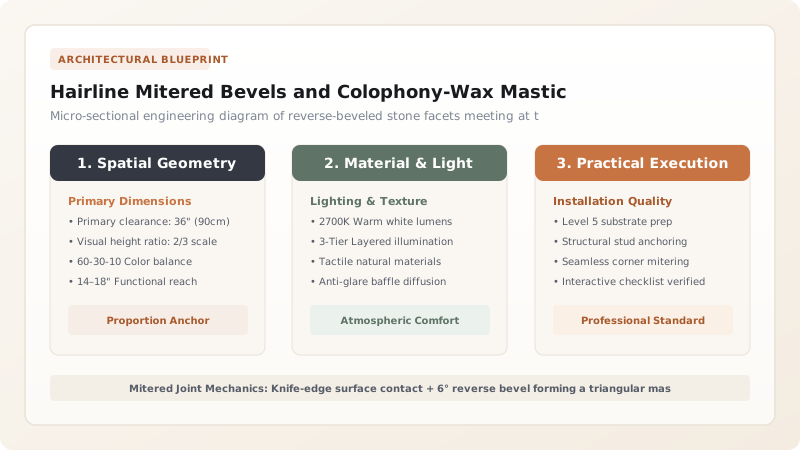
1. Stereotomy: The Magic of the Reverse-Beveled Miter
If two pieces of stone are cut with vertical 90° edges, any microscopic bump or grain irregularity along the 3mm depth will keep the top edges apart, resulting in an unsightly gap. The Florentine secret is the taglio a smusso (undercut bevel).
Using fine diamond-coated needle files and carborundum stones, the lapidary files the edges of every stone facet at an inward angle of 5° to 8°. Only the uppermost 0.5mm of the stone edge is left at the true outline. When two facets are placed side-by-side, their upper surfaces meet in seamless, razor-sharp contact, while the space underneath widens into a triangular reservoir that accepts adhesive.
2. Adhesive Chemistry: The Historic Colophony-Beeswax Blend
Modern epoxies are permanent and rigid; if a stone cracks or shifts decades later, epoxy cannot be removed without shattering the priceless gems. The Opificio delle Pietre Dure developed a magnificent thermoplastic natural mastic (mastice fiorentino):
- Colophony Pine Resin (Pez Greca): 70% by weight; distilled pine resin that melts at 85°C, wetting stone pores and providing high tensile adhesion.
- Virgin Beeswax (Cera d'Api): 20% by weight; natural plasticizer that eliminates brittleness and allows micro-flexibility.
- Finely Milled Brick Dust or Umber: 10% by weight; inert mineral filler that prevents excessive thermal shrinkage and tints the mastic dark brown-black.
3. Assembly Mechanics: Hot Bedding onto Slate
Pietra dura veneers cannot stand alone; a 3mm stone laminate would shatter under light handling. The assembly must be permanently backed by a rigid, non-warping stone slab: Ardesia di Lavagna (black Italian slate).
The slate slab (typically 20mm to 30mm thick) is scored with cross-hatch diamond grooves to provide mechanical keying. The slate is warmed on a heated iron plate to 70°C. Melted colophony mastic is brushed across the warm stone. The artisan fits the pre-assembled hardstone puzzle pieces onto the bed, pressing them down with heated bronze irons (ferri caldi). The heat liquifies the mastic, which rises into the reverse-beveled voids, expelling all air and locking the gems in a permanent, monolithic matrix.
Florentine Mastic Formulation & Thermal Parameters
Use this reference table to calculate exact physical dimensions, ratios, and specifications before purchasing:
| Mastic Component | Weight Ratio (%) | Melting Point (°C) | Mechanical Function | Reversibility Standard |
|---|---|---|---|---|
| Colophony (Pez Greca) | 70% | 80°C - 85°C | Primary tensile bonding & high hardness | 100% Soluble in alcohol/acetone |
| Virgin Yellow Beeswax | 20% | 62°C - 65°C | Flexibility; prevents brittle shattering | Melt-reversible at 70°C |
| Fine Terracotta Powder | 10% | Refractory (>1000°C) | Thixotropy; controls thermal shrinkage | Inert mineral suspension |
| Venice Turpentine (Optional) | 2% - 3% | Liquid resin | Increases tackiness for winter assembly | Plasticizing modifier |
Thermal & Material Constraints
Every successful decoration project must account for physical and environmental constraints:
Thermal Expansion Dissimilarity
Quartz jaspers expand at twice the rate of lapis lazuli; the mastic must remain slightly ductile across indoor temperature swings.
Reversibility Mandate
UNESCO museum conservation standards strictly prohibit irreversible epoxy adhesives on Renaissance pietra dura artifacts.
Protocol for Beveling, Fitting, and Bedding Commesso Facets
Execute this professional sequence to achieve flawless results without backtracking:
Facet Edge Beveling
Mount stone facet in wooden hand-vice; file perimeter with 400-grit diamond needle file at an inward 7° reverse angle.
Backlight Trial Fitting
Place adjoining facets together against a strong backlight; file high spots until zero light leaks between the top edges.
Substrate Slate Scoring
Plane a 25mm thick Lavagna slate slab dead flat; score shallow 1mm cross-hatch grooves using a diamond wheel.
Mastic Compounding & Heating
Melt colophony resin and beeswax in a copper pot at 85°C; stir in pulverized brick dust; maintain warm liquid state.
Pre-Heating and Bedding
Warm slate to 60°C; brush hot mastic generously; place stone facets tightly together; apply heated bronze irons to press flush.
Cooled Mastic Scraping
Allow panel to cool to room temperature; scrape away extruded mastic from surface using a brass scraper blade.
Common Mistakes & Countermeasures
Avoid these costly errors that compromise aesthetics, ergonomics, and budget:
Overheating the colophony-wax mastic past 130°C during preparation
Bedding stone facets onto a cold slate substrate
Project Execution Checklist
Track your physical progress. Checkboxes persist automatically on this device:
Frequently Asked Questions
Why is black slate (lavagna) chosen as the backing rather than marble or granite?
Italian Lavagna slate (quarried in Liguria) is an extraordinary fine-grained metamorphic rock. It is naturally dead-flat, possesses an extremely low thermal expansion coefficient, does not warp, can be easily scored or sawn, and its dark gray-black color ensures that any microscopic void beneath translucent chalcedony gems appears as deep natural shadow rather than an artificial bright spot.
Can an antique pietra dura panel be disassembled for restoration?
Yes. Because the colophony-wax mastic is thermoplastic, a conservator can place the entire panel in a temperature-controlled heating chamber at 75°C. As the mastic softens into liquid honey, damaged or displaced gemstones can be lifted out with suction cups or fine tweezers without exerting mechanical stress or damaging neighboring stones.


