
Traditional Indian Jaali (jali) screens are perforated architectural stone lattices developed across centuries of Hindu, Sultanate, and Mughal craftsmanship. Carved from monolithic single slabs of fine-grained red Agra sandstone, Makrana white marble, or yellow Jaisalmer limestone, jaalis serve a triple architectural imperative: climate engineering, structural light filtration, and social privacy (purdah). Using sophisticated compass-and-straightedge geometric girih strapwork, master stonemasons (silawats) drill and chisel thousands of beveled apertures through the stone slab. As hot desert winds pass through these narrow constrictions, the Venturi aerodynamic effect compresses the airflow, accelerating its velocity and inducing passive evaporative temperature drops of 4°C to 8°C while eliminating blinding solar glare and casting intricate calligraphic shadows across interior palace floors.
At a Glance: Key Takeaways
- Monolithic Stone Slabs: Carved from single 25–40mm slabs of red Sikri sandstone or Makrana marble.
- Venturi Passive Cooling: Physical airflow acceleration through constricted apertures dropping air temperature by 4°–8°C.
- Geometric Girih Drafting: Intricate star polygons, hexagrams, and octagrams drafted using pure Euclidean compass geometry.
- Chisel Undercutting & Beveling: Apertures beveled on the interior face to funnel air currents and diffuse raking sunbeams.
- Social Purdah & Visual Privacy: Allows occupants to look outward clearly while blocking views into domestic chambers.
- Chhajja & Jharokha Integration: Integrated with deep stone cantilever overhangs and projecting balcony oriels.
In-Depth Guides in this Directory
Explore specialized subtopic blueprints, technical dimensions, and execution checklists:
Single-Slab Sandstone Piercing, Compass Girih Drafting, and Relief Beveling
Technical stonemasonry guide to jaali fabrication: monolithic sandstone quarrying, Islamic girih compass geometry, bow-drilling, and two-sided relief piercing.
Passive Microclimate Cooling, Venturi Aerodynamics, and Glare Filtration
Architectural fluid dynamics guide to Indian jaali screens: Bernoulli principle, Venturi velocity acceleration, evaporative cooling, and daylight glare control.
Structural Chhajja Overhang Integration, Bracket Corbeling, and Dowelled Lintels
Technical stonemasonry guide to Rajasthani facade engineering: cantilevered chhajja eaves, serpentine corbel brackets (todas), and copper-dowelled stone lintels.
1. Vernacular Climatology and the Physics of the Venturi Cooling Effect
In the scorching, arid climates of North India and Rajasthan, where summer daytime temperatures frequently exceed 45°C, wide glass windows would turn interior palace rooms into uninhabitable thermal ovens. The jaali is an ancient, zero-energy bioclimatic cooling machine.
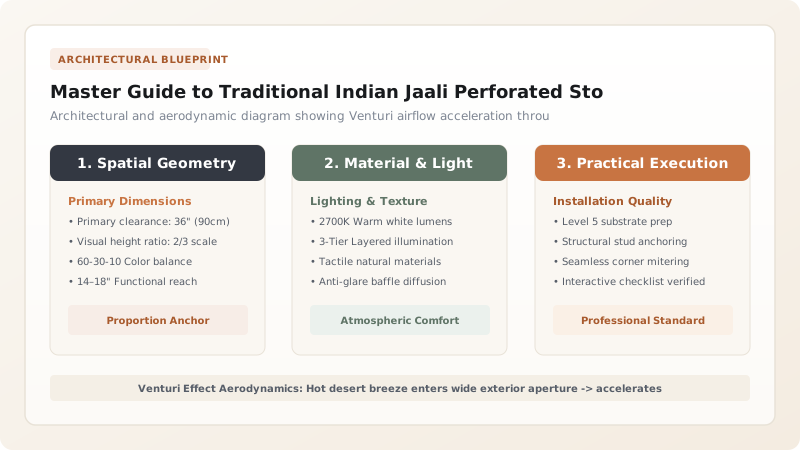
The screen operates on fundamental principles of fluid dynamics governed by the Venturi effect and the Bernoulli principle ($A_1 V_1 = A_2 V_2$). Hot, sluggish exterior air approaches the large surface area of the building envelope ($A_1$). As the air is forced through the hundreds of narrow, funnel-shaped perforations of the stone screen ($A_2$), its velocity increases dramatically ($V_2 > V_1$). According to the gas expansion laws, this rapid acceleration and subsequent expansion into the sheltered interior chamber produces a drop in sensible temperature of several degrees Celsius. When coupled with water channels or moist vetiver grass screens (khas-tattis), the passing breeze provides natural evaporative air conditioning.
2. Single-Slab Quarrying and Subtractive Fretting Mechanics
Unlike European tracery, which is frequently assembled from small interlocking stone segments, authentic Indian jaalis are subtractive masterworks carved from a single monolithic stone slab:
- Stone Sourcing: Quarried from homogenous, fine-grained deposits: quartz-cemented red sandstone from Tantpur or Dholpur, or dense crystalline marble from Makrana. Slabs 30 to 50mm thick are sawn with iron wire and wet abrasives to achieve dead-flat parallel faces.
- Geometric Pounce Layout: Master craftsmen (silawats) draft intricate star-and-polygon strapwork using brass compasses. Patterns are transferred to the stone using charcoal pounce bags dusted over pricked paper cartoons.
- Boring Pilot Voids: Using hand-bow drills (kamani) tipped with hardened carbon-steel bits, artisans drill starter holes through the geometric center of every planned negative space.
- Subtractive Chisel Piercing: Working from both sides to meet in the middle, the stonemason uses miniature flat and beveled chisels (chheni) and light wooden mallets to chip away the waste stone, leaving hair-thin stone ribs (3 to 5mm wide) that maintain full structural continuity.
3. Chhajja Overhang Integration and Projecting Jharokha Balconies
A jaali screen rarely stands alone in an exterior wall; it is integrated into a total microclimate facade system featuring chhajjas (deep, cantilevered stone eaves) and jharokhas (projecting oriel balconies).
The chhajja projects 600 to 1,200mm horizontally outward, supported by sculpted brackets (todas). This heavy stone shelf completely shades the jaali from high-altitude summer sun while allowing low winter sun to penetrate. In a projecting jharokha, jaali screens enclose three sides of an elevated seating alcove. Because the balcony projects outward into the ambient street air currents, it catches multi-directional cross-breezes that would otherwise slide past the flat wall, channeling fresh air directly into the private living chambers of the palace.
Indian Jaali Stone Selection and Aerodynamic Parameters
Use this reference table to calculate exact physical dimensions, ratios, and specifications before purchasing:
| Stone Material | Quarry Provenance | Slab Thickness | Aperture Ratio (Void %) | Thermal / Aerodynamic Performance |
|---|---|---|---|---|
| Red Sikri Sandstone | Agra / Bharatpur Basin | 35–45 mm | 35% – 45% Void | High thermal mass; absorbs heat; excellent Venturi cooling |
| Makrana Pure Marble | Nagaur District, Rajasthan | 25–35 mm | 45% – 55% Void | Low porosity; cool tactile touch; specular daylight scattering |
| Yellow Jaisalmer Limestone | Thar Desert, Rajasthan | 40–50 mm | 30% – 40% Void | Porous fossiliferous stone; ideal for dry desert wind filtration |
| Beige Dholpur Sandstone | Chambal Valley, Rajasthan | 30–40 mm | 40% – 50% Void | Extremely fine grain; allows razor-thin 3mm structural filigree |
| Green Serpentine Marble | Rishabhdeo, Udaipur | 20–30 mm | 25% – 35% Void | Used for delicate interior decorative screens and water niches |
Practical Constraints
Every successful decoration project must account for physical and environmental constraints:
Massive Breakage Risk During Carving
Heavy Stone Weight and Rigging
Master Stonemason Sequence for Carving a Monolithic Jaali Screen
Execute this professional sequence to achieve flawless results without backtracking:
Slab Quarrying and Wire Sawing
Quarry a 40mm thick monolithic slab of fine-grained sandstone; plane and hone faces dead-flat using water and carborundum stones.
Geometric Girih Drafting
Draft Euclidean octagonal star patterns on heavy parchment using compasses; prick pattern lines with fine needles to create a pounce cartoon.
Charcoal Pounce Transfer
Clamp the cartoon over the stone; pat charcoal dust bags across perforations, fixing the black guide lines with dilute shellac spray.
Bow-Drill Pilot Perforations
Bore starter holes through the center of every geometric aperture using hand-bow drills lubricated with water.
Rough Subtractive Piercing
Chisel waste stone away using narrow flat chisels, working from both faces toward the center to prevent rear blowout spalls.
Internal Aperture Beveling
Carve 45-degree beveled chamfers along the inner edges of every opening, creating funnel-like throats for Venturi aerodynamic airflow.
Structural Rebate and Mortise Slotting
Cut 25mm continuous perimeter tongues along the slab edges; dry-fit into grooved stone frame jambs and dowel with copper pins.
Common Mistakes & Countermeasures
Avoid these costly errors that compromise aesthetics, ergonomics, and budget:
Using modern CNC waterjet cutting on soft stone without hand beveling
Carving jaalis from stone slabs with visible shale bedding planes
Setting stone jaali panels with rigid Portland cement mortar
Project Execution Checklist
Track your physical progress. Checkboxes persist automatically on this device:
Frequently Asked Questions
How does a stone jaali screen provide privacy without glass?
The privacy mechanism relies on luminance contrast. Because the exterior desert daylight is blindingly bright (often >50,000 lux) and the interior room is deeply shaded (<500 lux), people outside see only a solid, dark, silhouetted stone lattice. However, occupants looking from the dark room toward the brightly lit exterior see through the perforations with total clarity.
Can jaali screens be used in modern energy-efficient architecture?
Yes. Leading contemporary architects (such as Charles Correa and B.V. Doshi) have integrated modernized stone and terra-cotta jaalis into LEED-certified buildings. Jaalis reduce mechanical HVAC loads by up to 30% by cutting solar solar heat gain coefficients (SHGC) while providing natural cross-ventilation.
Why are sandstone jaalis more common than marble jaalis in rural Rajasthan?
Red Agra and Dholpur sandstones are local sedimentary stones that are softer to carve and significantly less expensive than pure crystalline Makrana marble. Furthermore, porous sandstone absorbs morning dew, which evaporates during afternoon heat to enhance localized evaporative cooling.


