
Swept valleys (eingebundene Kehle) and precision copper nail fastening constitute the highest technical achievement in German slate roofing. In conventional roofing, roof valleys are formed with unsightly, high-maintenance metal flashing troughs. In the authentic German swept valley, the transition between intersecting roof planes is constructed as a continuous, sweeping curved wooden cradle lined with custom hand-hewn fan slates (Kehlsteine). The slates interweave seamlessly from the main roof pitch through the valley trough into the intersecting pitch with zero metal flashing. Hand-shaped with beveled edges on the roofer's anvil, each slate is fastened with solid copper or stainless steel slate nails driven with calibrated clearance into 24mm solid spruce sheathing, ensuring dynamic water shedding and multi-decade thermal durability without metal fatigue.
At a Glance: Key Takeaways
- Eingebundene Kehle Architecture: Monolithic stone valley transitioning across roof intersections with zero exposed metal.
- Curved Valley Board (Kehlbohle): 300–400mm wide concave wooden cradle softening the sharp intersection of two roof planes.
- Kehlsteine Fan Slates: Custom-trimmed curved trapezoidal slates bridging the valley trough with generous 100mm headlaps.
- Water Shedding Flow Lines: Slates pitched diagonally so rushing valley water flows away from nail holes and side seams.
- Fastener Clearance Mechanics: Copper nails driven with 0.5mm clearance under head to eliminate stone pinching and vibration fatigue.
- Solid Spruce Sheathing (Schalung): 24mm tongue-and-groove timber deck providing structural nail-holding power (> 450 N pull-out).
- Lifespan Parity: Valley stones match the 100+ year durability of the main roof, eliminating premature copper valley corrosion.
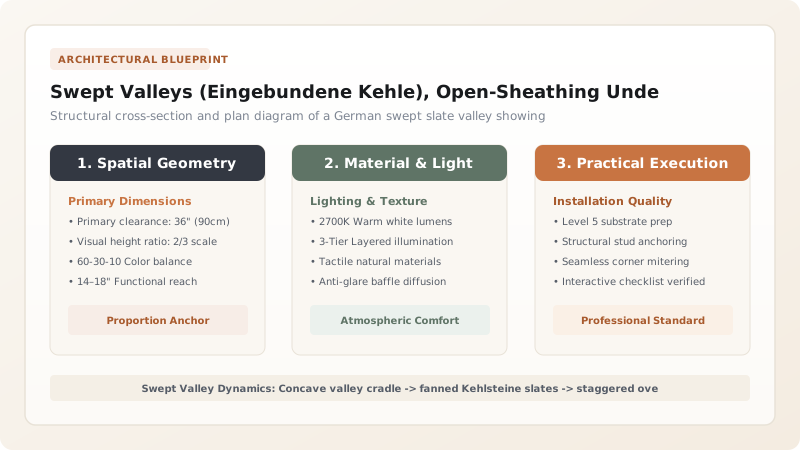
1. Swept Valley Hydrology: Eliminating the Metal Flashing Failure Point
In standard Western roofing, roof valleys—where two sloping roof planes intersect—are treated with open or closed metal sheet flashings (copper, zinc, or lead). While functional initially, metal valleys suffer from severe physical shortcomings: thermal expansion and contraction over decades causes metal fatigue cracking, standing snow dams scour the metal, and acidic rainwater runoff from slate slowly etches through copper trays within 30 to 40 years.
The German eingebundene Kehle (swept or laced valley) solves this permanently by constructing the valley entirely of slate. Water flows across an unbroken surface of pure Devonian stone. Because stone does not corrode, fatigue, or expand significantly with heat, the valley possesses the exact same 150-year lifespan as the surrounding roof, eliminating the most notorious leak-prone failure point in residential and monumental architecture.
2. The Kehlbohle Cradle and Fanned Kehlsteine Geometry
Constructing a swept valley begins with carpentry. A sharp, 90° V-shaped valley junction cannot be slated with brittle stone. Carpenters install a wide, concave curved valley board (Kehlbohle), measuring 350 to 500mm wide and 30mm thick, rounded with compass planes to create a gentle, sweeping circular trough (radius $R \ge 250\,\text{mm}$).
The slate roofer then lays the Kehlsteine (valley fan slates):
- Compound Diagonal Pitch: Slates do not lie horizontal in the valley; they are hewn into trapezoidal shapes and pitched at a calculated diagonal angle ($30^\circ - 45^\circ$) across the valley trough.
- Offset Headlaps: Because water volume in a valley is concentrated, headlaps are increased to 100–120mm (double the normal roof headlap).
- Smooth Transition Fans: As slates curve out of the valley trough, their widths and angles fan outward progressively, blending seamlessly into the horizontal coursing lines of both adjoining roof pitches.
3. Copper Nail Mechanics: Avoiding the Fatal Pinch Point
The mechanical connection between slate and timber deck governs roof longevity under gale-force winds. Fasteners must be solid copper or marine-grade stainless steel (hot-dip galvanized nails are strictly forbidden because sulfur in slate decomposes zinc):
Nails must have broad, flat heads (minimum 9mm diameter) and barbed or ring-shank shanks. In German guild practice, driving the nail requires calibrated finesse: the master roofer taps the nail until the underside of the head sits exactly 0.5mm above the slate surface. The stone must hang loosely from the nail shank like a pendulum.
If a roofer drives the nail tight against the slate, three catastrophic failure modes occur: (1) The percussive blow punches out the fragile conical countersink, ruining the stone; (2) The clamped stone cannot expand during hot summer days, causing thermal shear fracture; and (3) Dynamic building vibrations cannot dissipate, fatiguing the stone until it cracks across the nail hole.
Swept Valley Dimensions, Radius, and Fastener Engineering Standards
Use this reference table to calculate exact physical dimensions, ratios, and specifications before purchasing:
| Engineering Parameter | Standard Roof Pitch (30°–45°) | Low Pitch (25°–30°) | Steep Spire Pitch (> 50°) | Failure Mode if Out of Spec |
|---|---|---|---|---|
| Kehlbohle Cradle Radius | 250 – 300 mm radius | 350 – 450 mm wide arc | 180 – 220 mm radius | Sharp angle snaps brittle slate under foot |
| Valley Headlap Dimension | 100 – 120 mm | 130 – 150 mm | 80 – 100 mm | Water back-drives under slates in storms |
| Fastener Penetration Depth | Min 20mm into 24mm deck | Min 22mm into 28mm deck | Min 20mm into solid timber | Nails back out under cyclic wind suction |
| Fastener Offset from Trough | Min 150mm from centerline | Min 200mm from centerline | Min 120mm from centerline | Nail holes in water path cause severe leaks |
| Nail Head Clearance | 0.5 mm non-binding gap | 0.5 mm non-binding gap | 0.5 mm non-binding gap | Clamped nails crack stone under thermal expansion |
Practical Constraints
Every successful decoration project must account for physical and environmental constraints:
Highest Craft Guild Certification Requirement
Complex Valley Carpentry Substructure
Carpentry and Slating Sequence for a German Swept Valley
Execute this professional sequence to achieve flawless results without backtracking:
Kehlbohle Concave Cradle Carpentry
Fit 30mm thick clear spruce valley board into roof valley trough; plane concave circular cradle with 300mm radius; fasten to valley rafters.
Double-Layer Underlayment Lining
Line the wooden valley trough with two continuous layers of high-tensile slate underlayment membrane, extending 500mm up both adjoining pitches.
Chalk Centerline and Nail Boundary Lines
Snap chalk centerline down the valley trough; strike two 'no-nail' boundary lines 150mm to the left and right of center where nails are strictly prohibited.
Hewing Trapezoidal Kehlsteine Valley Slates
Hew broad Devonian slates into curved trapezoidal fan shapes on haubrücke anvil, beveling all edges at 45° to optimize water shedding.
Laying the Valley Starter Fan
Lay the first valley starter slate at the eaves cant; pitch stone at 35° diagonal across the cradle; verify minimum 120mm overlap.
Fanning into Adjoining Roof Courses
Interweave succeeding valley slates up the trough, blending the outer edges smoothly into the horizontal coursing of both adjoining roof slopes.
Safe Fastener Placement and Clearance Nailing
Drive two 35mm solid copper nails per slate, positioning fasteners outside the 150mm no-nail zone; leave 0.5mm clearance under nail heads.
Common Mistakes & Countermeasures
Avoid these costly errors that compromise aesthetics, ergonomics, and budget:
Driving slate nails through slates in the central trough of the swept valley
Slating the valley over a sharp 90-degree intersection without a rounded Kehlbohle board
Using galvanized steel or aluminum nails to fasten slates
Project Execution Checklist
Track your physical progress. Checkboxes persist automatically on this device:
Frequently Asked Questions
Can an eingebundene Kehle (swept valley) handle heavy winter snow loads?
Exceptionally well. Because the valley is supported by a continuous, solid 30mm thick curved spruce cradle and the slates are double-lapped and closely bedded, the structure has massive compressive strength capable of supporting tons of compacted wet snow without deflection.
Why don't German roofers use lead or copper soakers in swept valleys?
Metal soakers introduce dissimilar materials that expand and contract at vastly different rates than stone, creating friction and localized pressure points that crack slates. By constructing the entire valley out of stone, thermal movement is uniform, ensuring permanent monolithic integrity.
How long does it take to slate a typical 6-meter swept valley?
A master German Schieferdecker and an apprentice typically spend two full working days carefully templating, hewing, and interweaving slates across a single 6-meter swept valley. While labor-intensive, it never needs replacement for the lifetime of the building.


