
Galleting (also spelled garretting or galletting) is an ancient English masonry technique where small, sharp chips or flakes of stone—typically flint spalls, dark ferruginous carstone (ironstone), or slate splinters—are pressed into wide, wet lime mortar joints during wall construction. Originating in medieval Southeast England and East Anglia, galleting was never purely decorative: it served critical structural and environmental functions. The dense stone spalls reduce the overall volume of soft lime mortar exposed to driving rain, pin the joint mechanically to prevent mortar slump under the deadweight of heavy stones, prevent tensile shrinkage cracking during carbonation, and deter birds, insects, and rodents from picking away at the lime matrix.
At a Glance: Key Takeaways
- Mechanical Slump Resistance: Spalls act as miniature wedge bearings transferring gravity loads between irregular rubble stones.
- Mortar Volume Reduction: Replaces up to 30% of soft, vulnerable lime joint volume with non-porous silica or ironstone chips.
- Shrinkage Crack Mitigation: Breaks wide 25–40mm mortar beds into micro-zones, preventing continuous drying shrinkage fissures.
- Erosion & Weather Armor: Deflects horizontal driving rain cascade away from the softer underlying lime bedding.
- Material Typologies: Flint knapping waste flakes in East Anglia; dark chocolate-brown carstone ironstone in Norfolk and Surrey.
- Biological Defense: Blocks nesting sparrows, solitary bees, and mice from excavating soft medieval lime mortar.
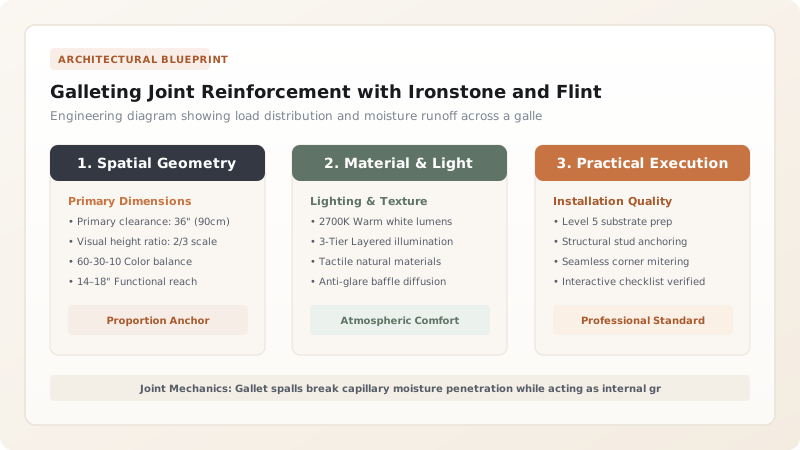
1. Structural Mechanics: Load Pinning and Mortar Slump Prevention
Unlike modern rapid-setting Portland cements, traditional hot-mixed lime and slaked lime putty mortars set very slowly through atmospheric carbonation. When constructing thick masonry walls with irregular fieldstones or rounded flint cobbles, mortar beds must be unusually wide—frequently 25 to 50mm thick.
Under the continuous deadweight of wet stone courses laid throughout the day, soft lime mortar tends to compress and bulge outward ('slump'), leading to wall settlement, leaning, and loss of line. By pushing flat, sharp chips of flint or ironstone horizontally into the wet mortar joint until they wedge firmly between the upper and lower stones, masons created miniature pinning bearings. These stone spalls transfer compressive loads directly stone-to-stone, stabilizing the fresh wall immediately and allowing masons to build faster without waiting days between lifts.
2. Environmental Armor: Rain Erosion and Shrinkage Control
Lime mortar has high water-vapor permeability, but wide, unreinforced mortar beds are vulnerable to mechanical wash-out during intense driving rainstorms before carbonation is complete:
- Shrinkage Micro-Zoning: As wet lime mortar dries, it undergoes volumetric shrinkage. In a solid 40mm joint, this creates continuous linear shrinkage fissures that allow rainwater to bypass the wall face. Galleting divides the mortar bed into dozens of tiny disconnected segments, completely eliminating continuous shrinkage cracking.
- Sacrificial Rain Deflection: When wind-driven rain strikes a stone wall, water runs down the face in sheets. By studding the joint with impermeable flint or ironstone chips set flush or slightly recessed, the water hits hard stone rather than soft lime paste, dramatically reducing hydraulic erosion.
3. Material Typologies: Norfolk Carstone, Surrey Ironstone, and Flint
The visual character of galleting varies distinctly across English geological regions:
- East Anglian Flint Spalls: In Norfolk and Suffolk, gallets were the free byproduct of the flint knapper's banker bench. Thousands of sharp, glossy black flakes were tapped into the creamy white lime joints of parish church rubble walls, creating a crisp monochrome contrast.
- Wealden & Greensand Ironstone: In Surrey, Sussex, and Kent, masons utilized chips of dark brown, rust-colored ferruginous sandstone (carstone or ironstone) inserted into pale sandstone or Bargate stone walls. These rich chocolate-brown chips were often arranged in deliberate decorative patterns—single rows, double parallel lines, or zigzag herringbone sequences.
Galleting Spall Specifications and Regional Stone Pairings
Use this reference table to calculate exact physical dimensions, ratios, and specifications before purchasing:
| Regional Typology | Host Wall Stone | Gallet Material | Spall Sizing (mm) | Arrangement Pattern |
|---|---|---|---|---|
| East Anglian Chalk Edge | Flint cobbles / fieldstones | Knapped black flint flakes | 15–30 mm long x 3–5 mm thick | Single or staggered random scatter |
| Norfolk Greensand Belt | Carstone ironstone ashlar | Dark carstone spalls | 20–40 mm long x 5–8 mm thick | Parallel horizontal bands |
| Surrey Bargate Hills | Bargate calcareous sandstone | Ferruginous Wealden ironstone | 15–25 mm angular chips | Dense herringbone / chevron lines |
| Sussex Downs | Chalk blocks / split boulders | Grey nodular flint chips | 20–35 mm tapered wedges | Continuous single-line centerline insertion |
| Kentish Ragstone | Hard sandy limestone (Ragstone) | Black chert / flint spalls | 10–25 mm sharp flakes | Random void filling in wide joints |
Practical Constraints
Every successful decoration project must account for physical and environmental constraints:
Labor-Intensive Craft Demands
Authenticity in Conservation Approvals
Execution Sequence for Inserting Galleting Spalls into Lime Joints
Execute this professional sequence to achieve flawless results without backtracking:
Spall Collection and Sizing
Collect waste flint flakes or ironstone spalls; sort by thickness, reserving 3–6mm flat tabular chips with sharp wedge profiles.
Mortar Bed Preparation
Mix rich hot-lime mortar (1 part quicklime to 2.5 parts sharp well-graded sand); lay full bedding joint beneath upper stone.
Stone Seating and Bedding
Set host stone into position, tapping down to true line while allowing mortar to squeeze outward flush with the stone face.
Joint Depth Raking
Before mortar stiffens, rake joint back 15–20mm from the stone face to create a defined bed for receiving gallets.
Gallet Spall Insertion
Grasp spall with fingers or light pliers; press firmly into the green mortar bed at 15–25mm intervals, driving spall edge horizontal.
Tapping and Bedding
Tap outer edge of spall lightly with small wooden trowel handle until its face sits flush or 1mm recessed behind host stone face.
Joint Compacting and Dressing
Using narrow pointing iron, press mortar firmly around each spall; wipe surrounding stone clean with dry coarse bristle brush.
Common Mistakes & Countermeasures
Avoid these costly errors that compromise aesthetics, ergonomics, and budget:
Gluing or pressing gallets into dry mortar as a purely decorative surface afterthought
Using soft, porous brick fragments or chalk chunks instead of dense flint or ironstone for galleting
Inserting spalls pointing downward so they catch cascading water like miniature gutters
Project Execution Checklist
Track your physical progress. Checkboxes persist automatically on this device:
Frequently Asked Questions
Was galleting done purely for decoration or for structural reasons?
While it creates an attractive decorative rhythm, galleting was primarily functional. In medieval construction, it pinned wide lime mortar joints against slumping, reduced drying shrinkage, and protected the soft lime mortar against driving rain erosion and burrowing insects.
Why do some people call galleting 'garretting'?
'Garretting' and 'galletting' are regional dialect variations of the same word. In Kent and Sussex it is often called garretting, while in Norfolk and Suffolk it is known as galleting. The word likely derives from the Old French 'galet', meaning a smooth river pebble or shingle.
Can you add galleting to modern brickwork?
In modern cavity brickwork with 10mm joints, there is no structural need for galleting. However, in bespoke heritage-style garden walls, rustic stone cottages, and flint veneers, masons frequently incorporate galleting to achieve authentic regional texture.


