
Limestone freestone tracery and flushwork checkerboard inlay is the sophisticated combination of fine-grained, easily carved limestone with jet-black knapped flint in English Gothic architecture. Because imported freestone (such as Caen, Barnack, or Ketton limestone) was costly to transport into stoneless East Anglia, medieval masons economized by carving delicate open tracery ribs, cusped blind arcades, and recessed checkerboard matrices from stone, then infilling the recessed backgrounds with squared, mirror-black knapped flints set dead flush with the stone face. This produced high-contrast decorative parapets, sacred Marian monograms, and heraldic shields that shimmer in changing sunlight while resisting weathering for centuries.
At a Glance: Key Takeaways
- Freestone Sourcing: Fine oolitic and magnesian limestones (Caen, Ketton, Clipsham, Ancaster) imported by sea and river barges.
- Rebated Stone Matrices: Limestone carved with 50–75mm deep recessed pockets (rebates) engineered to receive flint inlays.
- Checkerboard Geometry (Chequerwork): Alternating 150x150mm squares of pale freestone and black knapped flint ashlar.
- Sacred Monograms & Heraldry: Crowned 'M' (for the Virgin Mary), 'IHS', and merchant marks inlaid in flint against stone fields.
- Dead-Flush Alignment: Zero-tolerance flush alignment between stone ribs and flint faces preventing water ledges.
- Hot-Lime Bedding Mortar: Resilient high-calcium lime matrix absorbing differential thermal movement between stone and silica.
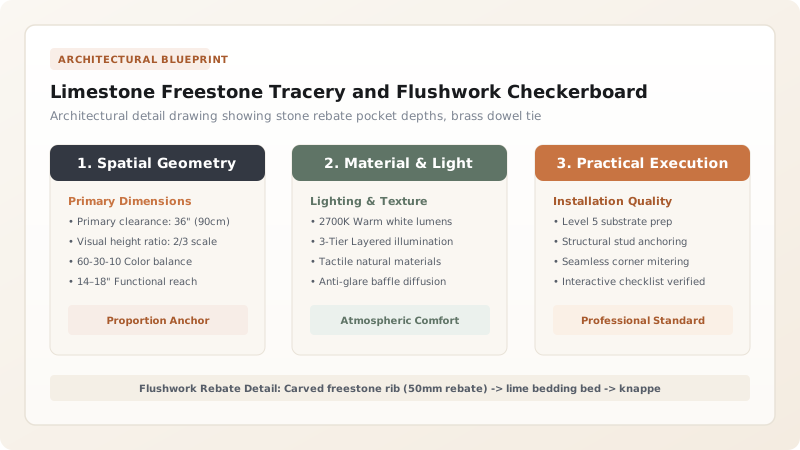
1. Economic Logic and the Waterborne Freestone Trade
In late medieval East Anglia, building stone was a luxury status symbol. Transporting heavy freestone overland across marshy roads on wooden oxcarts was prohibitively expensive—often costing triple the value of the stone itself. Consequently, stone was quarried in Normandy (fine-grained white Caen limestone) or the East Midlands (Barnack, Ketton, Clipsham) and transported on coastal sailing colliers and shallow river barges down the rivers Yare, Orwell, and Waveney.
To maximize this precious imported material, master masons developed flushwork. Rather than constructing solid walls of expensive ashlar freestone, masons sliced the limestone into thin architectural tracery frames, blind gothic arcades, and geometric fretwork. The deep negative spaces within the carving were then infilled with indigenous knapped flint, creating a monumental facade that appeared to use vast quantities of stone while utilizing 80% local flint by volume.
2. Visual Typologies: Chequerwork, Blind Tracery, and Monograms
Flushwork designs evolved through several distinct visual typologies across the Perpendicular Gothic period (1350–1520):
- Chequerwork (Checkerboards): The simplest and boldest form, alternating perfectly square blocks of pale dressed limestone with matching squares of black knapped flint. Used extensively on church plinths, parapets, and civic guildhalls (such as the famous Norwich Guildhall).
- Blind Tracery Arcades: Stone ribs carved to replicate miniature church windows—complete with cusped trefoils, quatrefoils, and soaring vertical mullions—with the glass replaced by gleaming black flint inlays.
- Crowned Marian Monograms and Heraldry: The ultimate display of carving virtuosity. Intricate letters—such as the crowned 'M' for Ave Maria, or the 'IHS' Christogram—were carved in relief freestone ribbons, with the surrounding background hollowed out and infilled with tiny, jewel-like knapped flints.
3. Rebate Carving, Tie-In Anchors, and Dead-Flush Alignment
The physical construction of flushwork requires microscopic architectural tolerances. If a knapped flint projects even 2mm beyond the adjoining limestone tracery, it forms a small horizontal shelf. In the British climate, this shelf traps rainwater, accelerating frost spalling and dirty algal streaks along the stone rebate.
Masons carved the freestone tracery stones on the banker bench with a uniform rear pocket or rebate (typically 50 to 65mm deep). Once the stone framework was hoisted and bedded onto the church wall with copper cramps, the knapper selected or custom-flaked flints to match the exact depth. Each flint was buttered with rich lime mortar and gently tapped with a wooden mallet until a straightedge laid across the stone tracery confirmed 100% dead-flush continuity.
Freestone Types Used in Historic East Anglian Flushwork
Use this reference table to calculate exact physical dimensions, ratios, and specifications before purchasing:
| Freestone Typology | Geological Source | Color & Texture | Carving Workability | Weather Resistance Factor |
|---|---|---|---|---|
| Caen Stone | Normandy, France (marine barge) | Creamy pale blonde; ultra-fine grain | Exceptionally crisp carving; soft on quarrying | Moderate; vulnerable to modern acidic rain |
| Ketton Stone | Rutland, UK (river barge) | Warm golden buff; oolitic limestone | Carves smoothly in all directions | High; excellent frost and freeze-thaw durability |
| Clipsham Stone | Rutland, UK (inland barge) | Creamy honey buff; shelly limestone | Dense, slightly coarser texture | Very high; favored for modern Gothic restoration |
| Barnack Stone | Northamptonshire, UK (Fen canals) | Pale grey-buff; dense shelly oolite | Tougher to carve; highly durable | Superb medieval durability (quarries exhausted 1460) |
| Ancaster Free | Lincolnshire, UK (canal barge) | Fine-grained warm white/cream | Highly ductile under fine chisels | High durability when properly bedded on quarry bed |
Practical Constraints
Every successful decoration project must account for physical and environmental constraints:
Complex Scaffolding and Protection
High Cost of Imported Heritage Freestone
Banker Masonry and Inlay Protocol for Gothic Flushwork Panels
Execute this professional sequence to achieve flawless results without backtracking:
Full-Scale Tracery Template Drafting
Draft 1:1 Gothic tracery pattern on wooden tracing floor; cut zinc or tin templates for limestone ribs, cusps, and checker grids.
Freestone Banker Dressing and Carving
Dress limestone blocks with chisels; carve surface tracery mouldings, maintaining consistent 50mm wall thickness for stone ribs.
Rebate Pocket Hollowing
Chisel flat-bottomed recess pockets (rebates) 55mm deep into the background fields behind tracery ribs, leaving crisp perpendicular margins.
Wall Erection and Cramp Anchoring
Set carved limestone tracery blocks on wall face using hot-lime bedding mortar; anchor blocks into rubble core with bronze cramps.
Knapped Flint Selection and Sizing
Knap deep black flints into rectilinear tiles matching the precise geometric shapes of the recessed stone pockets.
Lime Mortar Inlay Bedding
Butter reverse of knapped flints with non-hydraulic lime mortar; insert flints into stone pockets, tapping flush with wooden straightedge.
Joint Tooling and Sponge Dressing
Tool narrow lime joints with 2mm brass pointing irons; sponge freestone margins clean to remove lime smears before carbonation.
Common Mistakes & Countermeasures
Avoid these costly errors that compromise aesthetics, ergonomics, and budget:
Allowing knapped flint inlays to sit recessed or proud relative to the surrounding limestone tracery
Using iron or mild-steel cramps to tie freestone tracery blocks into the masonry core
Carving freestone tracery with the natural quarry bed oriented vertically instead of horizontally
Project Execution Checklist
Track your physical progress. Checkboxes persist automatically on this device:
Frequently Asked Questions
Why is it called 'flushwork' if the stone has carving?
It is termed 'flushwork' because despite the appearance of intricate three-dimensional Gothic carving, the surface of the black knapped flints and the front face of the limestone tracery ribs sit in the exact same planar surface—they are dead 'flush' with one another.
Can you clean dirty flushwork on historic churches with high-pressure power washers?
Strictly no. High-pressure water jets pulverize soft historic lime mortar, blast away historic gallets, and erode delicate medieval limestone tracery. Conservators use low-pressure superheated steam systems (such as DOFF) or gentle micro-abrasive methods.
What is the difference between 'flushwork' and 'proudwork'?
In flushwork, the flint and stone form a perfectly flat, unified surface plane. In proudwork, the carved limestone mouldings or flints project outward beyond the background wall plane, creating pronounced physical relief and shadows.


