
Burgundy quarry strata selection and hand-chiseled edge dressing (bords ébréchés) are the defining artisanal benchmarks of authentic Pierre de Bourgogne flooring. Quarried from specific geological benches (bancs) across the Côte-d'Or and Yonne, slabs are evaluated for fossil density, including crinoid 'St. Vincent stars' and coiled ammonite shells. To transform sawn modern slabs into authentic architectural flagstones, stonecutters manually distress the perimeter edges using specialized pitching tools and scutching hammers. Striking the stone at acute angles creates irregular, soft chipped facets that are subsequently hand-smoothed with diamond abrasive pads. This eliminates harsh diamond blade saw marks, creating the soft undulating contours characteristic of centuries-old French château pavements.
At a Glance: Key Takeaways
- Geological Bench Stratigraphy: Sourced from specific quarry benches (Banc Royal, Banc Franc, Banc Gris) governing density and hue.
- Bioclastic Fossils: Fossilized marine organisms (Pentacrinites, Nerinea mollusks, brachiopods) certifying authentic Burgundy origin.
- Hand-Chiseled Edges (Bords Ébréchés): Manual edge pitching removing straight sawn margins with deliberate rustic chipping.
- Brushed Finish (Brossé / Bouchonné): Heavy nylon and diamond bristle brushing highlighting natural fossil textures.
- Tumbled & Aged Patina (Vieilli): Mechanical wet tumbling in ceramic pebble drums softening sharp corners and surface ridges.
- Aesthetic Consistency Grading: Blending subtle color tone variances (doré, clair, rubané) across crate distributions.
1. Burgundy Quarry Strata: The Science of Banc Selection
In the limestone quarries of Burgundy, a single quarry face contains multiple distinct geological layers known as bancs. Deposited under fluctuating Jurassic sea levels, each banc exhibits unique mineral density, fossil concentrations, and coloration:
- Banc Franc (The Clean Bed): A fine-grained, uniform cream limestone with minimal fossils, favored for formal neoclassical salons and refined ashlar borders.
- Banc Royal (The Shell Bed): Packed with dense accumulations of fossilized marine fauna (lumachelle). When polished or brushed, spiral gastropods, bivalves, and crinoid segments (known locally as étoiles de Saint-Vincent) appear as stunning ivory and amber jewels within the stone.
- Banc Gris / Rubané: Deep lower strata containing trace manganese and clay minerals, producing handsome blue-grey ribbons and clouds running through warm beige stone.
2. Bords Ébréchés: The Art of Hand-Chiseled Edge Dressing
When large limestone blocks are sliced into 20mm or 30mm flooring slabs with modern industrial gang-saws, they leave sharp, sterile, perfectly straight 90° edges. In an authentic French country bastide or château, such edges look jarringly synthetic.
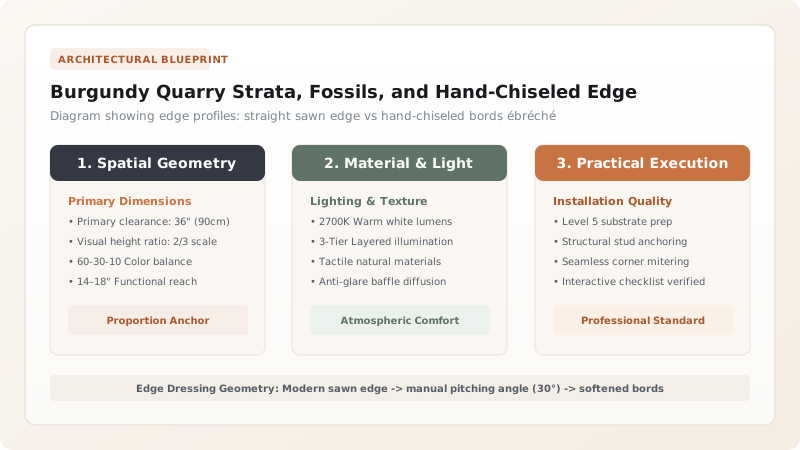
To create bords ébréchés, the stonecutter sits before the sawn slab with a heavy wooden mallet and a wide carbide pitching tool (chasse-pierre). Striking the top edge at an acute 30° angle, the mason chips small flakes (3 to 8mm deep) along the perimeter at irregular intervals. The corners are subtly knocked back (coins adoucis). Next, the artisan buffs the chipped edge with 80-grit diamond pads, softening any sharp burrs so the stone feels worn by centuries of soft woolen stockings rather than fresh tool strikes.
3. Surface Textures: Adouci, Brossé, and Antique Patinas
Following edge dressing, the top face of the limestone receives its final surface treatment:
- Adouci (Honed): Smooth, non-reflective matte finish created with fine abrasive stones; highlights natural fossil cross-sections without specular glare.
- Brossé (Brushed): High-tensile silicon carbide or diamond-impregnated brushes sweep across the slab. Because fossils and calcite veins are harder than the surrounding micritic limestone matrix, brushing gently erodes the softer stone, leaving fossils standing in subtle, tactile micro-relief.
- Vieilli (Antique Tumbled): Flagstones are placed in large rotating drums filled with water, silica sand, and smooth ceramic river stones. The tumbling action rounds edges and distresses the face into a soft, velvety antique patina.
Burgundy Limestone Finishes, Textures, and Edge Profiles
Use this reference table to calculate exact physical dimensions, ratios, and specifications before purchasing:
| Finish Classification | Surface Processing | Edge Profile Type | Slip Resistance (R-Value) | Recommended Interior Space |
|---|---|---|---|---|
| Adouci / Honed | Fine 220-grit wet diamond hone | Straight sawn or 2mm micro-bevel | R9 (smooth matte) | Contemporary urban apartments, formal galleries |
| Bords Ébréchés Brossé | Carbide hand pitching + diamond brush | Hand-chiseled chipped edges | R10 (tactile antique) | Classic French country kitchens, grand salons |
| Vieilli Patiné | Vibratory drum tumbling + soap polish | Rounded, softened tumbled edges | R10 (velvety soft) | Rustic châteaux corridors, bastide wine cellars |
| Bouchardé Brossé | Multi-point pneumatic bush-hammering | Hand-dressed rustic chamfer | R11 (textured exterior) | Covered porticos, pool terraces, garden loggias |
| Flammé Brossé | High-heat thermal spalling + brushing | Chiseled relief edges | R11 (deeply textured) | High-traffic entry foyers, public boutique halls |
Practical Constraints
Every successful decoration project must account for physical and environmental constraints:
Labor Time and Artisanal Cost
Authentic Quarry Sourcing Certification
Artisanal Execution of Hand-Chiseled Bords Ébréchés Edges
Execute this professional sequence to achieve flawless results without backtracking:
Slab Visual Inspection and Fossils Orientation
Inspect sawn Burgundy slab; orient face so prominent fossil veins and crinoid clusters align with primary room sightlines.
Perimeter Pitching Layout
Clamp slab to heavy wooden workbench over thick felt pads to prevent surface scratching during percussive tooling.
Initial Edge Pitching with Chasse
Hold 40mm carbide pitching chisel at 30° angle to slab edge; deliver light mallet taps to break away 4–8mm irregular flakes.
Corner Softening (Coins Adoucis)
Gently knock back all four 90° corners, creating subtle 5mm radius rounded contours mimicking natural footwear abrasion.
Scutching Hammer Secondary Dressing
Use multi-tooth scutch hammer along chipped edge to blend transitions between fresh fractures and flat stone face.
Diamond Abrasive Hand-Softening
Rub edge perimeters vigorously with 120-grit flexible diamond hand pads to remove razor-sharp microscopic burrs.
Face Brushing and Washing
Brush face with rotary nylon-diamond brush to remove limestone dust; wash with clean spring water and allow to dry for packaging.
Common Mistakes & Countermeasures
Avoid these costly errors that compromise aesthetics, ergonomics, and budget:
Using machine-stamped or CNC saw blades to create fake 'chiseled' edges
Pitching edges too deeply (> 15mm deep) during manual edge dressing
Leaving razor-sharp fresh fracture burrs along chiseled edges without diamond smoothing
Project Execution Checklist
Track your physical progress. Checkboxes persist automatically on this device:
Frequently Asked Questions
What are the small star-shaped fossils often found in Burgundy limestone?
They are the fossilized stem segments of ancient sea lilies (crinoids, specifically *Pentacrinites*), marine echinoderms that lived in the Jurassic sea 160 million years ago. In Burgundy folklore, they are called *étoiles de Saint-Vincent* (Saint Vincent's stars, named after the patron saint of winemakers) and are prized as authentic lucky marks.
Can machine-tumbled edges look as authentic as hand-chiseled bords ébréchés?
Machine tumbling softens the entire stone uniformly, rounding all edges like a river pebble. Bords ébréchés provides a different, more architectural character: the face remains crisp and flat, while the perimeter edge features lively, hand-hewn facets that catch dramatic low-angle light.
Does hand-chiseling weaken the limestone slab?
No. Hand-chiseling is a surface edge distress that penetrates only a few millimeters into dense 20mm to 30mm thick limestone. When properly bedded in a full mortar bed, the slab retains its full compressive load capacity.


