
Opus Romain (Roman Pattern) modular laying and Natural Hydraulic Lime (NHL) mortar bedding constitute the historical gold standard for installing French Pierre de Bourgogne limestone flagstones. Developed to eliminate monotonous linear joint grids across grand châteaux reception halls, Opus Romain combines four to five interlocking modular stone formats (typically 60x90cm, 60x60cm, 60x30cm, 30x30cm) into repeating geometric modules where joint intersections are strictly staggered to prevent cross-joints. Slabs are set into a 25–35mm breathable bed of pure Natural Hydraulic Lime mortar (NHL 2 or NHL 3.5) mixed with washed white silica sand. This breathable, flexible bedding accommodates subfloor deflections, prevents trapped moisture, and eliminates the catastrophic efflorescence and dark staining caused by Portland cement.
At a Glance: Key Takeaways
- Modular Grid Architecture: 4-to-5-format repeating interlocking module covering 1.44m² to 2.16m² per pattern cycle.
- Cross-Joint Prohibition: Strict architectural rule mandating zero continuous joints exceeding two tile lengths (< 1.2m).
- Natural Hydraulic Lime (NHL 2 / 3.5): Pure lime binder setting through hydraulic crystallization followed by atmospheric carbonation.
- Aggregate Specification: Washed 0–3mm well-graded silica river sand free of clay, iron, and soluble alkali salts.
- Medium-Bed Floating: 25–35mm thick mortar bed absorbing variations in handmade slab thickness and subfloor unevenness.
- Joint Pointing Mortar: White NHL 2 lime blended with pulverized Burgundy limestone flour for matching color tone and breathability.
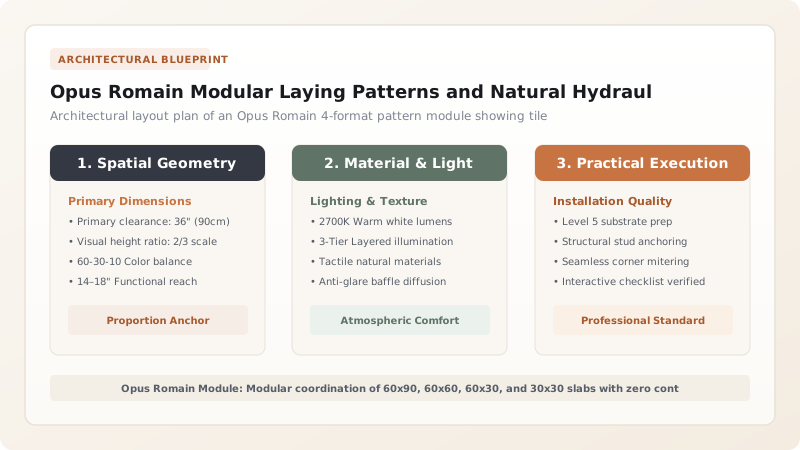
1. Opus Romain Geometry and Anti-Grid Layout Principles
Linear floor tile layouts (such as running bond or stack bond) introduce rigid parallel perspective lines that visually truncate spaces and emphasize substrate imperfections. The Opus Romain (French: Pavage Romain) was perfected to achieve organic visual harmony across expansive salons, orangeries, and cloister corridors.
A classic four-size Opus Romain module utilizes coordinated metric formats derived from a base module $M$ (typically $M = 300\,\text{mm}$):
- Format A ($2M \times 3M$): $600 \times 900\,\text{mm}$ (The dominant anchor slab).
- Format B ($2M \times 2M$): $600 \times 600\,\text{mm}$ (The primary square).
- Format C ($2M \times 1M$): $600 \times 300\,\text{mm}$ (The intermediate rectangle).
- Format D ($1M \times 1M$): $300 \times 300\,\text{mm}$ (The keystone infill square).
Three inviolable layout rules must be maintained: (1) No four corners may ever meet at a single intersection; (2) No straight joint line may extend for more than two slab lengths (maximum 1.2 meters); and (3) Identical slab sizes must never touch each other along an entire edge.
2. Mortar Science: Why Natural Hydraulic Lime (NHL) is Mandatory
Burgundy limestone is a natural, microporous bioclastic rock. Bedding it with modern Portland cement thin-sets or grey masonry cements is the leading cause of irreversible floor destruction in heritage architecture:
- Staining from Free Lime Hydrates: Grey Portland cement releases soluble calcium hydroxide and alkali salts (sodium and potassium) that bleed upward through the limestone capillaries, causing permanent grey, waterlogged shadows known as 'dark halo' or 'framing' stains.
- The Hydraulic Lime Solution: Chaux Hydraulique Naturelle (NHL 2 or NHL 3.5) is manufactured by calcining siliceous limestone at lower temperatures ($1200^\circ\text{C}$). It contains calcium silicates that set with water in thick beds (hydraulic set), followed by a slow carbonation process that absorbs atmospheric $\text{CO}_2$. NHL mortar is chemically pure white, contains zero staining alkalis, has high vapor permeability ($15 - 20\,\mu$), and cures with a flexible compressive strength ($2.5 - 5.0\,\text{MPa}$) that absorbs thermal expansions without cracking the stone.
3. Thick-Bed Setting Protocol and Stone-Dust Pointing
Because natural hand-dressed flagstones vary in thickness by $\pm 2\text{mm}$ to $\pm 4\text{mm}$, they cannot be set using thin-bed notched trowels. Installers utilize the traditional thick-bed method (pose sur lit de mortier):
A 30mm bed of semi-dry NHL mortar (consistency of damp earth) is screeded across the subfloor. The back of each pre-wetted limestone slab is buttered with a 3mm slip of creamy lime putty. The slab is placed and beaten firmly into the bed with a dead-blow white rubber mallet until the laser level indicates true elevation.
Joints are maintained at 3 to 5mm for bords ébréchés flagstones. Pointing mortar is formulated using 1 part NHL 2 white lime to 2 parts micro-pulverized Burgundy limestone dust (farine de pierre de Bourgogne). This ensures that the mortar joints possess the exact same coloration, thermal expansion, and porosity as the stone itself.
Opus Romain Formats and Hydraulic Mortar Engineering Ratios
Use this reference table to calculate exact physical dimensions, ratios, and specifications before purchasing:
| Application Component | Material Specification | Dimensional Ratio / Mix | Setting Bed Thickness | Structural Role |
|---|---|---|---|---|
| Format A Anchor Slab | Pierre de Bourgogne (Lanvignes/Chassagne) | 600 x 900 x 20 mm | 30 mm mortar bed | Anchor piece establishing visual weight in module |
| Format B Large Square | Pierre de Bourgogne | 600 x 600 x 20 mm | 30 mm mortar bed | Connects anchor to intermediate modules |
| Format C Rectangle | Pierre de Bourgogne | 600 x 300 x 20 mm | 30 mm mortar bed | Shifts joint alignment; breaks straight runs |
| Format D Small Square | Pierre de Bourgogne | 300 x 300 x 20 mm | 30 mm mortar bed | Keystone locking modular pattern rotation |
| Bedding Mortar | NHL 2 or NHL 3.5 Natural Hydraulic Lime | 1 Part Lime : 2.5 Parts White River Sand | 25–35 mm consolidated | Breathable, flexible, non-staining substrate |
| Joint Grout Pointing | NHL 2 Lime + Burgundy Stone Dust | 1 Part Lime : 1.5 Parts Stone Flour | 3–5 mm joint width | Vapor-permeable joint matching stone hue |
Practical Constraints
Every successful decoration project must account for physical and environmental constraints:
Complex Cutting and Waste Management
Subfloor Deflection Rigidity Limits
Field Layout and Setting Sequence for Opus Romain Burgundy Limestone
Execute this professional sequence to achieve flawless results without backtracking:
Establishing Room Centerline and Square Datum
Strike 3-4-5 perpendicular chalk reference lines through the center of the room; plan pattern to balance perimeter cuts on opposing walls.
Sub-Base Pre-Wetting
Thoroughly vacuum substrate; dampen concrete or lime screed with clean water to prevent rapid suction of mortar mixing water.
Mixing Natural Hydraulic Lime Mortar
Blend pure white NHL 2 lime with clean washed 0-3mm silica sand (1:2.5 ratio); mix with potable water to a buttery, non-slumping consistency.
Screeding Thick Mortar Bed
Spread a 30mm uniform bed of hydraulic mortar over an area sufficient for two pattern modules, keeping edges beveled.
Back-Buttering Flagstone Undersides
Sponge the reverse of each limestone slab with clean water; apply a 3mm contact layer of pure lime slurry (barbotine) to guarantee 100% adhesion.
Setting Slabs Following Module Blueprint
Place slabs sequentially according to Opus Romain layout; tap down with dead-blow white rubber mallet, checking planar level across joints.
Joint Spacer Verification
Insert 4mm wooden or plastic shims; verify zero joint lines exceed 1.2m and confirm zero four-corner cross-joint intersections occur.
Stone-Dust Lime Pointing and Sponge Cleanup
After 48 hours, pack joints flush with NHL 2 lime and Burgundy limestone flour mortar; sponge stone clean with fresh water before carbonation.
Common Mistakes & Countermeasures
Avoid these costly errors that compromise aesthetics, ergonomics, and budget:
Allowing four tile corners to meet at an intersection ('cross-joint') during Opus Romain laying
Setting limestone slabs with grey masonry cement or sand with high iron-oxide contamination
Walking on or grouting newly bedded flagstones before the hydraulic lime achieves initial set (within 48 hours)
Project Execution Checklist
Track your physical progress. Checkboxes persist automatically on this device:
Frequently Asked Questions
Can I install an Opus Romain pattern in a small room or hallway?
Opus Romain requires visual breathing room to display its repeating rhythm. In rooms under 15 square meters or narrow hallways under 1.8 meters wide, the large 60x90cm slabs must be cut frequently, which destroys the pattern flow. For small spaces, a single-format running bond (e.g., 40x60cm or 30x60cm) is aesthetically superior.
Why do you use pulverized limestone dust in the pointing mortar?
Using pulverized Burgundy limestone flour (*farine de pierre*) ensures that the joint mortar has the exact same optical color, texture, and mineral composition as the flagstones. As the floor wears and is washed with black soap, the joints patinate at the exact same rate as the stone.
How long after installing Burgundy limestone can furniture be moved in?
Light foot traffic in socks or soft shoes is permitted after 72 hours. However, heavy furniture point loads (such as pianos, bookcases, or heavy tables) should not be moved in for at least 21 to 28 days to allow the natural hydraulic lime bed to achieve full compressive cure.


