
Savon Noir (traditional French black soap) patination is the authentic, non-chemical finishing and curing discipline for Pierre de Bourgogne limestone floors. Made by saponifying cold-pressed olive or linseed oil with potassium hydroxide, genuine liquid or paste savon noir is rich in natural oleic and linoleic fatty acids. When washed across newly installed, unsealed Burgundy limestone, the potassium soap reacts chemically with the calcium carbonate (CaCO3) in the stone to form an insoluble, microscopic surface barrier of calcium oleate. Rather than forming a synthetic plastic film that traps sub-floor vapor, savon noir nourishes the microporous limestone from within. With routine damp-mopping and natural bristle buffing over years of use, the stone develops the legendary, silky, amber-hued château patina that repels grease, resists red wine staining, and never requires stripping.
At a Glance: Key Takeaways
- Potassium Saponification Chemistry: Pure olive/linseed oil saponified with KOH yielding rich, solvent-free fatty acid soap.
- Calcium Oleate Transformation: Oleic acid reacting with stone CaCO3 to precipitate an insoluble, water-repellent mineral patina.
- Breathable Micro-Crystalline Shield: Retains 100% vapor permeability while providing hydrophobic surface droplet beading.
- Zero Plastic Resins: 100% natural, biodegradable, and VOC-free; eliminates peeling, yellowing, and chemical stripping cycles.
- Mechanical Buffing Reaction: Tampico or palmyra fiber friction generating gentle heat that crystallizes the fatty soap layer.
- Stain Mitigation Protocols: Organic poultices (Terre de Sommières) resolving deep oil and wine spills without etching the stone.
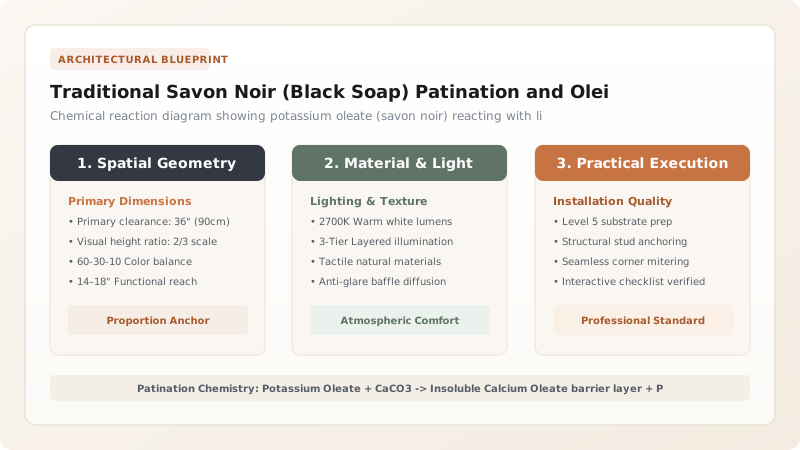
1. Saponification Chemistry: The Formation of Calcium Oleate
Authentic French savon noir (black soap) bears no relation to modern supermarket detergents or scented household cleaners. It is a traditional soft paste soap manufactured by saponifying vegetable oils—predominantly dark olive oil pomace and linseed oil—with potassium hydroxide ($\text{KOH}$):
$$\text{Fatty Acid Triglycerides} + 3\,\text{KOH} \longrightarrow 3\,\text{R-COOK (Potassium Oleate)} + \text{Glycerol}$$
When diluted in warm water and applied to Pierre de Bourgogne, the soluble potassium oleate molecules penetrate the open microscopic pores of the calcitic stone. There, an immediate ion-exchange reaction occurs with the active calcium ions on the limestone pore walls:
$$2\,\text{R-COOK} + \text{Ca}^{2+} \longrightarrow \text{Ca(R-COO)}_2\downarrow + 2\,\text{K}^+$$
The resulting compound—calcium oleate—is a hard, completely water-insoluble natural soap salt that crystallizes within the upper pore capillaries. It does not seal the stone like a plastic film; rather, it renders the pore throats hydrophobic, causing spilled liquids to bead up on the surface without inhibiting vapor transpiration.
2. The Initial Saturated Wash Protocol for Newly Installed Floors
A newly laid Pierre de Bourgogne floor is thirsty, chalky, and highly absorbent. The initial patination protocol initiates the transition from raw quarry stone to mature château pavement:
After the hydraulic lime joints have cured for at least 28 days and all residual grout haze has been washed away with clean water, the first 'saturated wash' is conducted. Master caretakers prepare a rich solution of 3 to 4 tablespoons of concentrated olive-oil savon noir paste per 5 liters of warm water.
The solution is scrubbed across the stone using natural Tampico fiber floor brooms, allowing the soap to sit for 10 minutes before wiping excess water with clean cotton floor cloths (serpillières). The floor is never rinsed with plain water afterward; leaving the soap residue allows the fatty acids to react and penetrate deep into the stone as it dries. Over the first six months, this wash is repeated weekly.
3. Natural Mechanical Buffing and Organic Stain Remediation
To accelerate the development of a silky satin sheen, the dried soap-washed floor is buffed using a rotary floor machine fitted with natural horsehair or Tampico brush pads. The mechanical friction generates surface temperatures of 35°C–40°C, melting the microscopic soap waxes and burnishing the limestone into an exquisite amber-patinated glow.
For accidental stains, chemical acid strippers or bleaches are catastrophic. Traditional remediation relies on natural adsorption:
- Grease & Cooking Oil: Dust the spill immediately with Terre de Sommières (a natural montmorillonite smectite clay from southern France). The ultra-porous clay has immense capillary suction, drawing grease out of the limestone within 6 to 12 hours.
- Red Wine & Coffee: Blot immediately; apply a paste of baking soda and 3% hydrogen peroxide covered with plastic wrap for 24 hours to oxidize tannins without etching the calcium matrix.
Burgundy Limestone Cleaning and Patination Schedule
Use this reference table to calculate exact physical dimensions, ratios, and specifications before purchasing:
| Maintenance Cycle | Cleaning Solution Formulation | Tooling / Equipment | Surface Reaction Goal | Inspection Standard |
|---|---|---|---|---|
| Initial Saturated Wash | 4 tbsp Savon Noir Paste / 5L hot water | Tampico scrubbing brush + cotton mop | Deep pore saturation & calcium oleate formation | Water droplet beads for 60 seconds |
| Weekly First-Year Mopping | 2 tbsp Liquid Savon Noir / 5L warm water | Microfiber / cotton mop (well wrung) | Builds continuous hydrophobic barrier | Soft satin sheen develops in walking paths |
| Monthly Mechanical Buffing | Dry buff (zero liquid) | 175 RPM rotary buffer + horsehair pad | Friction burnishes and hardens soap layer | Luminous, non-slip silky tactile finish |
| Routine Annual Washing | 1 tbsp Liquid Savon Noir / 5L water | Damp flat mop | Nourishes stone; cleans foot traffic grime | Flawless patina without build-up haze |
| Deep Oil Spill Remediation | Pure dry Terre de Sommières clay powder | Sprinkled dry; vacuumed after 12 hrs | Draws embedded lipids out of stone pores | 100% grease shadow extraction |
Practical Constraints
Every successful decoration project must account for physical and environmental constraints:
Patience Required for Mature Patina
Soap Dilution Discipline
Master Application and Patination Sequence with Savon Noir
Execute this professional sequence to achieve flawless results without backtracking:
Cure Verification and Vacuum Dusting
Verify lime mortar joints have cured 28 days; vacuum floor thoroughly to remove all abrasive grit and construction debris.
Grout Haze Wash with Clean Water
Mop floor with pure lukewarm water and clean cellulose sponges to dissolve remaining surface lime haze; allow 24h dryout.
Savon Noir Paste Solution Blending
Dissolve 3 tablespoons of 100% pure olive-oil savon noir paste into 5 liters of hot water, stirring until fully liquified.
Saturated Scrubbing Application
Apply warm soap solution generously with Tampico fiber deck broom, scrubbing in circular motions to work foam into micropores.
Wiping Excess Liquid without Rinsing
Mop up pooled surface liquid with well-wrung cotton towels; do NOT rinse with clean water; allow fatty acids to soak in and dry.
Air-Drying and Chemical Reaction Window
Allow floor to dry for 24 hours without foot traffic; fatty acids react with limestone calcium to form insoluble calcium oleate.
High-Speed Natural Fiber Burnishing
Buff dry floor using commercial rotary floor polisher with Tampico or natural horsehair brush at 175 RPM to produce silky satin glow.
Common Mistakes & Countermeasures
Avoid these costly errors that compromise aesthetics, ergonomics, and budget:
Rinsing the floor with cold, clean water immediately after applying Savon Noir
Using commercial 'black soap' containing synthetic fragrances, solvents, or petroleum detergents
Using acidic cleaners (vinegar, lemon juice, tile descalers) to clean stains on Burgundy limestone
Project Execution Checklist
Track your physical progress. Checkboxes persist automatically on this device:
Frequently Asked Questions
What is the difference between Moroccan black soap and French savon noir for stone?
Moroccan black soap (used in hammams and tadelakt) is also an olive-oil based potassium soap, but it typically contains crushed black olive pulp and eucalyptus oil for skin exfoliation. French architectural savon noir (savon noir à l'huile de lin or d'olive) is refined specifically for stone and wood floors, free of abrasive olive stones.
Will washing with savon noir make the limestone floor dangerously slippery?
No. When mixed at the proper dilution (1 to 2 tablespoons per 5 liters), the soap completely converts to insoluble calcium oleate and penetrates the pores. It leaves a silky, velvety touch under bare feet with excellent traction ($R10$ rating), unlike slippery topical wax pastes.
Can I use savon noir on other natural stones like marble or travertine?
Yes. Any calcium-based natural stone (limestone, marble, travertine, onyx) will react positively with savon noir to form a protective, nourishing calcium oleate patina.


