
The engineering genius of the Parquet de Versailles cassette is its self-compensating internal joinery. Assembled from 42 separate French oak parts, the panel combines an outer mortise-and-tenon frame pinned with wooden dowels (*chevilles*) and an internal woven basketweave lattice where small square lozenges float freely inside tongue-and-groove tracks, absorbing seasonal expansion without panel distortion.
At a Glance: Key Takeaways
- Cassette Components: 42 separate solid oak pieces milled to 23mm thickness
- Frame Joinery: Open mortise-and-tenon (bridle joint) secured with 8mm hand-carved oak pegs
- Internal Lattice: Tongue-and-groove edge profiles with 1.5mm expansion tolerances
- Floating Lozenges: 16 small central oak tiles held without glue to allow free breathing
- Subfloor Fixing: Secret blind nailing through tongue edge at 45 degrees into oak joists
- Cassette-to-Cassette: Connected via loose oak splines (*fausses languettes*) in edge grooves
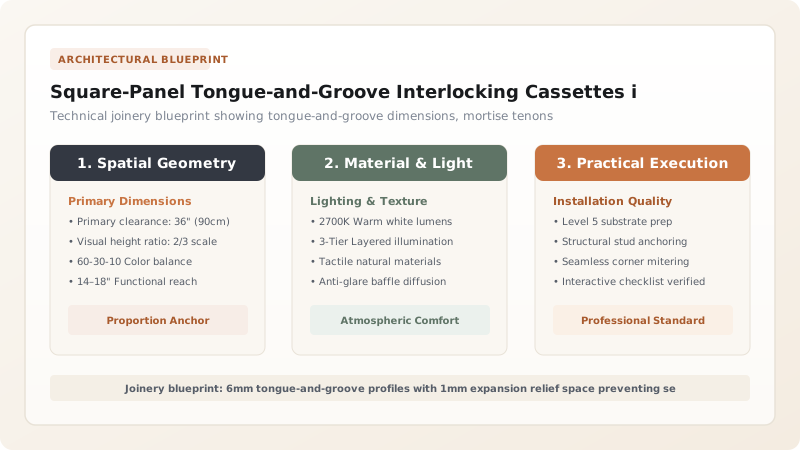
Assembly Mechanics of the 42-Piece Basketweave Lattice
A Parquet de Versailles cassette operates on the cabinetmaker's principle of 'floating construction'. If 42 pieces of solid wood were glued rigidly into a 1-meter frame, seasonal expansion would crack the joints apart. Master parqueteurs engineered an ingenious structural compromise:
- The Rigid Outer Frame (Le Cadre): Four outer border stiles (75 mm wide by 23 mm thick) are joined at the corners with pegged open mortise-and-tenons. This frame establishes the permanent, rigid square envelope.
- The Floating Infill: The internal diagonal cross-pieces, interwoven slats, and 16 square lozenges are fitted using precision tongue-and-groove joints (6 mm tongue width, 7 mm groove depth). Crucially, no glue is applied to the internal tongues.
- Seasonal Respiration: Each small square tile (120 x 120 mm) expands and contracts within its individual grooved cell by a fraction of a millimeter. The cumulative movement of 16 floating cells is absorbed internally without exerting outward hydraulic thrust against the master cadre frame.
Cassette Interconnection and Blind Nailing to Subfloor Joists
Connecting adjacent 1-meter cassettes across a vast palace salon requires specialized subfloor engineering:
1. Oak Joists (Lambourdes): The subfloor consists of seasoned oak battens (80 x 60 mm) spaced precisely at 500 mm centers, aligned perpendicular to the room's main axis.
2. Secret Nailing: The parqueteur sets the first cassette along the diagonal chalk datum line; heavy forged-steel lost-head brads (60 mm long) are driven diagonally at 45 degrees through the bottom shoulder of the outer frame tongue directly into the joist, and punched below the wood surface with a nail set.
3. False Splines (Fausses Languettes): All four outer edges of the cassette cadre feature continuous 6mm grooves. To join adjacent panels, separate dry oak spline strips (fausses languettes) are inserted into the grooves, bridging across panels to lock them into a seamless, flat, flush architectural plane without visible surface nails.
Square-Panel Tongue-and-Groove Interlocking Cassettes in Versailles Flooring Architectural Decision Matrix
Use this reference table to calculate exact physical dimensions, ratios, and specifications before purchasing:
| Joint Location | Joinery Specification | Glue Applied? | Fastener Used | Expansion Allowance |
|---|---|---|---|---|
| Cadre Corners | Open Bridle Tenon | Yes (Hide glue) | Two 8mm octagonal oak dowels | 0 mm (Rigid master frame) |
| Diagonal Slat Intersections | Half-Lap Halving | No (Dry fit) | None (Friction locked) | 0.5 mm internal play |
| Small Square Lozenges | 4-Sided Tongue & Groove | No (100% Free floating) | None | 1.0 mm perimeter gap in groove |
| Cassette-to-Cassette | Groove with loose spline | No | Diagonal blind nails through tongue | 1.5 mm inter-panel joint |
| Perimeter Wall Border | Raking cut into wall dado | No | Expansion foam / cork strip | 15–20 mm under baseboard |
Practical Constraints
Every successful decoration project must account for physical and environmental constraints:
Extremely High Milling Accuracy
Subfloor Flatness Tolerance
Bench Assembly and Pinning of a Versailles Cassette
Execute this professional sequence to achieve flawless results without backtracking:
Component Sorting
Sort the 42 milled oak pieces for color and grain harmony; match medullary ray flecks on central diamond lozenges.
Internal Basketweave Layup
Interweave diagonal slats and square lozenges into the central basketweave field on the assembly jig without glue.
Frame Fitting
Coat corner bridle tenons with warm rabbit-skin hide glue; slip outer cadre stiles over the tongues of the internal lattice.
Square Clamping
Apply four heavy steel bar clamps diagonally and orthogonally; measure corner diagonals with tram sticks (must match within 0.5mm).
Dowel Pinning (Cheviller)
Bore 8mm holes through the mortise cheeks; hammer hand-split octagonal oak dowels through the joint; let glue cure 12 hours.
Joint Scraping
Trim dowel ends flush with a flush-cut saw; level all seam transitions with a steel cabinet scraper (racloir).
Common Mistakes & Countermeasures
Avoid these costly errors that compromise aesthetics, ergonomics, and budget:
Gluing the floating square lozenges into their grooves
Assembling cassettes without measuring diagonal tram dimensions
Surface-nailing face boards with wire nails
Project Execution Checklist
Track your physical progress. Checkboxes persist automatically on this device:
Frequently Asked Questions
What are 'chevilles' and why are they visible on genuine Versailles parquet?
Chevilles are hand-hewn octagonal oak dowel pins driven through the mortise-and-tenon joints at the corners and intersections of the cassette cadre. Their exposed end-grain heads—slightly darker than the surrounding wood—are the universal hallmark of authentic, artisanal 17th- and 18th-century French parquet construction.
Can Parquet de Versailles panels be installed over modern underfloor heating?
Yes, but only if engineered multi-layer Versailles cassettes (oak wear layer bonded to multi-ply birch backing) are used, or if solid oak panels are strictly acclimated to underfloor hydronic heating with surface temperatures strictly limited to 27°C.


