
The centuries-long stability of authentic Parquet de Versailles rests on raw timber selection and sawing geometry. Sourced from slow-grown French pedunculate oak (*Quercus robur*) in historic royal forests like Tronçais, logs are strictly rift- and quarter-sawn to orient growth rings perpendicular to the face, minimizing tangential expansion and ensuring the 42 interlocking cassette parts remain flat under seasonal humidity swings.
At a Glance: Key Takeaways
- Botanical Species: French Pedunculate Oak (Quercus robur) and Sessile Oak (Quercus petraea)
- Historic Forest: Forêt de Tronçais (Allier, France), managed under Colbert's 1669 forestry ordinance
- Sawing Geometry: Rift-sawn and quarter-sawn (growth rings at 60°–90° to board face)
- Dimensional Stability: Radial movement is roughly half that of tangential movement (0.18% per 1% MC)
- Air-Seasoning Rule: Minimum 3 years open-air seasoning (1 year per 10mm of board thickness)
- Equilibrium Moisture: Kiln conditioned to 8–10% MC before precision tongue-and-groove milling
Tronçais Silviculture and Colbert's 1669 Forestry Legacy
The exceptional quality of French parquet oak is the direct result of 350 years of state silvicultural planning. In 1669, King Louis XIV's minister Jean-Baptiste Colbert issued the historic Ordonnance des Eaux et Forêts, transforming royal forests like Tronçais and Bercé into high-density managed oak reserves.
In these dense forest canopies, oaks grow slowly and vertically, competing for light. This yields exceptional timber characteristics:
- Ultra-Tight Growth Rings: Tronçais oak produces annual rings measuring less than 1.5 mm in width. This fine-grain structure yields dense, hard heartwood with uniform cellular density.
- High Tannin Preservation: High natural concentrations of ellagitannins provide biological immunity against wood-boring insects (Anobium punctatum) and fungal rot.
- Medullary Ray Brilliance: Dense transverse ray cells (la maille) become visible when quarter-sawn, creating shimmering silver flecks that add three-dimensional optical depth to polished parquet cassettes.
Quarter-Sawing Physics and Minimizing Dimensional Expansion
Wood is an anisotropic material: it shrinks and expands at different rates depending on cellular orientation. In common flat-sawn (tangential) lumber, width shrinkage across tangential growth rings is approximately 0.35% for every 1% change in moisture content. In a 1-meter parquet panel, a 5% humidity spike causes 18 mm of expansion—enough to buckle the floor and tear baseboards off walls.
French parqueteurs mandate quarter-sawing (débit sur quartier):
Logs are quartered, and boards are sawn perpendicular to the annual growth rings. In quarter-sawn boards, width expansion occurs along the radial axis, where shrinkage is only 0.18% per 1% moisture change (roughly half of tangential movement). Furthermore, radial boards never cup, bow, or twist; they expand and contract purely in plane, ensuring that the 42 individual interlocking tongue-and-groove joints of the Versailles cassette remain flush and tight through dry winters and humid summers.
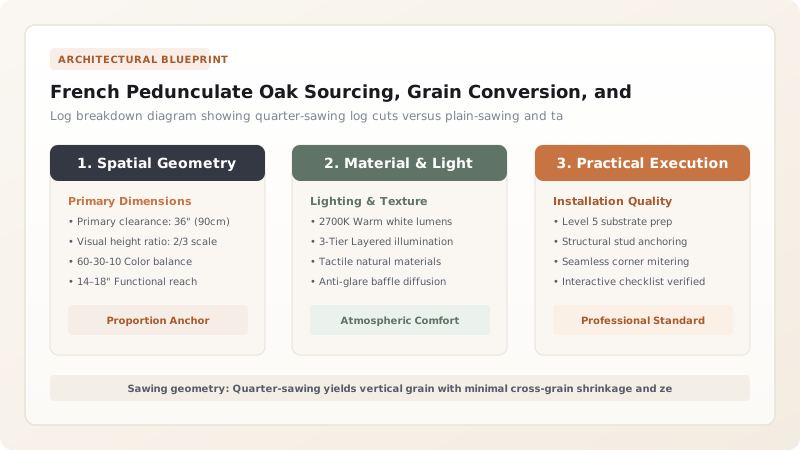
French Pedunculate Oak Sourcing, Grain Conversion, and Seasoning in Parquet Architectural Decision Matrix
Use this reference table to calculate exact physical dimensions, ratios, and specifications before purchasing:
| Sawing Method | Annual Ring Angle to Face | Tangential Shrinkage Coefficient | Cupping Risk | Suitability for Versailles Parquet |
|---|---|---|---|---|
| True Quarter-Sawn | 80°–90° (Vertical grain) | 0.15%–0.18% (Minimal) | Zero (Stays flat) | Mandatory for all lattice slats & frame |
| Rift-Sawn | 45°–75° (Diagonal grain) | 0.20%–0.22% (Low) | Very Low | Excellent for small central lozenge tiles |
| Plain / Flat-Sawn | 0°–30° (Cathedral grain) | 0.32%–0.38% (Severe) | Very High (Severe cupping) | Prohibited in traditional parquet cassettes |
| Live-Sawn (Through & Through) | Mixed tangential/radial | Variable across width | High | Acceptable only for rustic modern planks |
Practical Constraints
Every successful decoration project must account for physical and environmental constraints:
High Sawmill Yield Loss
Long Capital Tie-Up
Seasoning and Conditioning Protocol for Versailles Oak
Execute this professional sequence to achieve flawless results without backtracking:
Winter Log Felling
Fell 200-year-old French oaks between November and February when sap is dormant to minimize sugar content and beetle risk.
Quarter-Sawing Conversion
Saw logs into 32mm rough-cut quarter-sawn boards; wax log ends with paraffin to prevent end-checking.
Open-Air Seasoning Stack
Stack lumber on level concrete footings using clean dry pine stickers (separators) spaced every 400mm; cover top with open-sided rain roof.
36-Month Natural Air Drying
Allow boards to air-dry naturally for 3 years, washing out harsh free tannins and lowering moisture content to 14–16%.
Gentle Dehumidification Kilning
Transfer to low-temperature vacuum or condensation kilns; ramp temperature slowly (<45°C) to bring moisture to 9% without case-hardening.
Workshop Equalization
Store milled blanks in the assembly workshop for 30 days prior to final tongue-and-groove milling to equalize internal stresses.
Common Mistakes & Countermeasures
Avoid these costly errors that compromise aesthetics, ergonomics, and budget:
Fast industrial steam kilning (>70°C)
Mixing oak species (e.g., American red oak with French white oak)
Skipping sticker alignment in lumber stacks
Project Execution Checklist
Track your physical progress. Checkboxes persist automatically on this device:
Frequently Asked Questions
What is 'la maille' in French oak and why is it prized?
La maille refers to the medullary rays—ribbons of cellular tissue running radially from the center of the tree to the bark. When an oak log is quarter-sawn, the saw blade cuts parallel across these rays, exposing iridescent, wavy silver ribbons on the wood face that create the iconic shimmering luster of classical French parquet.
Can American white oak be used to make authentic Parquet de Versailles?
While American white oak (*Quercus alba*) has closed pores and good stability, its grain is generally coarser, ring widths are wider, and its natural color lacks the soft, warm golden-honey amber tones of aged French pedunculate oak from Tronçais.


