
The incomparable historical ambiance of Parquet de Versailles is born from traditional surface finishing. Instead of abrasive sandpaper and synthetic polyurethanes, craftsmen hand-scrape (*raboté main*) the oak with curved cabinet scrapers, stain the wood with boiled walnut husk extract (*brou de noix*), and impregnate the open pores with a molten blend of pure beeswax and carnauba wax (*encaustique*), buffed with heavy weighted iron brushes (*frottoirs*).
At a Glance: Key Takeaways
- Surface Preparation: Hand-scraping with curved steel cabinet scrapers (*Racloirs d'ébéniste*)
- Natural Stain: Brou de noix (concentrated aqueous decoction of ripe green walnut husks)
- Wax Formulation: Encaustique: Pure beeswax (70%), Carnauba palm wax (20%), gum turpentine (10%)
- Buffing Tool: Weighted cast-iron floor brush (*Frottoir de parquet*, 8–12 kg)
- Optical Quality: Translucent, tactile satin sheen with deep amber-gold grain chatoyancy
- Repairability: 100% locally spot-repairable; never requires complete floor sanding
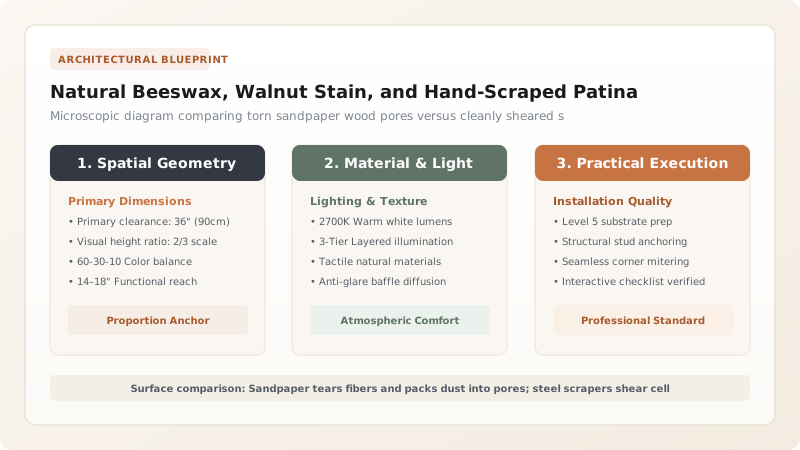
Hand-Scraping (Raboté Main) vs. Abrasive Sanding
In classical French parquetry, motorized belt sanders are considered destructive. Abrasive sandpaper tears the wood tracheids, dulls the sharp boundaries of annual rings, and clogs the cellular pores with microscopic wood dust, resulting in a flat, muddy, lifeless surface.
Master parqueteurs finish floors exclusively by hand-scraping (raboté main) using heavy steel cabinet scrapers (racloirs) fitted with a razor-sharp rolled burr:
- Cellular Shearing: The scraper blade shears cleanly through earlywood and latewood cells without tearing, leaving the hollow lumen of wood vessels wide open.
- Undulating Topography: The human hand naturally follows the soft summer growth rings, leaving subtle, microscopic surface undulations that catch raking window light and candlelight with incomparable organic vitality.
- Chatoyancy Activation: Scraped oak reflects light directly from clean crystalline cellulose cell walls, creating phenomenal optical chatoyancy (the 'cat's-eye' shimmering effect) that highlights medullary rays.
Brou de Noix and the Chemistry of L'Encaustique
To achieve the rich, warm golden-amber hue of antique palace floors, raw oak is treated with natural organic agents:
1. Brou de Noix (Walnut Husk Stain): Prepared by simmering the fleshy green outer husks of European walnuts (Juglans regia) in rainwater. It contains natural juglone tannins that penetrate deeply into oak fibers, reacting mildly with oak tannins to produce a warm, lightfast tobacco-gold tone that synthetic chemical dyes cannot mimic.
2. L'Encaustique (Beeswax Polish): Once dry, the floor is treated with molten wax:
Pure Yellow Beeswax (70%) + Carnauba Wax (20%) + Pure Gum Turpentine (10%)
Beeswax provides deep feeding and silky elasticity, while rock-hard carnauba wax (from Brazilian palm fronds) elevates the melting point and delivers high scratch resistance. Dissolved in pure distilled pine gum turpentine, the liquid wax is absorbed deep into the open oak pores. As the turpentine evaporates, the wax crystallizes inside the wood cells, sealing the floor against spills while allowing the wood to breathe.
Natural Beeswax, Walnut Stain, and Hand-Scraped Patina in French Parquet Architectural Decision Matrix
Use this reference table to calculate exact physical dimensions, ratios, and specifications before purchasing:
| Finishing Medium | Composition | Penetration Depth | Tactile Feel | Maintenance Lifecycle |
|---|---|---|---|---|
| Traditional Encaustique | Beeswax + Carnauba in turpentine | 1.5–2.5 mm into pores | Warm, silky, non-slippery | Periodic dry buffing & annual waxing |
| Hard-Wax Oil (Modern) | Linseed oil + modified vegetable waxes | 1.0–2.0 mm | Satin tactile wood grain | Spot cleaning with vegetable soap |
| Polyurethane Lacquer | Synthetic polyurethane resin | 0 mm (Sits on top) | Cold, glassy, synthetic plastic | Cannot spot repair; requires full sand |
| Linseed Oil Glaze | Boiled linseed oil + lead-free driers | 3.0–5.0 mm (Deep) | Matte / semi-gloss | Requires frequent oil re-application |
Practical Constraints
Every successful decoration project must account for physical and environmental constraints:
Frottoir Physical Exertion
Turpentine Vapor Ventilation
Executing the Traditional Encaustic Finish on Parquet
Execute this professional sequence to achieve flawless results without backtracking:
Hand Scraping
Draw cabinet scrapers along the diagonal grain of each oak slat with firm, overlapping body-weight strokes to remove milling marks.
Grain De-Dusting
Vacuum open pores thoroughly; wipe surface with a linen cloth dampened in denatured alcohol to lift residual dust.
Walnut Stain Application
Mop natural boiled brou de noix stain evenly across panels with a sheepskin fleece applicator; wipe excess with cotton rags; dry 24 hours.
Warm Wax Impregnation
Warm the encaustique beeswax blend to 40°C; apply a thin, even coat using natural bristle brushes, working wax into wood pores.
Curing Crystallization
Allow wax to harden and bond for 12 to 24 hours until surface develops a dull, matte haze.
Frottoir Iron Buffing
Buff vigorously with a 10kg cast-iron frottoir floor brush fitted with horsehair; finish with a soft wool blanket to achieve radiant satin gloss.
Common Mistakes & Countermeasures
Avoid these costly errors that compromise aesthetics, ergonomics, and budget:
Applying wax too thickly in heavy paste layers
Using water and chemical detergents to clean waxed parquet
Sanding with 220-grit orbital sanders before waxing
Project Execution Checklist
Track your physical progress. Checkboxes persist automatically on this device:
Frequently Asked Questions
What is a 'frottoir' and how was it used in French palaces?
A frottoir (from the French *frotter*, to rub) is a traditional floor-polishing tool consisting of a heavy cast-iron or lead block (weighing 8 to 15 kilograms) fitted with stiff wild-boar bristles and a long articulated wooden handle. The user pushes and pulls this weighted block across the floor; the heavy friction warms the beeswax, melting it into the oak pores and creating an incredible mirror-like shine.
How do you remove scuffs and water stains from a traditional waxed floor?
Waxed floors are remarkably easy to repair. Simply rub the stained spot with a fine steel-wool pad (#0000) dipped in a little liquid beeswax. The solvent in the wax dissolves the old dirty wax, lifts the stain, and deposits a fresh layer of clean wax. After 15 minutes, buff with a wool rag—the repair blends invisibly with zero lap marks.


