
Standing-Seam Zinc Lucarne Dormers and Bullseye Oculi represent the crowning decorative and functional metalwork of Parisian rooftops. Cladding the shallow 15°–20° upper terron deck and ornamenting the steep brisis facade, French zinc workers (couvreurs-zingueurs) employ double-lock standing seams (joint debout) and repoussé stamped ornaments. From monumental stone-pedimented lucarnes to curvilinear baroque œil-de-bœuf (bullseye) dormers, natural rolled titanium-zinc sheets are hand-formed with expansion cleats, capillary anti-siphon locks, and lead-soldered joints, weathering into a self-healing velvet gray patina.
At a Glance: Key Takeaways
- Titanium-Zinc Alloy (VMZINC): 99.995% pure zinc alloyed with micro-doses of titanium and copper for ductility and creep resistance.
- Double-Lock Standing Seam (Joint Debout): 25mm high mechanical seam folded without solder or sealant for water shedding.
- Sliding Expansion Cleats (Pattes Coulissantes): Stainless steel hidden clips accommodating massive 2.2mm/m/100°C thermal movement.
- Stamped Repoussé Oculi (Œil-de-Bœuf): Classical oval dormer frames stamped in zinc dies and adorned with floral swags and volutes.
- Tin-Lead Solder Welds (Brase-Soudure): 50/50 tin-lead solder applied with heavy copper irons for watertight box gutters and sumps.
- Self-Healing Zinc Patina: Formation of insoluble zinc hydroxycarbonate (Zn5(CO3)2(OH)6) protecting metal against urban corrosion.
1. Material Revolution: How Zinc Conquered the Rooftops of Paris
Before the 1830s, European roofs were clad in heavy lead, copper, or clay tile. The industrial revolution in the Liège valley pioneered commercial rolling of high-purity zinc sheets (Vieille Montagne). Baron Georges-Eugène Haussmann seized upon zinc during his massive 1850s renovation of Paris.
Zinc weighs only 5.5 kg/m² compared to 30 kg/m² for lead or 50 kg/m² for tile. This featherweight metal allowed architects to reduce the dimension of structural timber trusses while covering shallow 15° pitches (terron) where overlapping slate would leak. Modern architectural zinc is alloyed with 0.08% titanium and 0.12% copper, virtually eliminating thermal creep and metal fatigue.
2. Joint Debout Engineering: Double Standing Seam Technology
Zinc sheets cannot be nailed directly to roof boards; with a high thermal expansion coefficient of 0.022 mm/m/°C, a 10-meter zinc tray expands over 15mm between winter frosts (-10°C) and summer heatwaves (60°C roof deck). Rigid fasteners would buckle and crack the metal.
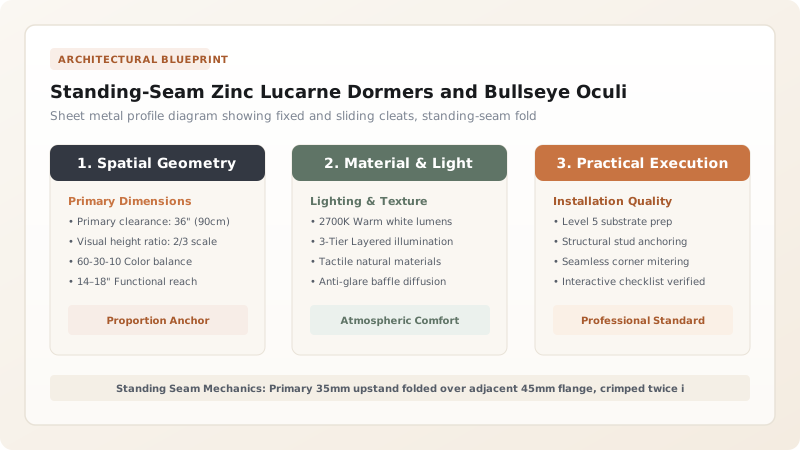
Zingueurs utilize the joint debout (double-lock standing seam). Sheets are profiled with 35mm and 45mm vertical upstands. The seam is anchored to the continuous pine roof boards (volige) using two-piece stainless steel sliding cleats (pattes coulissantes). The upper 10mm of the higher upstand is hand-folded or machine-crimped over the shorter flange, then folded a second time down to a finished 25mm height. The sliding cleat allows the sheet to expand and contract freely like a piston while forming a totally watertight mechanical capillary barrier.
3. Ornate Dormer Anatomy: Lucarnes and Bullseye Oculi
Mansard roofs derive their dramatic architectural rhythm from dormers. Standard dormers (lucarnes) feature triangular classical pediments, slate-clad vertical cheeks (jouées), and zinc hoods that drain onto lead stepped aprons.
For attic service rooms, stairwells, and corner pavilions, French sheet metal fabricators stamp ornate bullseye dormers (œil-de-bœuf). Built over a curved timber armillary frame, the circular or oval opening is clad in cold-rolled zinc pressed into cast-iron dies, reproducing baroque floral rosettes, acanthus scrolls, and fluted keystones. The lower sill incorporates an integrated zinc condensation trough that drains interior weep water safely to the building exterior.
Architectural Zinc Roofing Sheet Gauge & Component Selection
Use this reference table to calculate exact physical dimensions, ratios, and specifications before purchasing:
| Application | Zinc Sheet Gauge (mm) | Seaming / Joining Technique | Substrate Requirement | Thermal Expansion Provision |
|---|---|---|---|---|
| Upper Deck (Terron) | 0.70mm or 0.80mm | Double-lock standing seam (25mm) | Pine volige boards (80–120mm wide) | Sliding cleats placed every 330mm |
| Lucarne Dormer Cheeks | 0.65mm or 0.70mm | Single-lock seam or flat lock tiles | Rough-sawn pine sarking boards | Fixed cleats along top edge only |
| Œil-de-Bœuf Repoussé Frame | 0.80mm malleable soft zinc | Lead-tin soldered overlap seams | Curved multi-layer timber ribs | Oversized slotted screw brackets |
| Chéneau Box Gutter Lining | 0.80mm or 1.00mm | Continuous soldered laps (50/50) | Oak / pine gutter trough boxing | Vulcanized EPDM expansion compensators |
| Ridge Cap & Flashings | 0.70mm pre-patinated zinc | Hooked standing cleats & hem locks | Continuous ridge board (faîtage) | 50mm overlapping expansion sleeves |
Artisanal & Environmental Constraints
Every successful decoration project must account for physical and environmental constraints:
Extreme Cold Brittleness
Pure zinc becomes brittle below 7°C; bending or seaming sheets in winter without warming with a hot-air gun causes micro-tears along folds.
Specialized Soldering Chemistry
Soldering zinc requires muriatic acid neutralized with zinc scrap (killed spirits flux) and 500g heavy copper soldering irons.
Master Zingueur Protocol for Installing Standing-Seam Zinc Roofing
Execute this professional sequence to achieve flawless results without backtracking:
Volige Pine Deck Laying
Nail untreated rough-sawn pine boards (100x18mm) across rafters with 5mm expansion gaps between boards; ensure nails are punched flush.
Zingueur Chalk Layout
Snap perpendicular chalk lines on the pine deck to establish seam spacing (standard 500mm or 580mm coil tray widths).
Zinc Sheet Profiling & Cleating
Form 35mm and 45mm standing upstands on zinc trays; nail stainless sliding cleats along the seam line at 330mm intervals.
Double-Lock Mechanical Seaming
Nest adjacent tray upstands; use primary seaming pliers (pince à border) to fold the 1st lock; crimp the 2nd lock to 25mm finished height.
Lucarne Dormer Flashing Integration
Fold continuous zinc apron beneath dormer sill; solder cheek upstands with zinc-air flux and 50/50 tin-lead solder iron.
Curb Transition Drip Apron
At the ligne de brisis curb, solder a heavy continuous zinc drip apron that extends 150mm over the uppermost slate course.
Common Mistakes & Countermeasures
Avoid these costly errors that compromise aesthetics, ergonomics, and budget:
Laying zinc directly over acidic timber decking such as oak, chestnut, or Western red cedar
Using silicone sealant or mastic adhesives to seal standing seams or gutter joints
Project Execution Checklist
Track your physical progress. Checkboxes persist automatically on this device:
Frequently Asked Questions
How does the zinc patina protect Paris rooftops from pollution and acid rain?
When fresh titanium-zinc is exposed to the atmosphere, it reacts with oxygen to form zinc oxide (ZnO), then with water to form zinc hydroxide (Zn(OH)2), and finally with carbon dioxide to form insoluble zinc hydroxycarbonate (Zn5(CO3)2(OH)6). This micro-crystalline layer is self-healing: if scratched, atmospheric moisture and CO2 regenerate the gray protective seal automatically.
What is the function of the sliding cleat (patte coulissante) in zinc roofing?
A sliding cleat consists of a fixed base nailed to the wood deck and a sliding hook tab that locks into the zinc standing seam. As the zinc sheet heats up in summer and expands along its length, the tab glides smoothly inside the base slot, preventing the metal from buckling, wrinkling, or fatiguing the seam.


