
Réchampi Painted Distemper and Water Gilding Accents represents the refined decorative finish that gives 18th-century French boiserie its luminous, ethereal elegance. Rejecting heavy modern oil paints that clog fine woodcarving, artisans applied soft, breathable chalk distemper paints (peinture à la colle de peau) in a two-tone réchampis scheme—picking out raised moldings in crisp white or contrasting tones against muted pearl-gray or celadon field panels. Focal rocaille carvings and mold contours were enriched with traditional water gilding (dorure à l'eau): 23.75k gold leaf laid over red Armenian bole clay and burnished with agate stones to liquid golden brilliance.
At a Glance: Key Takeaways
- Réchampis Two-Tone Scheme: Picking out carved moldings and frames in contrasting colors against field panels.
- Rabbit-Skin Glue Distemper: Non-toxic chalk and animal protein paint providing an ultra-matte, velvety historical finish.
- Blanc de Meudon Gesso Primer: Multi-layer chalk primer smoothed with horsetail reeds to create a porcelain-smooth surface.
- Armenian Red Bole (Assiette): Iron-rich fatty volcanic clay providing a smooth, flexible cushion for gold leaf burnishing.
- Water Gilding on Bole (Dorure à l'Eau): Wicking loose gold leaf onto a wet alcohol-water size without oil or varnish.
- Agate Dog-Tooth Burnishing: Compressing gold crystals against the clay bole with polished agate stones to a mirror shine.
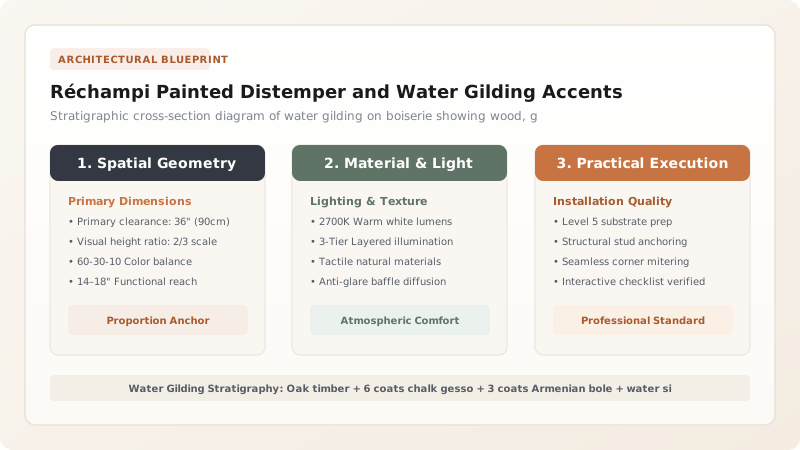
1. Color Aesthetics: The Subtle Harmony of Le Réchampis
The French verb réchampir means to pick out or highlight one element against another with contrasting color. In 18th-century boiserie, solid monotone painting was considered unrefined; the interaction of light and shadow demanded subtle chromatic dialogue.
The classic Parisian formula featured soft pearl-gray (gris perle), pale almond green, or warm dove-gray on the flat field panels, while the surrounding carved moldings, egg-and-dart borders, and acanthus corners were picked out in crisp chalk-white (blanc cassé) or genuine gold leaf. This subtle contrast accentuated the architectural proportion of the room while maintaining a tranquil, sophisticated atmosphere.
2. Paint Chemistry: Traditional Peinture à la Colle de Peau
Modern acrylic and oil-based enamels form a thick plastic skin that fills the delicate undercuts of hand-carved oak, blurring fine detail and suffocating the wood. Historic boiserie was painted with distemper (peinture à la colle).
Artisans dissolve purified rabbit-skin glue (colle de peau de lapin) in warm water as the binder, blending it with Blanc de Meudon (natural precipitated calcium carbonate / Champagne chalk) and finely ground mineral earth pigments (raw umber, French ochre, vine black). Distemper breathes freely with the wood, dries to an incomparably soft, light-scattering velvety matte texture, and can be completely washed off with warm water during future museum restorations without damaging the underlying oak.
3. The Sacred Craft: Dorure à l'Eau and Agate Burnishing
For high-prestige salons, carved accents were not painted; they were transformed into solid gold through water gilding (dorure à l'eau). The process is one of the most demanding disciplines in all the decorative arts:
- Apprêt (Gesso Grounds): Six to eight coats of warm chalk and rabbit-skin glue are brushed over the carved oak, then carved and smoothed (reparure) with specialized iron rifflers to sharpen obscured details.
- Assiette (Armenian Bole): Three coats of ultra-fine, greasy red clay (assiette) mixed with glue water are applied. The red clay provides a flexible, compressible cushion and imparts a warm, blushing undertone to the gold.
- Pose de l'Or (Laying the Leaf): The gilder wets the bole with water containing a splash of alcohol; a sheet of 23.75k gold leaf picked up on a squirrel-hair gilder's tip is brought near the wet surface, where surface tension snatches the gold flat against the clay.
- Brunissage (Burnishing): When the clay reaches the precise 'leather' stage of dryness, the gilder rubs the gold with a polished agate stone burnisher (pierre d'agate) with heavy, steady pressure, compressing the gold atoms into a mirror-like sheet of liquid metal.
Boiserie Finishing System Specifications
Use this reference table to calculate exact physical dimensions, ratios, and specifications before purchasing:
| Finishing Technique | Binder / Medium | Pigment / Metal Material | Surface Luster | Restoration Reversibility |
|---|---|---|---|---|
| Field Distemper Paint | Rabbit-skin glue (5% solution) | Champagne chalk + earth pigments | Dead matte velvety eggshell | 100% Water-reversible |
| Gesso Foundation (Apprêt) | Rabbit-skin glue (7% solution) | Blanc de Meudon (Calcium carbonate) | Hard, chalk-white foundation | Reversible with warm water |
| Bole Ground (Assiette) | Rabbit-skin glue size | Red Armenian volcanic clay | Silky compressible cushion | Softens with moisture |
| Burnished Water Gilding | Water + 10% grain alcohol size | 23.75k Double Ducat Gold Leaf | Mirror-bright metallic glass | Permanent mineral gilding |
| Matte Water Gilding | Very weak rabbit-skin glue wash | 23.75k Gold Leaf left unburnished | Soft, satin, glowing gold | Contrasts burnished highlights |
Environmental & Humidity Constraints
Every successful decoration project must account for physical and environmental constraints:
Relative Humidity Sensitivity
Water gilding cannot be executed in rooms with RH > 70% (bole never reaches burnishing hardness) or RH < 30% (bole dries too fast and flakes).
Gold Leaf Air Turbulence
23.75k gold leaf is so extraordinarily thin (0.1 micron) that an open door or drafty breath will crumple a sheet into unusable dust.
Protocol for Applying Réchampis Distemper and Water Gilding
Execute this professional sequence to achieve flawless results without backtracking:
Oak Degreasing & Sizing
Clean oak carvings with alcohol; apply warm 5% rabbit-skin glue size to seal wood pores and establish adhesive tooth.
Gesso Apprêt Layering (6 Coats)
Brush 6 successive coats of warm chalk-glue gesso over carved moldings; allow each coat to dry; rub smooth with damp linen cloth.
Reparure Iron Recarving
Re-cut and sharpen gesso-filled leaf veins and grooves using specialized iron hook-scrapers (fers à réparer) to restore sculptural crispness.
Armenian Red Bole Application
Brush three thin coats of warm red bole over the areas to be gilded; allow 24 hours drying; polish dry bole with a horsehair cloth.
Water Gilding with 23.75k Gold Leaf
Wet bole with water-alcohol size; transfer gold leaf using gilder's tip brush; watch gold suck flat; allow 2 hours drying to leather state.
Agate Burnishing & Field Painting
Burnish gold highlights to mirror shine with agate dog-tooth stone; paint field panels in matte pearl-gray distemper using hog-bristle brushes.
Common Mistakes & Countermeasures
Avoid these costly errors that compromise aesthetics, ergonomics, and budget:
Using modern gold-colored metallic bronze powder paint instead of genuine gold leaf
Burnishing gold leaf before the underlying clay bole has reached the proper dryness
Project Execution Checklist
Track your physical progress. Checkboxes persist automatically on this device:
Frequently Asked Questions
Why is red clay bole used under gold leaf instead of yellow or white?
Red Armenian bole (rich in hematite iron oxide) serves two crucial functions: optically, because gold leaf is so thin that it is semi-translucent, the warm red ground glows through the microscopic pores of the gold, imparting a warm, fiery, luxurious cast that makes yellow gold look richer; mechanically, the red volcanic clay is extraordinarily fine and fatty, compressing smoothly beneath the agate stone without scratching.
How do you clean and maintain historic water-gilded boiserie?
Water-gilded gold must NEVER be touched with water, damp sponges, or chemical cleaning sprays; moisture instantly dissolves the water-soluble rabbit-skin glue beneath, wiping the gold leaf right off the wood. Dust exclusively with an ultra-soft Siberian squirrel-hair mop brush or a dry ostrich feather duster with feather-light sweeps.


