
Traditional French Boiserie Carved Oak Wall Paneling represents the zenith of European architectural interior joinery (menuiserie d'art). Flourishing in 18th-century Parisian hôtels particuliers and royal châteaux under Louis XIV, Louis XV, and Louis XVI, authentic boiserie envelops entire salons in floor-to-ceiling carved French oak (chêne de France). Master sculptors (sculpteurs sur bois) carved asymmetrical rocaille C-scrolls, acanthus foliage, and trophies directly into solid oak stiles and rails. Engineered with floating field panels to accommodate seasonal wood movement, boiserie panels are acoustically isolated from damp stone walls on softwood battens, finished in muted réchampis distemper paint, and accented with water-gilded 24k gold leaf.
At a Glance: Key Takeaways
- French Sessile Oak (Chêne de France): Quarter-sawn slow-grown oak seasoned for 5 years to eliminate warp and shrinkage.
- Louis XV Rocaille Carving: Fluid, asymmetrical C-scrolls, counter-curves, and naturalistic flora hand-carved with gouges.
- Floating Field Panels (Panneaux à Plate-Bande): Chamfered inner panels floating inside grooved stiles with expansion play.
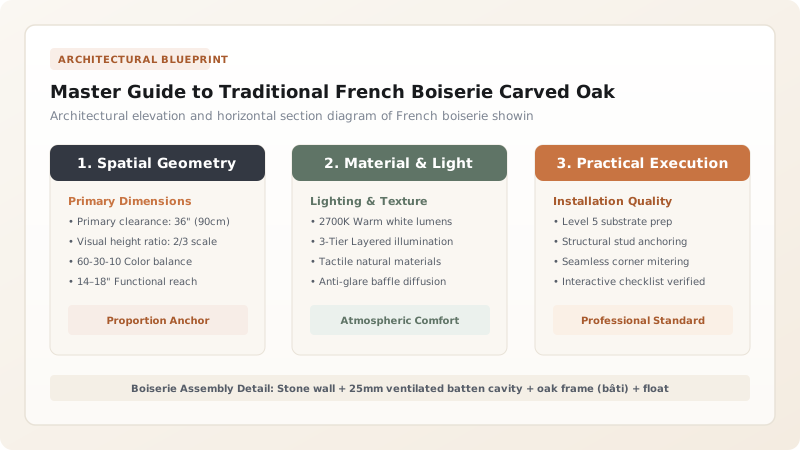
- Cavity Anti-Damp Battens (Tasseaux): Softwood framing separating oak paneling 25mm from masonry walls to prevent rot.
- Réchampis Distemper Painting: Muted two-tone chalk paints highlighting carved moldings against soft pearl-gray grounds.
- Water Gilding on Bole (Dorure à l'Eau): Burnishing 23.75k gold leaf over rabbit-skin glue and Armenian bole clay.
In-Depth Guides in this Directory
Explore specialized subtopic blueprints, technical dimensions, and execution checklists:
Rocaille C-Scroll and Acanthus Leaf Hand Carving
Sculptural carving manual for French Rococo boiserie: sweeping C-scrolls, asymmetrical rocaille crests, acanthus leaf undercutting, and Swiss gouge profiling.
Tongue-and-Groove Floating Framing and Réhauts Damp-Proofing
Technical joinery manual for French boiserie installation: floating field panel mechanics (plate-bande), draw-bored mortise joinery, cavity battens (tasseautage), and rear damp insulation.
Réchampi Painted Distemper and Water Gilding Accents
Finishing guide for French royal boiserie: two-tone réchampis distemper formulations, chalk-glue gesso preparation, Armenian bole application, and agate burnishing.
1. Cultural Context: The Enlightenment Salon and Domestic Comfort
During the 17th century, royal French interiors at Versailles were dominated by monumental marble revetments, gilded bronze, and heavy stucco. While grandiose, these cold, echoing chambers were drafty and inhospitable during winter.
In the 1720s under Louis XV, the aristocracy migrated to Paris, building elegant private mansions (hôtels particuliers) in the Faubourg Saint-Germain. Architects such as Germain Boffrand and Nicolas Pineau revolutionized interior space by introducing boiserie (from the French bois, meaning wood). Carved wood brought acoustic warmth, thermal insulation, intimate proportions, and human-scale sensory comfort, creating the legendary Parisian salon where Enlightenment philosophers gathered.
3. Decorative Finishes: Réchampis Distemper and Dorure à l'Eau
While provincial boiserie was occasionally left as waxed natural oak, high-style Parisian salons were finished in sophisticated polychrome schemes. The most celebrated technique is réchampis:
The flat background field panels were painted in matte distemper paints (chalk and rabbit-skin glue) tinted in muted historical shades: blanc cassé (soft off-white), gris perle (pearl gray), or pale celadon green. The raised carved moldings, rocaille scrolls, and floral wreaths were painted in contrasting tones or adorned with water gilding (dorure à l'eau). Burnished with agate dog-tooth stones, the gold leaf gleams with deep mirror brilliance under candlelight while remaining soft in shadow.
French Boiserie Stylistic & Structural Classification
Use this reference table to calculate exact physical dimensions, ratios, and specifications before purchasing:
| Architectural Style | Historical Era | Dominant Carving Motifs | Joinery Profile | Typical Surface Finish |
|---|---|---|---|---|
| Louis XIV (Baroque) | 1660 - 1715 | Strict symmetry, sunbursts, lion masks, heavy acanthus | Massive heavy moldings; proud panels | Gilded oak, faux marble, rich vermilion |
| Régence / Louis XV (Rococo) | 1715 - 1765 | Asymmetrical rocaille, C-scrolls, floral swags, shells | Curvilinear molded rails; serpentine tops | Two-tone réchampis + water gilding |
| Louis XVI (Neoclassical) | 1765 - 1792 | Strict geometry, ribbon bows, fluting, laurel wreaths | Rectangular frames; classical pilasters | Monochrome white/gray chalk distemper |
| Directoire / Empire | 1795 - 1815 | Sphinxes, swans, anthemion palmettes, military fasces | Flat planar mahogany and painted oak | Dark mahogany with polished gilt bronze mounts |
Material & Artisan Constraints
Every successful decoration project must account for physical and environmental constraints:
Tremendous Hand-Carving Duration
A complete Louis XV salon requiring 12 carved bays takes over 1,500 hours of master woodcarving.
Indoor Central Heating Damage
Modern dry forced-air heating (RH < 30%) desiccates historic 18th-century oak panels; climate control must maintain 45%–55% RH.
Protocol for Engineering, Carving, and Installing Boiserie
Execute this professional sequence to achieve flawless results without backtracking:
Substrate Battening (Tasseautage)
Fix 25x50mm treated fir battens vertically to the masonry wall using non-ferrous anchors; shim dead plumb; ensure 25mm continuous air cavity.
Quarter-Sawn Oak Frame Milling
Mill French oak stiles and rails to 30mm thickness; cut 10mm wide x 12mm deep grooves along inner edges; cut mortise-and-tenon joints.
Rocaille Hand Carving
Transfer ornamental rococo cartoon onto assembled oak stiles; carve C-scrolls, acanthus foliage, and moldings using Swiss carving gouges.
Plate-Bande Field Panel Insertion
Bevel the edges of the central oak panel to 9mm thickness; slide into frame grooves dry without glue; pin mortises with seasoned oak pegs.
Wall Mounting on Battens
Hang boiserie panels onto the wall battens using concealed wooden French cleats or brass screws hidden beneath removable carved trim beads.
Réchampis Painting & Gilding
Apply chalk-glue gesso primer; paint background in matte pearl-gray distemper; water-gild raised carved motifs with 23.75k gold leaf.
Common Mistakes & Countermeasures
Avoid these costly errors that compromise aesthetics, ergonomics, and budget:
Gluing the central field panel firmly into the groove of the outer oak frame
Mounting boiserie panels directly flush against damp masonry walls without a cavity
Project Execution Checklist
Track your physical progress. Checkboxes persist automatically on this device:
Frequently Asked Questions
Why is French oak (Quercus robur/petraea) the absolute standard for boiserie?
French oak harvested from managed royal forests (such as Tronçais) grows extraordinarily slowly in dense canopies. This produces ultra-tight annual rings, uniform grain density, and fine medullary rays (maille). It cuts cleanly under razor-sharp carving gouges without splintering, unlike coarse American red oak which has open pores and brittle cross-grain.
What is the difference between oil gilding and traditional water gilding on boiserie?
Oil gilding (dorure à la mixtion) uses an oil varnish adhesive; it is fast and weather-resistant, but yields a flat, dull, unburnishable gold finish. Water gilding (dorure à l'eau) is applied over multiple layers of rabbit-skin gesso and red clay bole. Once dry, the gold is rubbed with a polished agate stone, burnishing the gold crystals into a brilliant, mirror-like molten metallic luster impossible with oil gilding.


