
Hot-sand shading (ombrage) and chemically dyed sycamore (harewood) provide the color palette and three-dimensional realism of historical Dutch marquetry. By dipping veneer petals into 180°C heated silica sand, wood cellulose caramelizes into realistic shadow gradients. Sycamore veneers are chemically dyed using iron vitriol (ferrous sulfate) and plant extracts to produce rich greens and silvery grays.
At a Glance: Key Takeaways
- Hot-Sand Scorching (Ombrage): Controlled dipping of veneer pieces into 180°C silica sand to create delicate, un-burnt shadow gradients.
- Cellulose Caramelization: Thermal breakdown of natural wood sugars producing permanent, non-fading golden-to-umber transitions.
- English Harewood Reaction: Sycamore treated with ferrous sulfate (green vitriol) reacting with tannins to create iridescent slate-gray.
- Vegetable & Mineral Dye Baths: Logwood (purple), madder root (crimson), and Persian berries (yellow) boiled under vacuum immersion.
- Tweezer Immersion Control: Dipping pieces at an acute angle to create feathered shadow edges that mimic natural petal curling.
- Zero Paint Pigment Layer: All color and shading exists entirely inside the cellular wood structure, allowing flawless scraping and polishing.
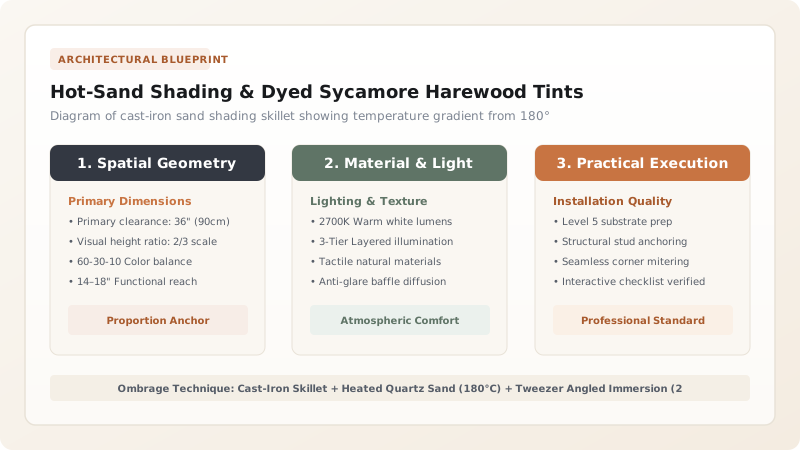
1. The Art of Ombrage: Thermal Scorching Physics
In painting, artists use glazes of umber to depict shadows. In marquetry, adding paint destroys the natural grain and light refraction of wood. The master solution is ombrage—burning shadows directly into the wood cells with hot sand.
A heavy cast-iron skillet is filled with washed, fine-grained quartz or volcanic sand and placed on a hotplate stabilized at \(175^\circ\text{C to }185^\circ\text{C}\). Using fine watchmaker tweezers, the artisan immerses the edge of a cut veneer petal into the hot sand:
- The sand conducts heat uniformly across the edge without combustion, caramelizing hemicellulose and lignin into dark melanoidin compounds.
- By inserting the piece deeper or rocking it on an angle, the artisan creates a feathered shadow gradient that transforms a flat piece of boxwood into a cupped, three-dimensional rose petal.
2. Chemical Transformation: The Creation of English Harewood
Natural wood produces few cool tones like silver and blue-gray. In the 17th and 18th centuries, cabinetmakers synthesized Harewood (dyed sycamore maple).
Quarter-sawn English sycamore (Acer pseudoplatanus) is selected for its high chatoyance and white color. The veneer leaves are submerged in an aqueous solution of ferrous sulfate (green vitriol, \(\text{FeSO}_4\)):
The chemical reaction turns the sycamore into an ethereal silvery-gray wood with holographic fiddleback ripples, universally used for acanthus foliage and architectural ribbons.
3. Natural Botanical Dyes for Exotic Flowers
To replicate the brilliant crimson tulips, golden lilies, and blue morning glories of Dutch botanical still lifes, artisans dyed pale woods (holly, spindle-tree, and pear):
- Madder Root & Brazilwood: Produces translucent ruby reds and coral pinks for carnations and roses.
- Woad & Indigo: Imparts celestial blue tones for forget-me-nots and ribbons.
- Verdigris (Copper Acetate): Produces vibrant emerald-green shades for botanical stems and leaves.
Shading Temperatures & Dye Formulations
Use this reference table to calculate exact physical dimensions, ratios, and specifications before purchasing:
| Process / Material | Chemical / Thermal Specification | Immersion Time / Protocol | Visual & Aesthetic Outcome |
|---|---|---|---|
| Hot-Sand Shading (Ombrage) | Heated silica sand at 175°C–185°C | 2 to 5 seconds with tweezers | Soft golden-brown to deep umber shadow gradient |
| English Harewood | 3% Ferrous sulfate (FeSO4) in water | Soak for 24 hours under vacuum | Iridescent silvery-slate gray with ripple figure |
| Verdigris Green Dye | Copper acetate in acetic acid (vinegar) | Submerged 48 hours; rinse cold | Vibrant botanical emerald green for leaf veins |
| Madder Crimson Dye | Extract of Rubia tinctorum + alum mordant | Boil at 80°C for 2 hours | Warm ruby rose pink for tulip flutes |
| Logwood Purple Dye | Haematoxylum campechianum extract | Soak 12 hours with tin mordant | Deep plum and violet for exotic iris flowers |
Thermal & Chemical Constraints
Every successful decoration project must account for physical and environmental constraints:
Sand Temperature Control
Sand below 160°C takes too long to scorch, drying the wood into brittle curling; sand above 200°C instantly burns edges to black ash. Use an infrared thermometer to verify skillet heat.
Chemical Bleed Through
Incompletely rinsed dyed veneers will bleed color into adjacent white woods when flooded with hot wet hide glue; dyed veneers must be neutralized and dried completely before packet assembly.
UV Lightfastness
Natural plant dyes fade under direct window sunlight over centuries; keep finished antiques protected from direct solar UV radiation.
Hot-Sand Shading & Chemical Dyeing Sequence
Execute this professional sequence to achieve flawless results without backtracking:
Sand Skillet Heating
Heat a heavy cast-iron skillet filled with 40mm depth of fine silica sand on an electric burner until sand stabilizes at 180°C.
Test Scorching
Dip scrap boxwood veneer pieces into sand to calibrate scorch time: 2 seconds for pale amber, 4 seconds for deep umber shadow.
Angled Petal Scorching
Grip cut veneer flower petals with watchmaker tweezers, dipping the curved base into sand at a 45-degree angle to produce feathered shadows.
Sycamore Chemical Dyeing
Submerge white sycamore veneer leaves in warm 3% ferrous sulfate solution, watching the wood transform into silver harewood.
Cold Water Rinsing & Neutralizing
Rinse dyed veneers in clean running water, neutralizing with dilute baking soda wash to halt acid crystallization.
Press Drying Between Blotters
Dry scorched and dyed veneer leaves flat between heavy cotton blotting paper under cast-iron press weights for 48 hours.
Common Mistakes & Countermeasures
Avoid these costly errors that compromise aesthetics, ergonomics, and budget:
Using coarse building sand with pebbles for ombrage shading
Attempting to paint shadow gradients with watercolor or airbrush instead of hot sand
Dipping damp or wet veneer pieces into 180°C hot sand
Project Execution Checklist
Track your physical progress. Checkboxes persist automatically on this device:
Frequently Asked Questions
Does hot-sand shading weaken the wood?
No. The scorching is microscopic, affecting only the surface 0.2mm to 0.4mm of cellulose. When assembled and bonded with hot hide glue under press pressure, scorched veneers retain full mechanical stability.
Can modern aniline dyes replace traditional vegetable dyes for harewood?
Yes. Modern metal-complex acid dyes (such as alcohol-soluble aniline dyes) offer superior UV lightfastness compared to historic 17th-century plant extracts and can match authentic harewood grays and greens with high precision.
Why is boxwood considered the best timber for hot-sand shading?
European boxwood (Buxus sempervirens) has an ultra-dense, homogeneous end-grain with virtually invisible annual rings. When scorched in sand, it develops a perfectly smooth, velvet-like shadow gradient without the patchy grain banding seen in coarser woods.


