
Balinese Candi Bentar Split Gates and Living Moss Patinas represent the architectural threshold between the mortal and the divine in Hindu-Balinese culture. Modeled as a soaring temple tower cleanly severed down its centerline, the Candi Bentar frames the sacred courtyard entry without an overhead lintel. Carved from porous volcanic paras stone, the gateway actively absorbs tropical humidity, fostering a living micro-ecosystem of velvet bryophyte mosses and lichens that softens geometric arrises and petrifies the temple into the natural jungle landscape.
At a Glance: Key Takeaways
- The Cosmic Split Mountain: Representing Mount Meru cleaved in two halves by Lord Shiva to let humans enter sacred space.
- Lintel-Free Vertical Gateway: Open vertical passage permitting soaring ancestral towers (bade) and cremation floats to pass.
- Stepped Multi-Tiered Crown (Sirah): Ascending stepped terraces echoing the cosmological layers of the heavens (Swah Loka).
- Biological Moss Colonization: 25% stone porosity providing permanent moisture reservoir for native velvet bryophytes.
- Thermal Evaporative Micro-Cooling: Wet stone surfaces continuously evaporating moisture to cool temple courtyard breezes.
- Non-Destructive Symbiosis: Living moss rhizoids forming a protective biological mantle that buffers stone from acid rain.
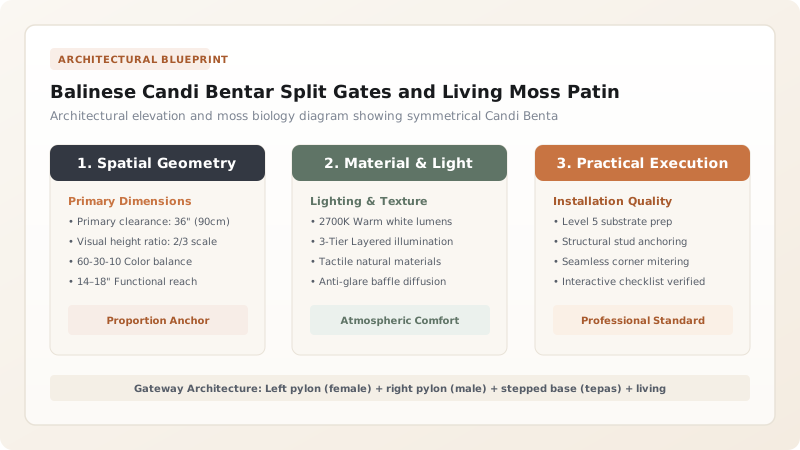
1. Theology of the Split Mountain: Candi Bentar vs. Kori Agung
In Balinese temple zoning (mandala), an outer courtyard (jaba) is separated from the middle courtyard (jaba tengah) by the Candi Bentar (split gate). Unlike Western gates that feature an overarching arch or lintel, the Candi Bentar is completely open to the sky.
This design is rooted in the Mahabharata myth of Mount Meru: when the gods shifted the sacred mountain to Bali, it cracked into two peaks—Mount Agung and Mount Batur. The two perfectly symmetrical tower halves of the gate symbolize this primordial mountain split asunder, welcoming mortals into the divine sanctuary. The inner sanctum (jeroan) is accessed via a second, roofed portal called the Kori Agung, reserved strictly for priests and gods.
2. Structural Stereotomy: Slicing the Symmetrical Towers
Constructing a Candi Bentar requires absolute stereotomic mastery. The two monumental towers—rising anywhere from 4 meters to 12 meters in height—must be perfectly identical mirror reflections of one another.
Masons construct the core from red terracotta brick or volcanic andesite rubble bedded in lime mortar, then clad the exterior in 150mm thick carved batu paras panels. The inside vertical faces of the passage are completely flat and plumb, as if sliced with a giant razor blade, contrasting dramatically with the stepped, foliate-encrusted, multi-tier profile of the outer faces.
3. The Living Moss Patina: Ecology and Conservation
In Western conservation, biological moss growth on stone is often aggressively eliminated with toxic biocides. In Bali, living moss (lumut) is revered as the ultimate architectural crowning glory.
Because batu paras has an open pore volume of 25%, it absorbs tropical monsoon deluges and retains water for weeks. Native bryophyte mosses (such as Fissidens and Hyophila) colonize the carved hollows. Rather than destroying the stone, their micro-rhizoids bind loose surface grains, shield the volcanic glass from acidic rain erosion, and transpire moisture during hot afternoons, keeping temple courtyard breezes cool and refreshing.
Balinese Temple Gateway Architectural Hierarchy
Use this reference table to calculate exact physical dimensions, ratios, and specifications before purchasing:
| Gateway Typology | Balinese Name | Roof Configuration | Temple Mandala Boundary | Symbolic / Ritual Function |
|---|---|---|---|---|
| Split Gate | Candi Bentar | Open to the sky (No lintel) | Outer courtyard (Jaba) entrance | Cosmic threshold; allows tall procession towers |
| Roofed Paduraksa Gate | Kori Agung | Stepped roof tower crowned with Bhoma | Inner holy sanctum (Jeroan) portal | Reserved for deity effigies & high priests (Pedanda) |
| Compound Entry Gate | Angkul-Angkul | Thatched or tiled roofed gate | Residential family compound entry | Guards domestic living space; incorporates aling-aling screen |
| Monumental Water Gate | Candi Tebing | Carved directly into living cliff face | Sacred river canyon royal hermitage | Ancient 11th-century royal funerary shrines (Gunung Kawi) |
Structural & Environmental Constraints
Every successful decoration project must account for physical and environmental constraints:
Severe Tropical Seismic Hazard
Tall, slender unreinforced stone pylons can topple during earthquakes; modern gates incorporate concealed reinforced concrete columns within the brick core.
Algal Black Crust Staining
In areas polluted by vehicle exhaust, urban soot combines with cyanobacteria to form black crusts that require gentle steam cleaning.
Protocol for Constructing and Moss-Cultivating a Candi Bentar Gate
Execute this professional sequence to achieve flawless results without backtracking:
Subgrade Trenching & Reinforced Footing
Excavate 1.2m foundation trench; pour volcanic basalt rubble and hydraulic lime footing; verify identical level across both towers.
Inner Core Brickwork Erection
Lay structural core using high-fired red terracotta bricks bedded in natural lime mortar; maintain dead-plumb inner passage faces.
Paras Stone Veneer Panel Anchoring
Anchor pre-soaked 150mm paras stone blocks to brick core using copper tie anchors and hydraulic lime-volcanic ash mortar.
Mirror-Image In-Situ Relief Carving
Carve symmetrical stepped terraces, Karang Sae brackets, and patra leaf scrolls on outer faces using water-lubricated chisels.
Aling-Aling Baffle Wall Placement
Erect freestanding masonry baffle screen wall (aling-aling) directly behind the gate passage to deflect malicious straight-line spirits.
Biological Moss Inoculation Spray
Blend native moss slurry with fresh coconut water and rice flour; brush across shaded carved stone hollows; mist daily during rainy season.
Common Mistakes & Countermeasures
Avoid these costly errors that compromise aesthetics, ergonomics, and budget:
Pressure-washing historic moss-covered paras stone gates with power washers
Connecting the two halves of a Candi Bentar with an overhead beam or arch
Project Execution Checklist
Track your physical progress. Checkboxes persist automatically on this device:
Frequently Asked Questions
What is the purpose of the aling-aling wall built directly behind a Candi Bentar?
In Balinese spiritual belief, malevolent spirits and demonic entities can only travel in straight lines. The aling-aling is a freestanding stone screen wall erected a few feet directly behind the open gate; arriving demons hit this wall and are deflected away, unable to enter the sacred temple grounds.
Does moss growth damage the underlying volcanic stone over time?
Unlike woody plants or invasive tree roots, true bryophyte mosses have non-vascular micro-rhizoids that do not penetrate deeply into stone. Studies in tropical heritage conservation confirm that a healthy moss layer actually protects soft volcanic tuff by buffering it from rain impact and dramatic solar temperature swings.


