
Moorish Albarrada Whitewashed Lime Courtyard Architecture represents the bioclimatic zenith of Hispanic-Islamic vernacular design in Andalusia and North Africa. Developed during the Al-Andalus era across Córdoba, Seville, and Granada, albarrada architecture solved the challenge of scorching Mediterranean summers without mechanical energy. By enclosing private courtyard houses (patios) with thick rammed-earth and brick walls coated in pure calcium whitewash (cal apagada) that reflects 90% of solar radiation, and integrating unglazed porous earthenware cooling jars (albarradas), water rills, and citrus trees, builders created cool, private microclimatic oasis sanctuaries.
At a Glance: Key Takeaways
- Porous Earthenware Water Jars (Albarradas): Unglazed terracotta vessels sweating moisture to provide natural evaporative cooling.
- High-Albedo Pure Lime Whitewash: Pure slaked calcium lime reflecting 90%+ of solar heat rays away from thick courtyard walls.
- Deep Shaded Courtyard Geometry: High-walled patio proportions trapping heavy, cool night air through noon.
- Gravity-Fed Rills & Fountains: Central marble water basins (albercas) inducing continuous convective air currents.
- Citrus & Jasmine Transpiration: Orange trees and night-blooming jasmine providing evaporative cooling and aromatic scent.
- Bioclimatic Thermal Flywheel: Thick masonry walls dampening 40°C exterior heat down to a serene 24°C courtyard interior.
In-Depth Guides in this Directory
Explore specialized subtopic blueprints, technical dimensions, and execution checklists:
Albarrada Clay Cooling Jars and Gravity Irrigation Wells
Hydraulic engineering manual for Moorish courtyards: porous earthenware albarrada ceramic physics, wellhead norias, gravity clay rills, and evaporative chilling.
Pure Calcium Whitewashing and High-Albedo Solar Heat Reflection
Building physics manual for Andalusian whitewashing: calcium hydroxide pit-slaking, 92% solar albedo reflection, salt-fixing additives, and carbonation kinetics.
Moorish Courtyard Microclimate Shadow and Citrus Evaporation
Bioclimatic architecture guide to Andalusian patios: courtyard aspect ratios, thermal stratification, night air drainage, bitter orange transpiration, and solar shading.
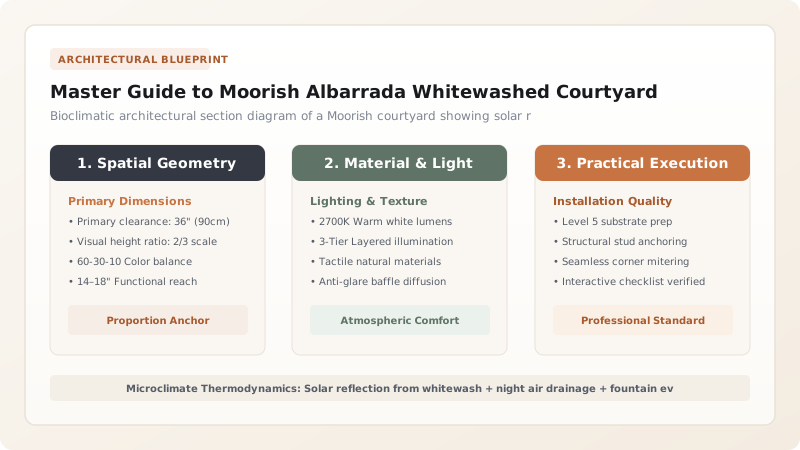
1. The Al-Andalus Courtyard: Paradise on Earth and Bioclimatic Shelter
During the Islamic Golden Age in Spain (8th to 15th centuries), Moorish architects perfected the patio courtyard house. In Islamic philosophy, the home is an introspective sanctuary (sakan, meaning peace and rest) turned inward away from public city streets.
In the blisteringly hot plains of the Guadalquivir valley (where summer temperatures routinely exceed 45°C), the courtyard functioned as a thermodynamic engine. By enclosing central open-air gardens with high, solid exterior walls, builders blocked desert winds while creating an intimate paradise garden evoking Quranic visions of lush celestial gardens watered by flowing springs.
2. The Albarrada: Natural Evaporative Refrigeration
The namesake feature of this architecture is the albarrada (from the Arabic al-barrada, 'the cooler'). These are large, unglazed earthenware amphorae and jars set into courtyard niches, window grilles, and arcades.
Molded from porous calcareous clay, water stored inside the jar seeps micro-capillarily through the unglazed walls to the exterior surface. As dry Andalusian winds blow across the moist clay skin, the water evaporates rapidly. This phase change absorbs latent heat of vaporization (2,260 kJ per liter of water evaporated), cooling the remaining water down to 14°C and creating a localized micro-draft of cool, humidified air that cascades into adjoining living salons.
3. The Whitewash Envelope: High Albedo and Hygiene
The luminous white visual identity of Andalusian pueblos blancos and courtyard walls is driven by the physics of albedo (solar reflectance). Walls are coated with multiple layers of pure slaked lime putty (cal aérea apagada).
Pure calcium carbonate has a solar reflectance index exceeding 90% to 92%, reflecting almost all incident infrared solar radiation back into the sky before it can penetrate the thick rammed-earth (tapial) or brick walls. Furthermore, the high alkalinity of fresh lime (pH 12.5) acted as a continuous natural bactericide, sterilizing courtyard surfaces against pathogens and pests.
Moorish Courtyard Bioclimatic Components & Thermal Contribution
Use this reference table to calculate exact physical dimensions, ratios, and specifications before purchasing:
| Architectural Element | Arabic / Spanish Term | Thermodynamic Mechanism | Cooling Capacity (°C Drop) | Operational Requirement |
|---|---|---|---|---|
| Porous Water Jar | Albarrada / Botijo | Capillary evaporative refrigeration | Cools water to 12°C - 15°C; cools room by 3°C | Unglazed porous terracotta; regular water refilling |
| Pure Lime Whitewash | Cal Apagada | High-albedo solar reflection (90%) | Reduces wall surface temp by 15°C - 20°C | Annual spring re-whitewashing ritual |
| Central Water Basin | Alberca / Fuente | Surface evaporation & thermal mass | Lowers ambient courtyard air by 4°C - 6°C | Gravity-fed circulating water from acequias |
| Deep Shaded Arcades | Galerías / Portales | Shaded thermal buffer zone | Maintains cool microclimate through afternoon | North-south orientation; double brick arches |
| Bitter Orange Trees | Naranjos Amargos | Vegetative evapotranspiration | Filters direct sun & humidifies air by 20% | Deep root irrigation via perimeter clay rills |
Maintenance & Climatic Constraints
Every successful decoration project must account for physical and environmental constraints:
Sacrificial Annual Whitewashing
In southern Spain, traditional whitewash chalks slowly; courtyards are ritually re-whitewashed every spring before the summer heat.
Winter Frost Vulnerability
Porous, water-saturated albarrada jars will crack if exposed to sub-zero winter temperatures; must be drained and stored in autumn.
Protocol for Slaking, Whitewashing, and Positioning Albarrada Cooling Jars
Execute this professional sequence to achieve flawless results without backtracking:
Quicklime Pit Slaking (Cal Viva)
Slake pure high-calcium quicklime lumps (CL90) in outdoor stone pit with excess water; age putty underwater for minimum 6 months.
Whitewash Slurry Thinning & Salting
Dilute aged lime putty with clean water to whole-milk consistency; stir in 1% sea salt (sodium chloride) to fix binder and improve wash hardness.
Courtyard Wall Pre-Wetting
Wash masonry courtyard walls with fresh water; apply whitewash in three thin, cross-hatched coats using wide grass brooms (encalado).
Albarrada Porosity Testing
Test unglazed clay jars for capillary sweating rate (evaporating approx. 0.5 liters/day per jar); reject glazed or vitrified vessels.
Niche Placement in Natural Breezeways
Mount albarradas in iron brackets set within shaded arcade archways or window grilles directly in the path of courtyard convective drafts.
Night-Flushing Ventilation Operation
Open courtyard gates at night to flush house with dense 18°C night air; close exterior shutters at 9:00 AM to seal trapped cool air inside.
Common Mistakes & Countermeasures
Avoid these costly errors that compromise aesthetics, ergonomics, and budget:
Applying modern synthetic acrylic exterior paints over historic courtyard lime whitewash
Glazing the exterior of albarrada clay water jars with ceramic glazes
Project Execution Checklist
Track your physical progress. Checkboxes persist automatically on this device:
Frequently Asked Questions
How cold can an unglazed albarrada or botijo cool drinking water?
In dry Mediterranean air with low relative humidity (approx. 20-30%), an unglazed clay botijo or albarrada can naturally cool water inside down to 10°C to 14°C—producing refreshing ice-cold drinking water even when ambient shade temperatures reach 42°C.
Why did Andalusian courtyards use toldos (canvas awnings) over the roof opening?
During scorching summer afternoons, residents unfurled heavy canvas awnings (toldos) across the open top of the courtyard. This shielded the patio from direct solar radiation while trapping the cool night air inside; at sunset, the awnings were retracted, allowing the courtyard to radiate heat into the clear night sky.


