
Pure Calcium Whitewashing and High-Albedo Solar Heat Reflection represent the thermodynamic protective envelope of southern Mediterranean architecture. In the intense sunlight of Andalusia and North Africa, where solar irradiance exceeds 1,000 W/m², painting walls with synthetic paint causes catastrophic heat buildup. By slaking high-purity limestone (cal viva) into aged calcium hydroxide putty (cal apagada) and applying it in multi-layered washes, builders achieve a luminous white crystalline calcite skin with a solar reflectance index (SRI) over 90%, deflecting solar heat into space and cooling building mass by up to 20°C.
At a Glance: Key Takeaways
- 92% Solar Reflectance Index (Albedo): Reflecting 90%+ of solar radiation, preventing daytime wall heat accumulation.
- Aged Pit-Slaked Pure Fat Lime (CL90): Ultra-fine micro-platelets creating an opaque, radiant white mineral skin.
- Salt & Alum Weather-Fixing: Dissolving marine sea salt to chemically harden the wash and eliminate chalking rub-off.
- Breathable Vapor Permeability: Permitting thick rammed-earth (tapial) walls to transpire internal dampness continuously.
- Natural Alkaline Antiseptic Shield: High pH 12.5 environment sterilizing walls against bacteria, mold, and insects.
- Sacrificial Annual Spring Ritual: The communal encalado tradition renewing rural whitewash before summer heat waves.
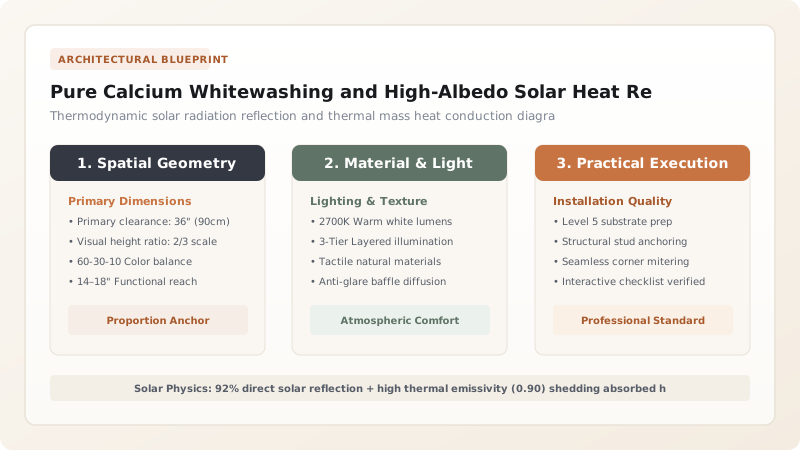
1. Albedo Physics: How Whitewash Deflects 1,000 W/m² of Solar Energy
During Andalusian summers, building facades are bombarded by extreme solar radiation exceeding 1,000 Watts per square meter. Dark or unpainted stone walls absorb 70% to 85% of this heat, conducting thermal energy deep into the building mass where it radiates into bedrooms all night.
Pure calcium whitewash operates as an optical mirror (high-albedo surface). When calcium hydroxide carbonates into pure calcite (CaCO3), its crystal cleavage planes scatter all wavelengths of visible and near-infrared solar light. With an albedo rating of 0.90 to 0.92, over 900 Watts of solar energy per square meter bounce harmlessly back into the upper atmosphere, keeping the exterior wall face up to 20°C cooler than an unwhitewashed surface.
2. Pit-Slaking and Aging the Pure Calcium Putty
The luminous brilliance of Moorish whitewash depends strictly on the purity of the limestone. Andalusian lime masters (caleros) from centers like Morón de la Frontera burn 99% pure calcium carbonate limestone in wood-fired artisanal kilns.
The resulting quicklime (cal viva) is slaked in outdoor pits with excess water and matured underwater for at least 6 to 12 months. During aging, the hexagonal calcium hydroxide crystals break down into colloidal micro-platelets (sub-micron size). This colloidal fineness yields an extraordinarily opaque, silky paint that covers masonry in a brilliant, non-glare chalk-white coat with zero visible brush drag.
3. The Secret Additives: Sea Salt and Potassium Alum
Raw lime water easily chalks off onto clothes when touched. Traditional whitewashers solved this by adding natural mineral fixatives to the slurry:
- Sea Salt (Sodium Chloride - 1% to 2%): Salt is hygroscopic; it draws microscopic ambient moisture into the drying lime wash, slowing down water evaporation and allowing full crystalline carbonation to complete without powdery dusting.
- Potassium Alum (Alumbre - 0.5%): Hardens the calcite crystal matrix and increases surface water-shedding resilience against driving rains.
- Animal Soap or Oil Skim: A splash of olive-oil soap reacts with lime to synthesize hydrophobic calcium soaps, preventing rain streaking.
Andalusian Whitewash Formulations & Performance Specs
Use this reference table to calculate exact physical dimensions, ratios, and specifications before purchasing:
| Wash Coat Stage | Lime-to-Water Ratio | Fixative Additive | Target Layer Thickness | Thermal Albedo Rating |
|---|---|---|---|---|
| Primer Base Coat (Imprimación) | 1 Part Putty : 4 Parts Water | 2% Sea Salt (dissolved) | Semi-translucent penetrating wash | Base adhesion & suction neutralization |
| Intermediate Body Wash | 1 Part Putty : 2.5 Parts Water | 1% Sea Salt + 0.5% Alum | Opaque milky coat (0.5mm) | Builds dense reflective calcite barrier |
| Finish Burnish Wash | 1 Part Putty : 2 Parts Water | 0.5% Olive-oil soap emulsion | Silky matte white skin (0.3mm) | 92% Solar albedo & rain resistance |
| Emergency Disinfection Wash | Fresh boiling quicklime slake | None (pure caustic Ca(OH)2) | Heavy thick paste | Sanitary livestock barn disinfection |
Application & Environmental Constraints
Every successful decoration project must account for physical and environmental constraints:
Severe Eye Irritation Hazard
Slaked lime has a high pH (12.5); accidental splatter in eyes causes chemical burns; goggles are mandatory.
Wet Weather Sensitivity
Fresh whitewash will wash off if rain strikes before initial carbonation (approx. 24-48 hours after application).
Protocol for Preparing and Applying Pure Calcium Whitewash (Encalado)
Execute this professional sequence to achieve flawless results without backtracking:
Substrate Descaling & Washdown
Scrape loose flaking chalk from wall with stiff broom; wash masonry with clean water to remove dust and saturate suction.
Lime Putty Dilution & Straining
Dilute 1 part aged Morón lime putty with 2.5 parts water in wooden vat; strain through fine wire sieve to remove grit.
Sea Salt Dissolution & Emulsification
Dissolve coarse sea salt (150g per 10L) in warm water; stir into lime slurry; add 50ml melted olive-oil soap; paddle for 5 minutes.
First Cross-Hatched Coat Application
Dip wide esparto-grass broom (calabrote) into slurry; apply first coat using sweeping figure-eight strokes; keep layer paper-thin.
Inter-Coat Carbonation Drying
Allow first coat to dry for 24 hours until carbonation transforms gray-white wash into brilliant matte white; mist lightly with water.
Second & Third Coat Layering
Apply second and third thin coats perpendicular to previous strokes; inspect under bright sun for 100% opaque, seamless white coverage.
Common Mistakes & Countermeasures
Avoid these costly errors that compromise aesthetics, ergonomics, and budget:
Applying whitewash in thick, pasty coats like modern wall paint
Adding Portland cement to whitewash to make it 'harder'
Project Execution Checklist
Track your physical progress. Checkboxes persist automatically on this device:
Frequently Asked Questions
Why does freshly applied whitewash look gray and transparent when wet?
When wet, water fills the microscopic crystal pores between calcium hydroxide particles, allowing light to pass through to the dark masonry beneath. As the water evaporates and carbon dioxide converts the lime into solid calcium carbonate (calcite), the air-crystal interface scatters light in all directions, turning the wall brilliantly opaque white.
How did Andalusian villages get their famous 'Pueblos Blancos' nickname?
In the 19th and early 20th centuries, municipal health decrees across Andalusia required all buildings—from grand churches to humble peasant cottages—to be whitewashed inside and out every spring to combat cholera and typhus epidemics. The complete white coating transformed entire cliff-side mountain villages into glittering white jewels.


