
Balinese Boma Guardian Masks and Karang Mythological Fauna represent the sacred sculptural language of Hindu-Balinese architecture. Carved into soft volcanic paras stone above temple portals, niches, and wall corners, these fierce demon heads (Bhoma) and foliate mythological hybrids (karang) serve as apotropaic guardians. By blending ferocious animal features (lions, elephants, and birds) with lush curling vegetation (patra), master carvers transform mineral stone into living spiritual guardians that devour evil energies and consecrate sacred temple ground.
At a Glance: Key Takeaways
- Bhoma (Kirtimukha) Face of Glory: Celestial forest demon head carved above portals, devouring malicious spiritual energies.
- Karang Boma & Karang Sae: Foliate animal corner brackets blending lion and mythological dragon features with floral curls.
- Karang Gajah (Elephant Demon): Massive corner brackets sculpted with elephant trunks symbolizing grounded immovable strength.
- Patra Punggel Floral Tendrils: Dynamic, curling acanthus-like vine tendrils framing and flowing from guardian mouths.
- Apotropaic Protection Magic: Transforming demonic ferocity into positive spiritual armor shielding sacred inner sanctums.
- Deep 50mm Undercut Relief: Carving multi-layered shadow cavities that catch raking tropical sunlight.
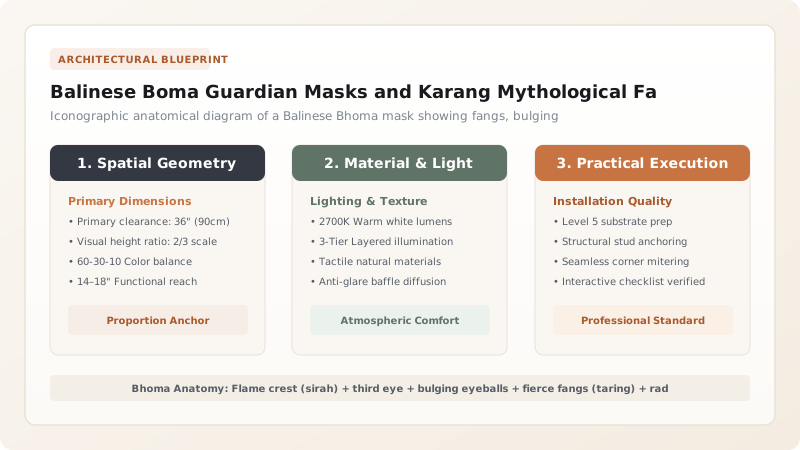
1. The Mythological Origins of Bhoma (The Face of Glory)
In Balinese Hindu mythology, Bhoma (or Boma) is the offspring of Lord Vishnu and the earth goddess Dewi Pertiwi. In ancient texts, he is also identified with the pan-Asian motif of the Kirtimukha ('Face of Glory').
Legend relates that Shiva commanded a ferocious demon to devour itself as punishment for arrogance; the monster complied, eating its own body until only its face, eyes, and fangs remained. Pleased with this total obedience, Shiva appointed the disembodied head as the guardian of all sacred thresholds, decreeing that anyone entering a temple must first pass beneath Bhoma's purifying, all-seeing gaze.
2. The Karang Pantheon: Sculpting Mythological Corner Beasts
Balinese temple corners are never plain; they are articulated with karang (sculpted grotesque brackets). These figures synthesize animal power with vegetative growth:
- Karang Sae: A mythological monster combining a lion's fanged jaw with stag horns and foliate ears, placed at upper wall junctions.
- Karang Gajah: An elephant-headed bracket whose downward-pointing trunk anchors the corners of temple plinths, symbolizing unyielding structural stability.
- Karang Goak: A bird-headed guardian with a sharp raptor beak, crowning upper temple cornices to guard against aerial spirits.
- Karang Asti: Stylized dragon-beasts vomiting continuous scrolls of leafy vines (patra punggel) from their jaws.
3. The Flow of Foliage: Patra Punggel Carving Mechanics
The hallmark of authentic Balinese relief carving is the seamless integration of animal anatomy into patra punggel (curling vegetative scrollwork). A demon's eyebrow does not end in hair; it transforms organically into a sweeping acanthus-like leaf.
Using specialized curved gouges (pahat penguku), the carver cuts deep 50mm undercuts behind the leaf lobes. By hollowing out the stone beneath the scrolling leaves, tropical daylight passes completely behind the carving, making the dense volcanic stone appear weightless, dynamic, and pulsating with biological life.
Balinese Temple Guardian Sculptures & Mythological Placements
Use this reference table to calculate exact physical dimensions, ratios, and specifications before purchasing:
| Sculptural Figure | Balinese Name | Anatomical Composition | Apotropaic Symbolic Role | Typical Temple Position |
|---|---|---|---|---|
| Face of Glory | Bhoma / Kirtimukha | Disembodied fanged head with foliage | Purifies visitors; devours evil thoughts | Directly above lintel of Candi Bentar & Kori Agung |
| Lion-Stag Corner | Karang Sae | Lion fangs, bovine nose, foliate horns | Guards wall corners against spirit intrusion | Upper corners of shrine bodies (awak) |
| Elephant Corner | Karang Gajah | Elephant head with curved trunk & tusks | Anchors building; physical & spiritual weight | Lower corners of stepped foundation plinths |
| Raptor Bird Head | Karang Goak | Fierce eagle/crow head with hooked beak | Guards against flying celestial malevolence | Roof gables, upper cornice corners |
| Sea Monster Spout | Makara | Composite crocodile, fish, and elephant | Purifies sacred lustral water flows | Water spouts in holy cleansing baths (petirtaan) |
Religious & Physical Constraints
Every successful decoration project must account for physical and environmental constraints:
Sacred Consecration Mandates
Carving a sacred Bhoma mask requires spiritual purification (mebanten) by the undagi sculptor; irreverent carving is considered taboo.
Extreme Chisel Sharpness Maintenance
Soft volcanic ash quickly dulls cutting bevels; carvers must sharpen chisels on Arkansas stones every 45 minutes.
Protocol for Laying Out and Carving a Bhoma Guardian Mask in Paras Stone
Execute this professional sequence to achieve flawless results without backtracking:
Stone Block Squaring & Water Soaking
Square 600mm x 800mm x 350mm paras block; submerge in water for 24 hours until fully saturated; mount on sturdy timber easel.
Symmetrical Scribing of Bhoma Facial Proportions
Snap vertical centerline; scribe bulging eye orbits, wide mouth opening, and fangs using charcoal stick per Asta Kosala rules.
Rough Volumetric Mass Blocking
Chisel away broad negative background down 60mm; block out protruding snout, forehead crest, and cheek bones with wide flat chisels.
Eyeball & Fanged Jaw Deep Carving
Carve spherical eyeballs and vicious taring fangs; undercut lips to create deep shadow oral cavity behind fangs.
Patra Punggel Foliage Undercutting
Sculpt radiating foliate crest; undercut leaves at 45° angle with hollow gouge until leaves stand proud in complete relief.
Detail Tooling & Sacred Consecration (Melaspas)
Tool teeth ridges and pupil highlights with fine pointed stylus; wash stone clean; prepare for temple melaspas blessing ritual.
Common Mistakes & Countermeasures
Avoid these costly errors that compromise aesthetics, ergonomics, and budget:
Carving Bhoma features flat without sufficient three-dimensional depth
Carving foliate patra tendrils with blunt, non-tapering leaf tips
Project Execution Checklist
Track your physical progress. Checkboxes persist automatically on this device:
Frequently Asked Questions
Why does Bhoma have no lower jaw in Balinese temple carvings?
Because according to sacred Hindu-Balinese mythology, Bhoma devoured his own body down to his upper jaw in total obedience to Shiva's divine command. The absence of a lower jaw also creates a soaring arched opening that frames the top of temple doorways perfectly.
Can private residential houses in Bali install a Bhoma mask above their front door?
Traditionally, no. The full Bhoma mask with fangs is reserved for sacred temples (pura) and royal palaces (puri). Commoner family compounds traditionally use a simpler foliate motif or a stylized Karang Sae above their entrance gate (angkul-angkul).


