
Dancheong Morucho Beam Patterns and Geumdancheong Gold Filigree represent the pinnacle of Korean architectural ornamentation. Applied to the ends of monumental horizontal beams, purlins, and bracket sets, Morucho (머리초) is a standardized yet infinite decorative composition featuring central lotus rosettes (yeonhwa), pomegranate seeds, radiating feather leaves (gitbal), and stepped color gradients (bic-gi). In royal throne halls and master temple shrines, this expands into Geumdancheong (금단청)—where every millimeter of timber is encrusted with microscopic geometric brocades and genuine 24k gold leaf filigree.
At a Glance: Key Takeaways
- Morucho Compositional Schema: Symmetrical lotus bulb, green pomegranate core, and radiating feathered wings.
- Bic-gi Graduated Stepped Shading: 3-tier to 5-tier concentric color stepping creating vibrant three-dimensional optical relief.
- Geumdancheong Supreme Grade: Continuous brocade lattice (geum-munt-ui) embellished with hand-cut 24k gold leaf.
- Gongpo Bracket Set Polychromy: Articulating complex multi-cluster cantilever brackets with rhythmic color bands.
- Meok-Seon Black Calligraphic Outlining: Pure pine soot ink contour lines binding and separating contrasting hues.
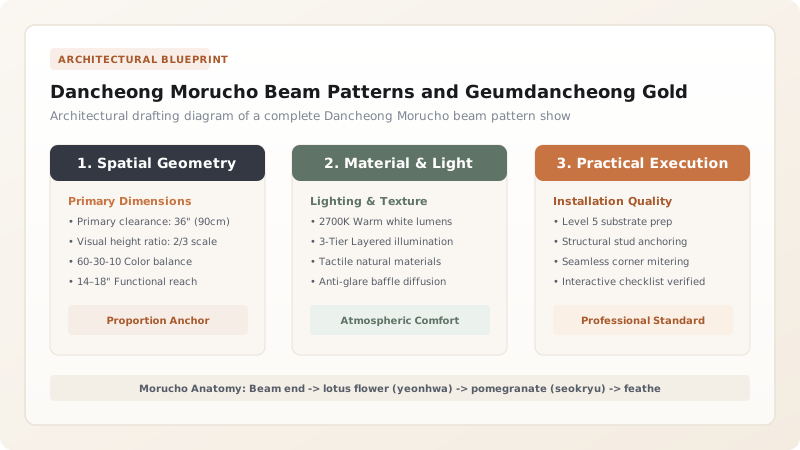
1. Anatomy of the Morucho Pattern: From Lotus to Feather Bands
The core building block of Dancheong is the Morucho (head pattern). Painted across the outer one-third of horizontal structural timbers (such as cross-beams, tie beams, and purlins), Morucho establishes a symmetrical heraldic focal point:
- Yeonhwa-mori (Lotus Apex): A stylized lotus flower blooming outward from the timber end, symbolizing Buddhist purity.
- Seokryu-dudumi (Pomegranate Core): A rounded cluster of green or turquoise seeds representing fertility and abundant royal lineage.
- Gitbal (Feather Wings): Concentric radiating blade-like feathers that flare backward along the beam sides.
- Golt-gae (Transition Stripes): Parallel bands of white, black, red, and blue stripes that transition the ornate head pattern into the plain mid-span of the timber.
2. Optical Stepping: The Science of Bic-gi Color Gradients
To make flat wooden beams read as dynamic, vibrating three-dimensional forms from the ground 10 meters below, Dancheong painters utilize bic-gi (stepped graduation).
Instead of blending colors into a soft photographic fade, artisans paint hard, parallel bands of three to five calibrated shades of the same color family (e.g., dark pine green → medium malachite green → pale jade green → white). Under the natural diffuse daylight reflecting off granite courtyard pavements, these concentric stepped bands create astonishing optical luminescence and volumetric depth.
3. Geumdancheong: Imperial Gold Leaf and Brocade Lace
While standard palace halls feature Morucho with plain unpainted beam centers, the supreme architectural grade—Geumdancheong (Gold Dancheong)—leaves zero timber uncovered.
The central beam spans are filled with geum-munt-ui (brocade patterns) depicting interlocking swastikas (wan-ja), tortoise-shell hexagons, and ascending five-clawed imperial dragons. The outlines of lotus stamens, dragon scales, and cloud scrolls are sized with garlic-infused fish glue and covered with genuine 24k gold leaf, glowing like celestial lanterns in the dim interiors of palace throne rooms.
Dancheong Morucho Motifs & Cosmological Symbolism
Use this reference table to calculate exact physical dimensions, ratios, and specifications before purchasing:
| Motif Component | Korean Term | Visual Form | Philosophical / Symbolic Meaning | Typical Color Scheme |
|---|---|---|---|---|
| Lotus Bloom | Yeonhwa-mori | Multi-petal flared water lily | Spiritual purity, enlightenment, rebirth | White petals tipped with cinnabar red |
| Pomegranate Heart | Seokryu-dudumi | Globular cluster of jewel-like seeds | Abundance, royal prosperity, many sons | Malachite green with jade highlights |
| Radiating Feathers | Gitbal | Serrated aerodynamic wing blades | Ascending spiritual energy, flight | Stepped blue, red, and yellow bands |
| Cloud Waves | Gureum-mun | Swirling curvilinear vapor eddies | Divine celestial realm, rain bringer | Three-tier stepped lapis lazuli blues |
| Brocade Filigree | Bidan-munt-ui | Dense interlocking geometric lattice | Endless cosmic perpetuity (Tessellation) | Gold leaf lines over crimson ground |
Artistic & Architectural Constraints
Every successful decoration project must account for physical and environmental constraints:
Monumental Scale Precision
Beam patterns must match perfectly across dozens of adjacent bays spanning over 60 meters in palace courtyards.
Compound Curved Timber Substrates
Natural Korean pine beams retain organic twists and taper; patterns must be manually adjusted to taper smoothly.
Protocol for Executing a Complete Geumdancheong Beam Panel
Execute this professional sequence to achieve flawless results without backtracking:
Beam Proportioning & Chulcho Transfer
Divide beam length into head pattern thirds and center span; align perforated chulcho stencils; pounce white hobon dots.
Background Celadon Ground Laying
Paint broad background fields with uniform coat of noe-nok (malachite green); allow to dry for 24 hours.
Stepped Bic-gi Color Laying
Paint stepped color bands sequentially: dark base hues first, stepping through intermediate tints to pure white highlights.
Meok-Seon Black Contour Outlining
Using fine wolf-hair liner brush, trace sharp black pine-soot ink contours along every color boundary with continuous stroke.
Gold Size Garlic-Glue Application
Paint delicate filigree lines with aged garlic-colla adhesive size; wait 30 minutes until size attains tacky thumb-print stickiness.
24k Gold Leaf Laying & Burnishing
Lay genuine 24-karat gold leaf sheets onto sized lines using gilder's tip; press with velvet pad; brush away loose gold skewings.
Common Mistakes & Countermeasures
Avoid these costly errors that compromise aesthetics, ergonomics, and budget:
Applying meok-seon black outlines with hesitant, broken brushstrokes
Using imitation aluminum/copper gold leaf (Dutch metal) outdoors
Project Execution Checklist
Track your physical progress. Checkboxes persist automatically on this device:
Frequently Asked Questions
What is the purpose of the black line (meok-seon) between bright colors in Dancheong?
In color theory, placing two intense complementary colors (such as red and green) directly adjacent causes visual vibration and optical fuzziness. The crisp black pine soot line (meok-seon) acts as a neutral visual buffer, allowing both saturated colors to sing with maximum brilliance without clashing.
How do Dancheong masters transfer identical patterns to dozens of beams?
They use a pricked stencil technique called 'chulcho' (출초). The master pattern is drawn on tough Korean mulberry paper (hanji), and every line is pricked with thousands of needle holes. When held against a beam and dusted with white shell powder, the design transfers onto the wood in seconds with sub-millimeter precision.


