
Traditional Balinese Paras Stone Carving and Temple Reliefs represent the spiritual and architectural soul of Bali's sacred landscape. Quarried along deep river ravines around Ubud, Batubulan, and Tampaksiring, batu paras is a soft, highly porous volcanic tuff formed from solidified ash flows. Master stonecarvers (undagi) carve this stone while it is saturated with water, carving intricate guardian demon masks (Bhoma), mythological beasts (karang), and soaring split gates (Candi Bentar). Over time, the porous volcanic stone hosts lush living mosses and lichens, seamlessly merging temple architecture with the tropical rainforest.
At a Glance: Key Takeaways
- Soft Volcanic Tuff (Batu Paras): Highly porous, fine-grained volcanic ash stone quarried from sacred river gorges.
- Water-Saturation Carving: Soaking stone in river water to keep it soft and cheese-like for sub-millimeter chisel carving.
- Fierce Guardian Iconography: Sculpting Bhoma demon heads and Kala monster masks to ward off demonic spirits.
- Candi Bentar Split Gates: Monumental monumental ceremonial entrance portals representing the cosmic Mount Meru split in half.
- Living Moss & Lichen Symbiosis: High water retention creating an evolving velvet-green organic patina within 2 rainy seasons.
- Asta Kosala Kosali Sacred Proportions: Building dimensions governed by traditional anatomical units of the master mason.
In-Depth Guides in this Directory
Explore specialized subtopic blueprints, technical dimensions, and execution checklists:
Balinese Paras Volcanic Tuff Porosity and Water-Saturation Carving
Geological and sculpting manual for Balinese paras: pyroclastic ash tuff mineralogy, pore capillary water retention, water-saturation carving, and chisel kinetics.
Balinese Boma Guardian Masks and Karang Mythological Fauna
Iconographic and carving guide to Balinese temple sculpture: Bhoma guardian demon heads, Karang animal-foliate hybrids, Makara spouts, and spiritual apotropaism.
Balinese Candi Bentar Split Gates and Living Moss Patinas
Architectural and environmental guide to Balinese temple gates: Candi Bentar stereotomy, Kori Agung roofed gates, bryophyte moss colonization, and stone conservation.
1. Hindu-Balinese Cosmology: The Sacred Tri Hita Karana
In Balinese architecture, a temple (pura) or traditional compound is an earthly microcosm of the cosmic universe. Governed by the philosophical principle of Tri Hita Karana (harmony between gods, humanity, and nature), every carved stone element serves a metaphysical purpose.
The stone carving tradition flourished in artisan villages like Batubulan and Singapadu. Sculptors transformed volcanic ash stone into dynamic architectural screens, stepped ancestral altars (pelinggih), and monumental shrines, carving sacred myths from the Ramayana and Mahabharata to preserve divine cosmic balance against chaotic chthonic forces.
2. Material Science: Batu Paras Volcanic Tuff and Water Carving
Unlike hard basalt or granite that requires diamond blades, traditional batu paras is a pyroclastic volcanic ash tuff. Deposited during ancient volcanic eruptions of Mount Batur and Mount Agung, the stone is composed of micro-porous glass shards, pumice fragments, and feldspar cemented under low geothermal heat.
When first quarried from shaded river canyons, the stone is saturated with ground moisture (quarry sap) and is soft enough to carve with simple carbon-steel chisels. Artisans continually pour river water over the stone as they work. The water lubricates the chisel edge and keeps the volcanic matrix pliable, allowing carvers to sculpt deep 50mm undercuts, feather-thin flame tendrils, and delicate floral fretwork without fracturing the stone.
3. The Split Gate (Candi Bentar) and the Living Moss Patina
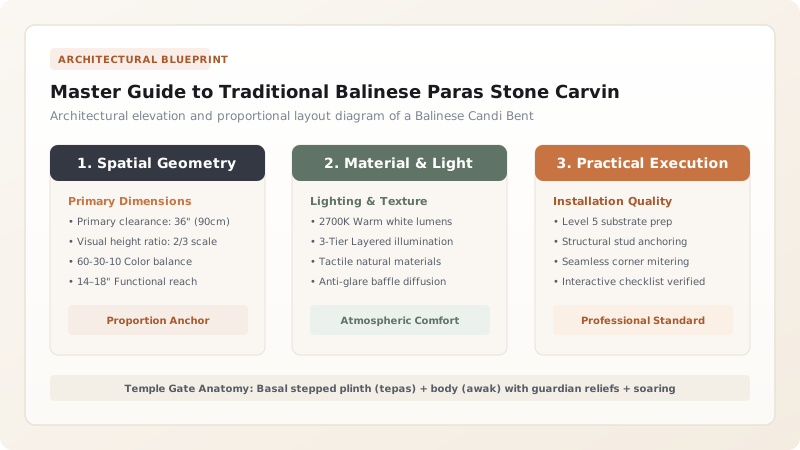
The most iconic architectural monument in Bali is the Candi Bentar (split gateway). Flanking temple courtyards, the gate represents the sacred cosmological Mount Meru split cleanly in two halves by divine thunder, opening a spiritual threshold through which visitors step from the profane outer world into sacred inner space.
Because batu paras has an open porosity exceeding 20% to 25%, it absorbs tropical monsoon rains like a sponge. Within 12 to 24 months, microscopic moss spores and bryophytes colonize the carved hollows. This velvet-green moss patina softens the stone's edges, transforming the man-made temple into an organic extension of the surrounding jungle.
Balinese Volcanic Stone Varieties & Sculptural Roles
Use this reference table to calculate exact physical dimensions, ratios, and specifications before purchasing:
| Stone Variety | Balinese Name | Porosity & Density | Color & Texture | Typical Temple Application |
|---|---|---|---|---|
| Soft Gray River Tuff | Paras Gray (Batubulan) | High porosity (25%); soft | Light silver-gray; fine ash grain | Delicate wall friezes, Bhoma masks, garden statues |
| Yellow Sandstone Tuff | Paras Taro / Sandung | Moderate porosity (18%); medium | Warm golden-ochre; gritty texture | Stepped wall copings, ancestral altars |
| Black Hard Volcanic Lava | Batu Candi / Andesite | Low porosity (5%); very hard | Dense charcoal black; crystalline | Foundation plinths, heavy water fountain spouts |
| Hard River Basalt | Batu Kali | Impermeable (< 2%); rock hard | Smooth water-rounded dark gray | Flood defense base walls, courtyard perimeter kerbs |
Material & Climate Constraints
Every successful decoration project must account for physical and environmental constraints:
Severe Frost Vulnerability
Porous, water-saturated paras stone will shatter completely during freeze-thaw cycles; unsuitable for cold exterior climates without indoor climate control.
Soft Mechanical Wear
Paras stone is soft and easily scratched by pedestrian contact; delicate reliefs must be positioned above shoulder height.
Protocol for Sourcing, Soaking, and Hand-Carving Balinese Paras Stone
Execute this professional sequence to achieve flawless results without backtracking:
Riverbed Quarry Sourcing
Extract green paras ash tuff blocks from deep river ravines in Batubulan; wrap blocks in wet banana leaves to preserve quarry sap.
Water Submersion Soaking
Submerge stone block in freshwater basin for 24 hours prior to carving; confirm stone is fully saturated to core.
Asta Kosala Proportional Scribing
Layout sacred anatomical proportions (depa, rai, agulku) directly onto wet stone face using charcoal sticks.
Rough Mass Blocking (Ngasar)
Block out primary silhouette and volumetric planes using heavy flat iron chisels (pahat) struck with wooden mallets.
Detailed Motif Sculpting (Ngukir)
Carve deep floral tendrils (patra) and fanged Bhoma features using curved gouges and V-parting chisels; lubricate with water mist.
Surface Smoothing & Moss Inoculation
Clean carved relief with soft bamboo scrapers; brush face with natural yogurt or rice water to accelerate organic moss colonization.
Common Mistakes & Countermeasures
Avoid these costly errors that compromise aesthetics, ergonomics, and budget:
Carving dry, desiccation-hardened paras stone without pre-soaking in water
Sealing exterior Balinese paras stone with clear synthetic acrylic or polyurethane lacquers
Project Execution Checklist
Track your physical progress. Checkboxes persist automatically on this device:
Frequently Asked Questions
How long does soft paras stone survive outdoors in the Balinese climate?
In tropical, frost-free Bali, carved paras stone survives for 80 to 120 years before natural rainwater weathering rounds off fine details. In Balinese culture, this natural erosion is celebrated as impermanence (anicca); temple communities happily recarve and replace weathered stones every few generations as an act of communal devotion.
What is the meaning of the Bhoma head carved above temple doorways?
Bhoma (or Kirtimukha) is the celestial son of the Earth goddess (Pertiwi) and the god Vishnu, representing the sacred, protective spirit of the forest. Carved with bulging eyes, ferocious fangs, and foliate hair above temple gates, Bhoma consumes all evil thoughts, purifying arriving worshippers before they enter the sacred courtyard.


