
Balinese Bale joinery employs an unanchored mortise-and-tenon timber space frame resting on carved volcanic andesite stone pedestals (sendi). By using shallow cylindrical tenons (puser) sitting unbolted in recessed stone sockets, coupled with interlocking perimeter ring-beams (lambang sari and lambang kunci) locked by hardwood wedge pins, the structure behaves as a flexible seismic pendulum that dissipates ground accelerations.
At a Glance: Key Takeaways
- Stone Foundation Material: Volcanic andesite (batu candi) or dense paras tuff carved with padma lotus reliefs.
- Base-Isolation Connection: Shallow 25mm locating tenon (puser) resting in stone recess without mortar or bolts.
- Ring-Beam Architecture: Double interlocking perimeter beams—lambang sari (lower) and lambang kunci (locking upper).
- Column Joinery: Pass-through mortise-and-tenon joints secured with tapered jackfruit or teak wedge keys (pasak).
- Damping Behavior: Kinetic friction between wood and stone absorbs up to 60% of seismic earthquake energy.
- Timber Alignment: Timber grain strictly oriented so root-end faces groundward (purwa) matching botanical growth.
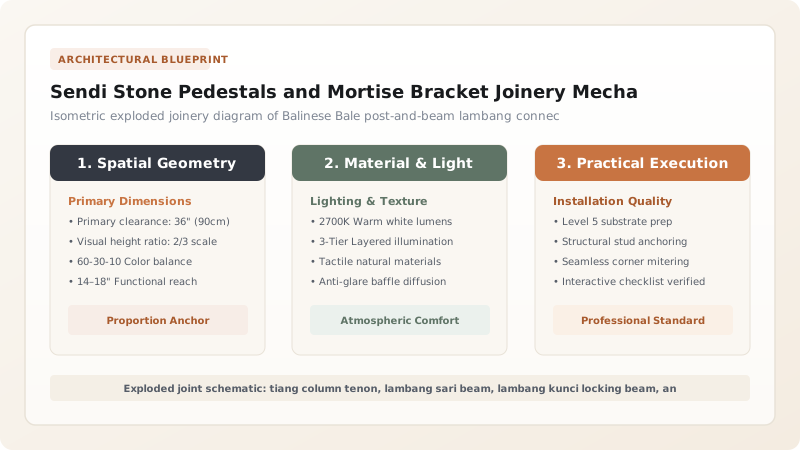
Andesite Stone Petrology and Dynamic Sliding Mechanics
The foundation pedestal of the Balinese Bale is known as the sendi (or umpak). Sculpted from dark grey volcanic andesite rock (batu candi) quarried from river gorges, the sendi measures 300mm to 450mm in height. Its surface is adorned with carved lotus petals (padma) symbolizing purity and stability.
At the center of the upper polished face is a circular or square recess 100mm wide and 25mm deep. The bottom of the timber column features a matching short tenon called the puser (navel). Because no chemical mortar, adhesive, or mechanical steel anchor binds the post to the stone, the post is free to micro-slide and rock during intense tectonic earthquakes, preventing devastating moment stresses from snapping the timber base.
The Lambang Interlocking Perimeter Beam Cage
At the top of the columns, structural stability is achieved through a multi-tiered interlocking ring-beam framework. Rather than a single timber header, Balinese carpenters employ a two-layer beam system:
- Lambang Sari: The lower continuous perimeter beam that penetrates through mortises cut into the top of the columns, tying all vertical posts into a rigid rectangular box.
- Lambang Kunci: The upper locking beam that drops over the exposed column tenons at right angles, clamping the lower beam into place like a three-dimensional wooden puzzle.
The junction is locked with a tapered hardwood wedge (pasak) driven through the column tenon. If wood shrinks seasonally, a single hammer tap on the pasak wedge restores 100% structural rigidity without disassembly.
Botanical Orientation (Purwa) and Fiber Physics
Balinese woodworking dictates a strict spiritual and physical rule regarding timber orientation: the tree's natural growth direction must never be inverted. The end of the log that grew closer to the tree roots must always face downward toward the earth (hulu-teben / root-to-crown alignment).
From a wood physics standpoint, this ensures that the denser, tighter growth rings found at the base of the tree carry the heavier compressive loads at the bottom of the column, while the lighter crown wood supports the upper roof trusses, optimizing structural efficiency and natural sap-drainage dynamics.
Comparison of Traditional Balinese Joinery vs Modern Fasteners
Use this reference table to calculate exact physical dimensions, ratios, and specifications before purchasing:
| Connection Type | Traditional Lambang & Pasak | Modern Steel Plate & Bolts | Concrete Post Embedding |
|---|---|---|---|
| Seismic Performance | Dynamic energy dissipation via friction | Rigid; high stress concentration | Catastrophic shearing at footing interface |
| Thermal/Moisture Flex | Joints self-adjust with humidity | Steel causes splitting around bolt holes | Traps moisture; rots interior core |
| Reversibility / Repair | 100% demountable; tap wedge to tighten | Bolts rust into timber; hard to replace | Irreversible; requires pneumatic demolition |
| Lifespan Potential | 100 to 200+ years in tropical shade | 30 to 50 years (rust and galvanic rot) | 15 to 30 years (rapid rot at groundline) |
Practical Constraints
Every successful decoration project must account for physical and environmental constraints:
Differential settling of individual sendi stone plinths on soft tropical soils
Mitigation: Excavate 1-meter footing pits, backfill with compacted volcanic crushed gravel, and cap with unreinforced lime concrete pads.
Execution Blueprint & Craftsmanship Sequence
Execute this professional sequence to achieve flawless results without backtracking:
Dress and Hollow Andesite Sendi Pedestals
Chisel volcanic stone blocks with flat bearing face and central 100mm-diameter by 25mm-deep locating socket.
Turn or Shape Hardwood Tiang Columns
True timber posts on wood lathe or hand plane, carving lower puser tenon to fit loosely inside the sendi socket.
Mortise Upper Post Heads for Dual Beams
Chisel compound through-mortises at top of columns to receive both lambang sari and perpendicular lambang kunci beams.
Slot Lambang Sari Beams Across Column Spans
Slide primary horizontal beams through column mortises, checking diagonal squareness of the perimeter rectangle.
Drop Lambang Kunci Beams and Drive Pasak Wedges
Seat upper locking beams into rebates and drive hand-planed teak wedges (pasak) tight to lock all four corners.
Coat Joinery Pockets with Camphor and Linseed Oil
Swab all internal end-grain mortise pockets with heated camphorated linseed oil to repel boring beetles.
Common Mistakes & Countermeasures
Avoid these costly errors that compromise aesthetics, ergonomics, and budget:
Grouting the timber puser tenon solid into the sendi stone socket with Portland cement
Inverting the column so the botanical crown end faces groundward
Project Execution Checklist
Track your physical progress. Checkboxes persist automatically on this device:
Frequently Asked Questions
Can coconut palm columns be turned on a conventional wood lathe?
Yes, but only sharp carbide-tipped turning chisels should be used; the high density of silicified vascular bundles in mature coconut wood quickly blunts standard high-speed steel tools.
What happens if a pasak locking wedge loosens after seasonal dryout?
The wedge is simply tapped inward with a wooden mallet. The slight taper instantly restores tension across the joint without requiring shims or adhesives.


