
Balinese alang-alang thatching requires selecting mature, silica-rich cogon grass (Imperata cylindrica) cut during dry season dormancy. The grass is woven into 2.5–3.0m flexible panels (kreb) bound around split bamboo laths using rot-proof black sugar-palm fiber (ijuk), layered at 100–120mm exposures on 50° bamboo rafters, and crowned with a watertight inverted grass-and-bamboo ridge cap (bumbungan).
At a Glance: Key Takeaways
- Botanical Species: Imperata cylindrica (cogon grass / alang-alang), harvested at 1.2–1.8m stem maturity.
- Harvest Timing: Peak dry season (July–September) when sap flow ceases and silica content reaches 8%–12%.
- Panel Anatomy: Pre-fabricated 3-meter kreb panels woven over split Petung bamboo battens (usuk).
- Binding Rope: Black arenga pinnata palm fiber (ijuk), naturally impervious to water, fungal rot, and insects.
- Layering Overlap: 80% overlap ratio with 100mm–120mm maximum weather exposure per course.
- Ridge Water Barrier: Bumbungan saddle cap combining folded thatch, bamboo half-pipes, and coconut leaves.
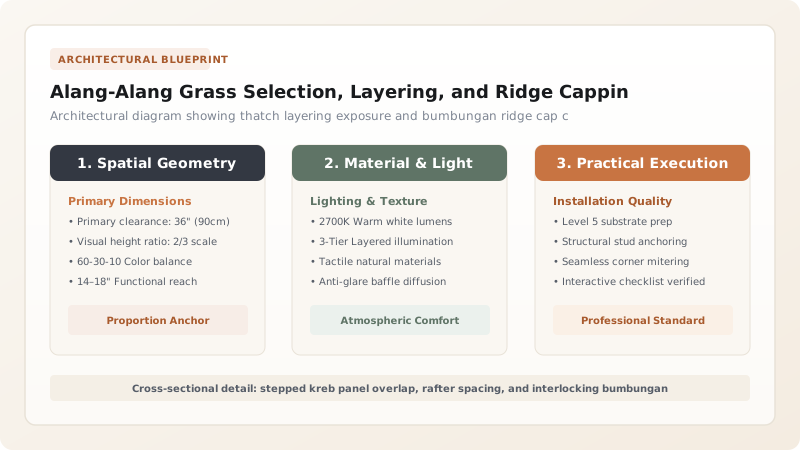
Botanical Maturity and High-Silica Grass Selection
Not all cogon grass is suitable for architectural thatching. Coastal valley grass grows too rapidly, producing spongy, low-silica culms that rot within four seasons. Master thatchers specify upland mountain-grown alang-alang harvested from volcanic hillsides in Karangasem and Bangli.
Harvesting occurs exclusively in the dry season (July to September). Cut stalks must measure 1.2 to 1.8 meters in length, with thick, stiff golden-tan culms. The natural cuticle of mountain grass contains up to 12% amorphous silica (silicon dioxide), which creates a glass-like crystalline water-shedding shield that repels tropical rain and fungal spores.
Weaving the Kreb: Split Bamboo and Ijuk Fiber Physics
Unlike European reed thatching where loose stems are dressed directly on the roof, Balinese thatchers pre-fabricate modular panels called kreb. The weaver sits on the ground with a 3-meter split bamboo slat (usuk) held on wooden pegs.
Small bundles of alang-alang are bent over the bamboo spine at their root ends, folding the stems back against themselves. To lash the bundles solid, thatchers reject synthetic twine in favor of ijuk—the coarse black horsehair-like fiber harvested from the trunk of the sugar palm (Arenga pinnata). Ijuk is chemically rich in natural resins, virtually rot-proof, and impervious to tropical UV radiation for over 30 years.
Stepped Installation Geometry and the Bumbungan Ridge Cap
Installation begins at the lowest eaves course (lengis). Thatchers fasten three full kreb panels directly on top of each other at the eaves to create a thick 250mm water-deflecting drip fascia. Subsequent courses are spaced upward at tight 100mm to 120mm intervals.
The critical vulnerability of any thatched roof is the ridge apex. Here, thatchers erect the bumbungan: bundles of flexible young grass and braided coconut fronds (klakat) are folded over the ridge beam like an inverted saddle. Split bamboo poles are laid along both sides of the ridge and clamped through the thatch with carved hardwood pegs (pasak), creating an impenetrable mechanical seal against monsoon wind uplift.
Alang-Alang Thatching Specifications vs European Water Reed
Use this reference table to calculate exact physical dimensions, ratios, and specifications before purchasing:
| Technical Metric | Balinese Alang-Alang Thatch | European Water Reed (Phragmites) | Modern Synthetic Thatch |
|---|---|---|---|
| Raw Material | Imperata cylindrica (cogon grass) | Phragmites australis (water reed) | Polyolefin / HDPE synthetic strands |
| Average Lifespan | 15 to 25 years (at 50° pitch) | 25 to 40 years | 30 to 50 years (non-biodegradable) |
| Minimum Pitch | 45° (recommended 50°–55°) | 45° | 30° (less sensitive to pooling) |
| Thermal Insulation | R-3.5 per inch (R-28 total) | R-2.8 per inch | R-1.5 per inch (requires insulation) |
| Acoustic Dampening | Absorbs 90% tropical rain impact | Absorbs 85% sound | Noisy rain drumming sound |
Practical Constraints
Every successful decoration project must account for physical and environmental constraints:
Nesting birds and geckos pulling loose thatch strands out of eaves for nesting
Mitigation: Weave fine brass mesh or woven bamboo lattice under eaves courses to physically block pest entry without restricting airflow.
Execution Blueprint & Craftsmanship Sequence
Execute this professional sequence to achieve flawless results without backtracking:
Sun-Dry and Grade Harvested Alang-Alang Culms
Spread harvested grass on bamboo drying racks for 10 days until moisture drops below 12% and color turns golden straw.
Split and Smooth Bamboo Spine Battens
Rive Petung bamboo into 25mm x 15mm straight battens, deburring edges to prevent cutting grass fibers during weaving.
Weave Grass Bundles onto Bamboo Spines with Ijuk
Bend grass root ends around bamboo slat, looping double-strand twisted ijuk cord around each knot every 25mm.
Mount Triple Eaves Starter Courses
Lash three overlapping kreb panels at the roof drip-edge to form a dense 250mm-thick eaves butt.
Ascend Rafters at 100mm Spacing Intervals
Tie successive kreb courses up the rafters, maintaining uniform 100mm weather exposure for 80% double-layer coverage.
Clamp and Peg the Bumbungan Ridge Cap
Fold dense grass crest over ridge board, clamp with split bamboo compression rails, and drive hardwood locking pins.
Common Mistakes & Countermeasures
Avoid these costly errors that compromise aesthetics, ergonomics, and budget:
Using damp or green alang-alang grass for roof panel weaving
Exposing more than 150mm of grass per panel course on the roof
Project Execution Checklist
Track your physical progress. Checkboxes persist automatically on this device:
Frequently Asked Questions
Can an alang-alang roof be repaired without stripping the whole pavilion?
Yes. Worn or bird-damaged sections can be patched using 'suntiak'—inserting individual new grass bundles beneath upper courses and binding them into the bamboo battens with needle awls.
Does alang-alang thatching attract insects and pests?
Naturally high silica content makes mature grass unpalatable to most insects. Traditionally, kitchen smoke from pavilion hearths naturally fumigated the thatch, keeping spiders and wasps away.


