
The Tirolean Kantschrot is a masterwork of alpine corner joinery engineered for square-hewn timber log walls. By combining a multi-angled interlocking dovetail notch with an exterior downward-sloping water-shedding face (Wasserschnitt), the Kantschrot achieves exceptional three-dimensional structural stability. The joint locks intersecting walls together against lateral wind shear and seismic vibration while continuously shedding snowmelt away from the vulnerable end-grain core. Packed with natural dried sphagnum moss (Bleikmoos), it forms an airtight, weather-sealed envelope.
At a Glance: Key Takeaways
- Chinking Material: Natural compressed Sphagnum moss (Bleikmoos) packed in grooves
- Corner Typology: Kantschrot (compound interlocking notch for squared baulks)
- Timber Processing: Hewn with broadaxes into uniform rectangular profiles (16–22 cm)
- Water Shedding: Exterior 45° angled drainage bevel (Wasserschnitt)
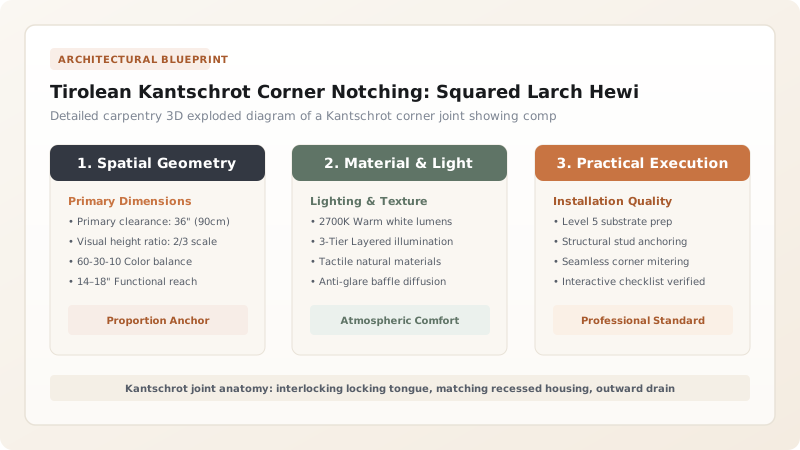
Hewing Mechanics: Converting Round Larch into Rectangular Baulks
Unlike Scandinavian or Russian log builders who often used round scribed logs, alpine carpenters in the Tirol converted logs into flat, rectangular baulks (Kantholz). This transformation maximized interior floor space, provided flat surfaces for mounting furniture, and eliminated dust-catching horizontal ledges.
Master carpenters hewed logs using heavy single-bevel broadaxes (Breitbeil). After scoring reference chalk lines, the carpenter stood atop the log, slicing off side slabs in long, continuous downward shearing strokes. The finished baulks were uniform in thickness (typically 18 cm) but often varied in height from 25 to 35 cm, following the natural taper of the tree trunk.
Geometric Anatomy: The Compound Facets of the Kantschrot
The name Kantschrot derives from Kante (edge or square timber) and Schrot (carpentry notch). The joint represents an evolution from simple half-lap notches into a three-dimensional interlocking puzzle.
The joint incorporates four distinct geometric planes: a flat horizontal load-bearing shoulder that carries the vertical dead-weight of the upper courses; an internal locking tenon or tongue that prevents the log from sliding outward along its axis; a transverse dovetail cheek that resists inward room-buckling; and a steep outward-sloping 45-degree chamfer (Wasserschnitt). This outward chamfer ensures that any rain or melting snow running down the corner is projected away from the joint rather than being drawn inward by capillary attraction.
Thermal Sealing: The Biology of Bleikmoos (Sphagnum Moss)
A solid timber wall expands and contracts constantly with changing alpine humidity. Sealing the horizontal seams between logs demands a chinking material that remains flexible, compressible, and rot-resistant over decades. Alpine builders relied exclusively on Bleikmoos (sphagnum peat moss, Sphagnum palustre).
Harvested from high alpine bogs in late summer, the moss was dried and packed into shallow longitudinal grooves (Moosrille) gouged along the top of each log before the next course was placed. Sphagnum moss possesses extraordinary biological properties: its dead hyaline cells can absorb up to 20 times their dry weight in moisture while remaining breathable, and its natural phenolic compounds (sphagnic acid) inhibit bacteria and fungal rot, preserving the wood contact surfaces for centuries.
Internal Structural Pinning: Oak Dübel and Buckling Restraint
To prevent long, slender log walls from bowing outward under heavy snow loads or internal room pressure, alpine carpenters installed internal vertical hardwood drift pins (Dübel).
Every 1.5 to 2.0 meters along the wall, vertical holes were augered through two adjacent log courses. Octagonal pins hand-cleaved from seasoned oak or mountain ash heartwood were driven through the holes. These pins allowed the logs to settle vertically as the green wood seasoned, but prevented any lateral movement or out-of-plane bowing during high winds or ground tremors.
Alpine Log Corner Joint Typologies & Engineering Characteristics
Use this reference table to calculate exact physical dimensions, ratios, and specifications before purchasing:
| Corner Joint Name | Log Cross-Section | Water Shedding Capability | Tensile Interlock Strength | Regional Distribution |
|---|---|---|---|---|
| Tirolean Kantschrot | Squared rectangular baulks (18x25 cm) | Superior (integral 45° Wasserschnitt) | Maximum (multi-plane compound locking) | North and South Tyrol, Vorarlberg, Dolomites |
| Klingschrot (Dovetail) | Squared timber baulks | Moderate (requires external corner boards) | Very High (flared dovetail resistance) | Salzburg, Upper Austria, Bavarian Alps |
| Münsterwalder Schrot | Half-round or plank logs | Low (prone to moisture traps at base) | Moderate (simple stepped lap) | Eastern Alps, Carinthia, Styria |
| Rundholz-Sattelkerbe | Natural round logs (unhewn) | Poor (moisture collects in saddle) | Moderate (friction fit only) | High-altitude hay barns and summer Alm huts |
Practical Constraints
Every successful decoration project must account for physical and environmental constraints:
Substantial Tangential Shrinkage During In-Situ Seasoning
Green larch logs shrink tangentially by up to 5% across their height, causing a 3-meter wall to drop by 10 to 15 cm over its first 3 years. Mitigation: Incorporate sliding T-splines (Schiebeleisten) on all window and door jambs and leave 12-cm expansion voids above headers packed with moss.
Physical Labor of Manual Broadaxe Hewing
Hewing a full house of 18-cm larch baulks requires hundreds of hours of intense physical chopping by experienced timberwrights. Mitigation: Utilize modern sawmill bandsaws to rough-cut logs to square dimensions, finishing exterior faces with traditional hand adzes for authentic texture.
High Resin Friction During Precision Corner Sawing
Larch heartwood is packed with sticky resin that gums up saw teeth and creates friction heat that burns tool cutting edges. Mitigation: Lubricate saw blades continuously with natural mineral spirits or kerosene and maintain dedicated wide-set Japanese framing pull-saws.
Execution Blueprint & Craftsmanship Sequence
Execute this professional sequence to achieve flawless results without backtracking:
Squaring Log Baulks with Chalk Lines and Broadaxes
Snap plumb chalk lines on opposing sides of a winter larch log. Score waste wood with a felling axe and hew dead-flat using a single-bevel Austrian broadaxe.
Gouging the Central Longitudinal Moss Groove
Gouge a continuous 30 mm wide, 10 mm deep shallow trough along the center of the top face using a curved adze to receive the sphagnum chinking.
Marking Kantschrot Angles with Master Zinc Templates
Lay out the compound locking angles and outward-sloping 45-degree Wasserschnitt bevel on the log ends using precision sheet-metal scribing templates.
Sawing and Chiseling the Compound Corner Notch
Make relief cuts with a sharp framing saw. Chisel away waste wood with heavy corner chisels to create mirror-smooth interlocking cheeks and tenons.
Distributing Dried Bleikmoos Chinking
Spread a continuous, thick bed of dried alpine sphagnum moss into the longitudinal groove and across the corner joint shoulders.
Driving Vertical Oak Alignment Pins (Dübel)
Seat the new log atop the course, compress firmly, auger 30 mm vertical holes through two courses, and drive dry cleft-oak pins flush.
Common Mistakes & Countermeasures
Avoid these costly errors that compromise aesthetics, ergonomics, and budget:
Omitting the Outward Drainage Bevel (Wasserschnitt)
Using Synthetic Expanding Spray Foam for Log Chinking
Using Round Steel Reinforcing Bars Instead of Wooden Dübel
Project Execution Checklist
Track your physical progress. Checkboxes persist automatically on this device:
Frequently Asked Questions
What is the advantage of the Kantschrot over a standard dovetail joint?
While a standard dovetail resists horizontal pulling, the Tirolean Kantschrot incorporates an integrated outward-sloping water-shedding bevel (Wasserschnitt) that prevents rain from entering the joint, while multi-faceted internal cheeks lock the log in both directions.
Why is sphagnum moss used between logs instead of lime mortar?
Sphagnum moss (Bleikmoos) contains natural antiseptic acids that prevent mold and rot. Unlike rigid lime mortar, which cracks and falls out as logs shrink and expand, moss acts like a resilient natural spring that remains airtight under continuous log movement.
How do carpenters handle wall shrinkage in Blockbau houses?
Because horizontal logs shrink across their width as they dry, an entire wall can settle 10 to 15 centimeters. Carpenters leave wide empty pockets (settlement gaps) above all window and door frames, concealing them behind floating wooden trim boards.
Can round logs be used for Kantschrot joinery?
No. The Kantschrot is designed specifically for squared or rectangular hewn timbers (Kantholz). Round logs use different corner notching systems, such as round saddle notches or scribed coves.


