
Legschindeln are traditional alpine wooden roof shingles hand-cleft from straight-grained European larch heartwood. Laid loose in triple-overlapping courses across low-pitched roof laths without metallic nails, the shingles are held in place against ferocious alpine gales by horizontal round spruce poles (Schwerstangen) weighted down with massive alpine river boulders. This nail-free ballast roofing system allows wood shingles to expand and contract freely during wet and dry cycles, shedding water naturally while enduring over 50 years of heavy alpine snow loads.
At a Glance: Key Takeaways
- Ballast Load: Smooth alpine river boulders (15–30 kg each, 150–250 kg/m² total)
- Fastener System: 100% nail-free loose-laid; weighted with Schwerstangen timber poles
- Shingle Dimensions: 50 to 65 cm length, 12 to 18 cm width, 12 mm butt tapering to 4 mm
- Shingle Material: Straight-grained cleft European Larch (Larix decidua, Lärchenholz)
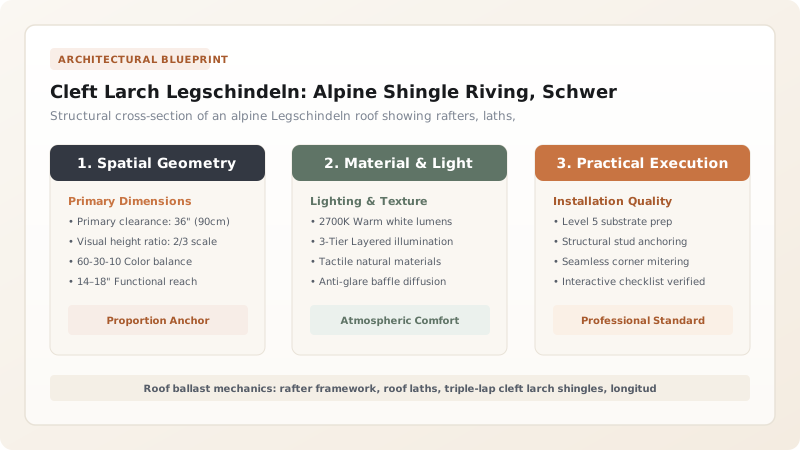
Shingle Riving Science: The Froe, the Mallet, and Fiber Continuity
A high-altitude wooden shingle must never be sawn. Sawn shingles cut across the natural vascular tubes of the wood, exposing millions of open capillary tubes that wick rainwater into the core, causing rot, cupping, and lichen colonization within a decade.
Instead, master shingle-makers (Schindelmacher) split shingles by hand using a froe (Spaltklinge) and wooden club. Working with fresh, slow-growth larch bolts free of spiral grain, the artisan rives the wood radially along the natural medullary rays. This hand-splitting process tears the wood along its natural grain boundaries, leaving the cellular walls intact and burnished. Water droplets bead up and slide off the surface without penetrating, giving cleft larch shingles a lifespan exceeding 50 to 70 years.
Laying Geometry: Triple Overlap and Loose-Laid Mechanics
The term Legschindel translates literally as 'laid shingle'—distinguishing it from nailed shingles (Nagelschindeln). These shingles are substantial: roughly 60 centimeters long, 15 centimeters wide, and tapering from 12 mm at the butt to 4 mm at the head.
Artisans lay the shingles directly onto horizontal roof battens in a triple overlap (dreifache Deckung). Only the bottom one-third (roughly 18 to 20 cm) of each shingle is exposed to the weather; the upper two-thirds are protected beneath the two overlapping courses above. Crucially, the shingles are laid loose—completely free of nails or mechanical clips. When rains soak the roof, the wood expands freely across its width without the internal splitting stresses that destroy nailed shingles.
Ballast Physics: The Schwerstange and Alpine Boulder Retention
To prevent violent valley windstorms and mountain updrafts from stripping the loose shingles from the roof, alpine builders developed the Schwerstange (weight-pole) system. Long, peeled spruce or larch poles measuring 10 to 12 cm in diameter are laid horizontally across the roof, spaced roughly 50 to 60 cm apart.
These poles are held in place by wooden knee brackets (Schindelknechte) mortised into the underlying rafters. Across these poles, builders place large, smooth alpine river boulders weighing 15 to 30 kg each. The stones are spaced evenly across the entire roof surface, providing an even gravity pre-compression of 150 to 250 kg per square meter. This continuous downward pressure holds the shingle matrix firmly against the battens while allowing air to circulate freely beneath the shingles, promoting rapid drying after rain.
Snow Management: Thermal Insulation and Avalanche Prevention
In contemporary lowland construction, roofs are pitched steeply to shed snow as quickly as possible. In the high Alps, the opposite philosophy prevails: a Legschindeldach is built with a shallow pitch (between 18° and 24°) precisely to retain snow.
The rough, weathered texture of the cleft larch shingles and the protruding Schwerstange boulders create immense frictional drag. When heavy winter snow falls, it cannot slide off in dangerous roof avalanches; instead, a thick, uniform 1- to 2-meter blanket of snow accumulates across the entire roof. This stable snowpack functions as an extraordinary natural thermal insulation blanket (effective R-value exceeding R-30), preventing interior hearth heat from escaping into the sub-zero mountain sky.
Alpine Wooden Roof Systems & Exposure Profiles
Use this reference table to calculate exact physical dimensions, ratios, and specifications before purchasing:
| Shingle Typology | Fastening System | Average Shingle Length | Recommended Roof Pitch | Typical Service Life |
|---|---|---|---|---|
| Legschindeldach (Weighted) | Loose-laid + Schwerstange poles & river rocks | 50 cm to 65 cm | 18° to 24° (snow-retaining) | 50 to 75 years (re-turned at 25 years) |
| Nagelschindeldach (Nailed) | Direct-nailed with hand-forged copper nails | 35 cm to 45 cm | 35° to 50° (steep shedding) | 30 to 45 years (vulnerable to nail splitting) |
| Scharschindeln (Church Spire) | Beveled precision shingles; nailed double-lap | 25 cm to 35 cm | 60° to 80° (vertical spires) | 40 to 60 years (demands premium slow-growth) |
| Nutschindeln (Grooved/Tongued) | Interlocking edge tongue-and-groove | 40 cm to 50 cm | 25° to 35° (moderate pitch) | 25 to 35 years (grooves trap damp needles) |
Practical Constraints
Every successful decoration project must account for physical and environmental constraints:
Extreme Structural Dead-Load on Alpine Timber Roof Trusses
Combining heavy larch shingles (35 kg/m²), rock ballast (180 kg/m²), and winter snowpack (400 kg/m²) creates total roof loads exceeding 600 kg/m². Mitigation: Frame roof rafters with minimum 18x24 cm squared spruce logs spaced closely at 60 cm centers, supported by heavy intermediate purlin walls.
Labor-Intensive 25-Year Roof Maintenance ('Umdecken')
After 25 years, exposed shingle tails weather; the entire roof must be dismantled to clean and re-lay the shingles. Mitigation: Execute traditional 'Umdecken': lift the rocks, turn each shingle end-for-end (placing the weathered tail up under the lap), doubling total roof lifespan.
Scarcity of Experienced Master Shingle Splitters
The physical stamina and tactile judgment required to rive straight shingles with a froe are rare among modern industrial roofers. Mitigation: Support regional alpine forestry guilds and agricultural vocational schools that preserve heritage cleft-shingle craft certifications.
Execution Blueprint & Craftsmanship Sequence
Execute this professional sequence to achieve flawless results without backtracking:
Selecting Straight-Grained Larch Shingle Bolts
Select slow-growth mountain larch logs free of spiral grain. Cross-cut into 60 cm bolts, splitting out the center pith to eliminate core tension.
Riving Shingles with a Froe and Mallet
Drive a steel froe radially into the log end along medullary rays using a heavy wooden club, prying off 12-mm-thick cleft shingle blanks.
Dressing and Tapering with a Drawknife on a Shaving Horse
Clamp each shingle in a foot-operated shaving horse (Schnitzbank). Taper the top two-thirds down to 4 mm using a two-handled curved drawknife.
Laying Loose-Laid Triple-Lap Shingle Courses
Lay shingles across horizontal roof battens in triple overlap, leaving a 5 mm lateral expansion gap between adjacent shingles to accommodate swelling.
Mounting Schwerstange Retaining Poles and Knees
Fasten carved wooden knee brackets (Schindelknechte) to extended rafter tails. Lay peeled round spruce Schwerstange poles horizontally across shingles.
Distributing Alpine River Rock Ballast
Hoist smooth, rounded alpine river boulders (20 kg average) onto the roof, nesting them securely against the upstream side of each Schwerstange pole.
Common Mistakes & Countermeasures
Avoid these costly errors that compromise aesthetics, ergonomics, and budget:
Using Spiral-Grained (Drehwüchsig) Timber for Shingles
Laying Shingles Tightly Edge-to-Edge Without Expansion Gaps
Using Sharp, Angular Quarry Stones for Ballast
Project Execution Checklist
Track your physical progress. Checkboxes persist automatically on this device:
Frequently Asked Questions
How long does an alpine cleft larch shingle roof last?
A hand-cleft larch Legschindeldach lasts 50 to 70 years. At roughly the 25-year mark, homeowners perform 'Umdecken'—turning the shingles upside-down and end-for-end so the unweathered upper half faces the weather, effectively providing two full lifespans from a single batch of wood.
Why don't builders use nails to fasten Legschindeln?
Nails create rigid anchor points. In the Alps, where temperatures swing from -25°C in winter to +30°C in summer, wood shingles expand and shrink dramatically. Nailed shingles split around nail holes and rot; loose-laid, rock-weighted shingles expand freely without stress.
What keeps the heavy stones from rolling off the roof?
The gentle slope of the roof (around 20 degrees) combined with horizontal wooden poles (Schwerstangen) anchored into rafter brackets keeps the smooth boulders firmly nested in place against the poles.
Can snow slide off a Legschindeldach and hurt people below?
No. Unlike smooth metal or glazed tile roofs where snow slides off in sudden dangerous avalanches, the rough texture of wooden shingles and protruding rock poles locks the snowpack securely to the roof until it melts slowly in spring.


