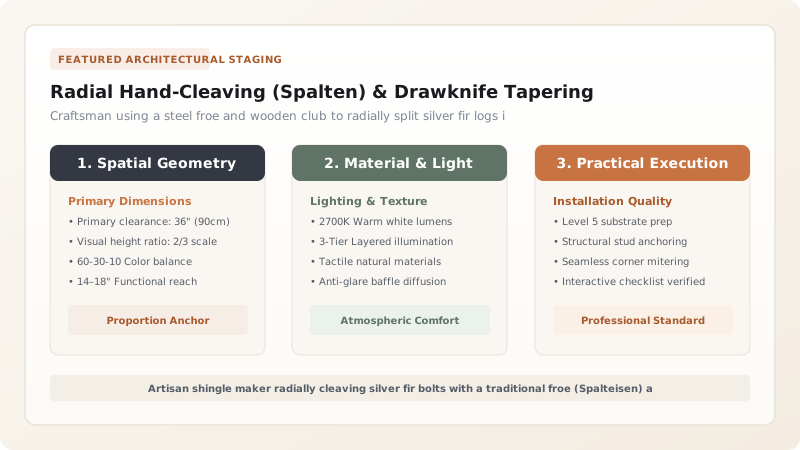
Radial hand-cleaving (Spalten) is the foundational artisan process that gives Bregenzerwald shingles their unmatched water repellency and century-long durability. Using a specialized hand froe (Spalteisen) struck by a wooden club, the shingle maker splits straight-grained mountain fir bolts radially outward from the heart to the sapwood along natural medullary rays, keeping every longitudinal wood fiber completely uncut. The cleft shingle is then clamped into a foot-operated shaving horse (Schnitzbank) and tapered with a curved drawknife (Ziehmesser) to a feather-thin head and thick butt.
At a Glance: Key Takeaways
- Cleaving Tool: Forged carbon steel froe (Spalteisen / Schindelmesser)
- Striking Mallet: Turned beech or hornbeam club mallet (Schlägel)
- Shaving Apparatus: Traditional foot-pedal wooden shaving horse (Schnitzbank / Hoazelbank)
- Shaping Tool: Curved two-handled carbon steel drawknife (Ziehmesser)
- Fiber Integrity: 100% uncut, continuous longitudinal capillary vessels
The Physics of Wood Cleavage: Why Fibers Must Remain Intact
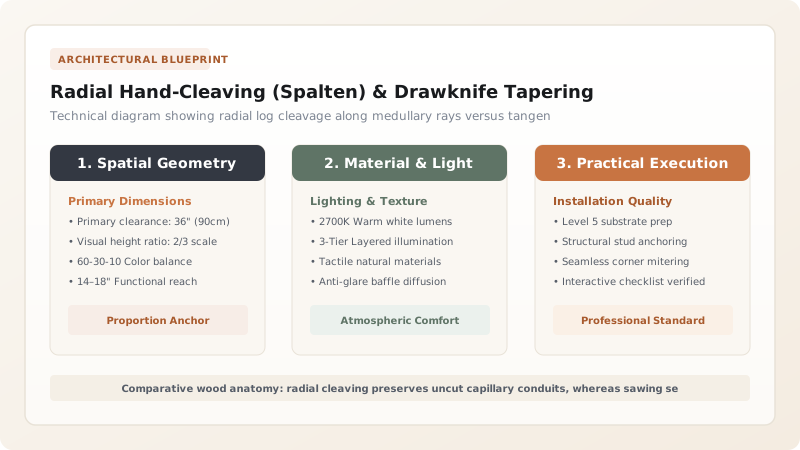
To understand why traditional Bregenzerwald wood shingles outlast modern machine-milled siding by decades, one must examine wood at the microscopic cellular level. A coniferous tree trunk is composed of billions of elongated, hollow cellulose cells called tracheids, aligned parallel to the vertical axis of the tree. These microscopic conduits function during the tree’s life as pressurized pipelines transporting water and minerals from roots to canopy.
When wood is cut with a mechanical circular saw or band saw, the spinning steel teeth slice indifferently across these cellular conduits at arbitrary angles, severing millions of tube walls and exposing open capillary lumens to the atmosphere. When rain strikes a sawn shingle, these severed tubes act like micro-drinking straws, sucking water deep into the core via capillary action. In sharp contrast, radial hand-cleaving (Spalten) applies mechanical wedge tension that forces the wood to split along the path of least resistance—parting the cells along their natural intercellular middle lamella without fracturing the cell walls. The resulting cleft surface presents an unbroken, continuous armor of intact cellulose fibers that sheds water instantly.
The Master Cleaving Tools: Spalteisen & Schlägel Mechanics
The artisanal splitting of shingle bolts is performed using specialized, hand-forged tools unchanged since the Middle Ages. The central instrument is the Spalteisen (froe), a heavy carbon-steel blade measuring roughly 350 mm in length, with a blunt, robust spine and an eye forged at one end to receive an upright ash-wood handle. The craftsman places the edge of the froe across the top end-grain of the shingle bolt, aligned strictly along the radial plane from pith to bark.
Using a heavy cylindrical wooden mallet turned from dense European hornbeam or beech (the Schlägel), the shingle maker strikes the spine of the froe to seat the blade 20 mm into the end grain. The mallet is then set aside, and the long wooden handle is grasped with both hands. By pushing and pulling the handle, the craftsman leverages the blade like a crowbar. This rotational torque tears the wood open along its radial medullary rays, propagating a clean, straight split from top to bottom in a fraction of a second.
The Shaving Horse (Schnitzbank) & Ergonomic Tapering
A freshly cleft shingle blank is relatively thick (10 to 12 mm) and parallel-sided. If nailed to a wall in this state, the overlapping courses would kick outward awkwardly, creating wide voids that catch wind-driven rain and snow. To ensure a tight, planar, weather-tight lap, the shingle must be tapered along its length. This delicate shaping is performed on a traditional foot-operated clamping bench called the Schnitzbank (shaving horse, or Hoazelbank).
The artisan sits astride the wooden bench, resting their feet upon a pivoting wooden swing-frame. Depressing the foot pedal swings a heavy wooden clamping head forward, pinning the cleft shingle securely against the angled worktable with hundreds of pounds of mechanical force. With both hands free, the craftsman takes the Ziehmesser (drawknife)—a curved, razor-sharp two-handled blade—and draws it smoothly toward their chest. In three or four practiced, sweeping passes, the upper two-thirds of the shingle is tapered down to a feather-thin head of just 2 to 3 mm, while the bottom butt is left at its full structural thickness of 8 to 10 mm to face the weather.
Sorting, Grading & Grain Selection for Alpine Exposures
Quality control in Bregenzerwald shingle making is uncompromising. As each shingle is shaved, the craftsman assesses its grain alignment, flexibility, and fiber density. Shingles are sorted into three distinct structural grades: First-Grade Standing Ring (vertical grain oriented strictly 90° to the face), Second-Grade Semi-Radial, and Utility Grade.
Only first-grade standing-ring shingles are selected for exterior wall facades and high-exposure roof slopes. Standing-ring wood exhibits virtually zero tangential shrinkage, eliminating the risk of cupping, warping, or lateral splitting under extreme alpine temperature swings. Second-grade shingles are reserved for sheltered soffits, gable under-eaves, and agricultural barns. Shingles that fail inspection are immediately set aside for kindling; in the rigorous ethic of Vorarlberg craftsmanship, a single flawed shingle could compromise an entire wall intended to endure for a century.
Anatomy of Hand-Cleaved vs Machine-Sawn Shingles
Use this reference table to calculate exact physical dimensions, ratios, and specifications before purchasing:
| Technical Criterion | Hand-Cleaved (Spalt-Schindel) | Machine-Sawn (Säge-Schindel) | Artisan Significance |
|---|---|---|---|
| Capillary Conduit Status | Intact, uninterrupted cell tubes | Severed by spinning circular saw blade | Cleaved shingles shed rain immediately; sawn shingles absorb water like sponges |
| Surface Texture | Silky, ridged along natural annual rings | Fuzzy, scarred by micro-saw kerf marks | Cleaved texture speeds water runoff and sheds algae spores effortlessly |
| Grain Alignment | Strictly radial (standing growth rings) | Often tangential or mixed flat-grain | Radial cleft wood has zero cupping or transverse warping tendency |
| Dimensional Taper | Hand-tapered with drawknife (8 mm butt to 2 mm head) | Uniform machine wedge profile | Hand taper allows flexible nesting against irregular log or timber substrates |
| Expected Service Life | 80 to 120+ years untreated | 20 to 35 years untreated | Hand cleaving quadruples service life through biological fiber preservation |
Practical Constraints
Every successful decoration project must account for physical and environmental constraints:
Physical exhaustion and repetitive strain from manual froe and drawknife work
A master craftsman can produce only 400 to 600 finished shingles per day by hand Mitigation: Utilize ergonomic foot-pedal shaving horses with adjustable clamping jaws and maintain razor-sharp tool bevels
High timber wastage when selecting knot-free slow-grown alpine logs
Only 30% to 40% of an alpine log round meets the flawless straight-grained standard for cleaving Mitigation: Repurpose off-cuts, slab wood, and knotty core hearts for biomass heating or interior timber joists
Execution Blueprint & Craftsmanship Sequence
Execute this professional sequence to achieve flawless results without backtracking:
Log Round Cross-Cutting & Bolt Prep
Cross-cut winter-felled silver fir trunks into exact 330 mm cylindrical bolts, discarding sections with branch whorls.
Radial Quartering Along Medullary Rays
Drive steel splitting wedges into the bolt ends, dividing the cylinder into quarters radiating precisely outward from the core.
Heartwood & Sapwood Removal
Chop away the soft inner pith core and outer perishable sapwood band, retaining only dense, durable heartwood.
Froe Cleaving (Spalten)
Set the blade of the hand froe (Spalteisen) across the radial face, striking the spine with a wooden club to cleave off a 10 mm blank.
Prying & Fiber Separation
Lever the long froe handle backward and forward; the controlled mechanical prying forces the wood to split cleanly along its natural grain.
Clamping on the Shaving Horse
Sit astride the wooden shaving horse (Schnitzbank), depressing the foot pedal to lock the cleft blank firmly beneath the wooden clamping head.
Drawknife Tapering & Beveling
Pull the curved drawknife toward your chest in long, rhythmic strokes, tapering the upper head down to 2 mm while maintaining an 8 mm butt.
Edge Dressing & Bundling
Square both lateral edges with light drawknife passes, bundling 100 shingles tightly with hazel withies for slow air seasoning.
Common Mistakes & Countermeasures
Avoid these costly errors that compromise aesthetics, ergonomics, and budget:
Attempting to cleave logs that exhibit spiral grain (Drehwuchs)
Shaving across the grain rather than down the slope of the fibers on the shaving horse
Kiln-drying cleft shingles with rapid forced heat
Project Execution Checklist
Track your physical progress. Checkboxes persist automatically on this device:
Frequently Asked Questions
What is a 'froe' (Spalteisen) and how does it work?
A froe (known in Austrian dialect as a Spalteisen or Schindelmesser) is an L-shaped cleaving tool consisting of a heavy, rigid carbon steel blade set at a right angle to a long vertical wooden handle. The blade is hammered into the end-grain of the wood bolt; once embedded, the craftsman levers the handle to exert immense mechanical prying force, tearing the wood cleanly along its natural grain line.
Why is heartwood required while sapwood is discarded?
Sapwood is the living outer layer of the tree containing active sugars, starches, and nutrients that attract fungi and wood-boring larvae. Heartwood is dead, chemically stable inner wood filled with natural phenolic extractives that resist rot and insect attack.
Can machine-split shingles match the quality of hand-split shingles?
Hydraulic shingle splitters speed up initial bolt cleaving, but cannot sense subtle shifts in grain direction. A master craftsman feels the grain yielding beneath the hand froe and instantly adjusts handle torque to keep the split running true. Hand-cleft shingles remain the gold standard for high-end Vorarlberg architecture.