Bregenzerwald wood shingle cladding (Holzschindeln) is a legendary alpine architectural craft from Vorarlberg, western Austria. High-altitude mountain spruce, silver fir, and cedar are hand-cleaved radially along natural growth rings to preserve uncut wood fibers, then hand-tapered with drawknives. Installed in meticulous triple-overlap configurations (Dreifachdeckung) with copper nails over ventilated battens, these shingles create a breathable, chemical-free building envelope that withstands severe alpine snow and rain, naturally transforming into a stunning silver-grey protective patina that lasts over a century.
At a Glance: Key Takeaways
- Geographic Origin: Bregenzerwald, Vorarlberg, Western Austria
- Preferred Wood Species: Winter-felled mountain silver fir (Weißtanne), spruce (Bergfichte), and cedar/larch
- Production Craft: Radial hand-cleaving with froe (Spalten) & drawknife shaving (Ziehmesser)
- Installation Typology: Triple-overlap wall cladding (Dreifachdeckung) with rear ventilation cavity
- Facade Lifespan: 80 to 120+ years completely untreated and chemical-free
In-Depth Guides in this Directory
Explore specialized subtopic blueprints, technical dimensions, and execution checklists:
Radial Hand-Cleaving (Spalten) & Drawknife Tapering in Bregenzerwald Shingles
Master the art of radial hand-cleaving (spalten) with froe and drawknife tapering on shaving horses for authentic Bregenzerwald shingles.
Triple-Overlap Installation & Copper Tack Staggering for Alpine Shingle Facades
Learn the precision installation geometry, triple-overlap layout (Dreifachdeckung), and copper tack fastening of Bregenzerwald shingle facades.
Alpine Solar Weathering & Silver-Grey Patina Cycles in Raw Shingle Siding
Explore the photochemistry, micro-ecology, and chromatic silver-grey patina cycles of untreated Bregenzerwald wood shingles.
The Forest Ecology & Craft Heritage of Vorarlberg Shingle Architecture
In the rugged mountain valleys of the Bregenzerwald in western Austria, timber is not merely a building material; it is the cultural and economic lifeblood of the landscape. Enclosed by steep limestone massifs and receiving over 2,000 millimeters of annual precipitation in the form of torrential alpine rain and heavy winter snowpacks, vernacular builders in Vorarlberg developed an ingenious, self-healing exterior skin: the Holzschindel (wooden shingle).
The traditional Bregenzerwälderhaus combined farmhouse, barn, and cattle stable under a single vast, unified roof. To shield these massive timber-frame structures from relentless alpine weathering, craftsmen enveloped entire facades—walls, gables, dormers, and roof planes—in hundreds of thousands of tiny, hand-cleaved wooden shingles. Far from fading into history, this craft underwent a spectacular renaissance in the late 20th century under the Vorarlberg School of Architecture, where minimalist contemporary architects merged traditional shingle-making with ultra-precise passive house building physics.
Botany of Mondholz: Mountain Silver Fir & Slow-Grown Spruce
The longevity of Bregenzerwald shingle cladding begins in the alpine forest. The preferred species is Weißtanne (silver fir, Abies alba), complemented by Bergfichte (mountain spruce, Picea abies) and alpine larch. Trees must grow at altitudes above 1,000 meters on steep, north-facing slopes, where cold temperatures and short growing seasons force the tree to produce extraordinarily dense, tight annual growth rings—frequently less than 1.0 mm apart.
Furthermore, timber is harvested strictly according to the ancient tradition of Mondholz (moon wood)—felled during the deep winter freeze in December and January during the waning moon. At this physiological juncture, sap circulation has ceased, cellular water content is at its annual minimum, and wood sugars that attract fungal spores and boring insects are depleted. Silver fir is particularly prized because, unlike pine or spruce, it contains virtually no resin channels; its pores are naturally saturated with water-resistant tyloses, allowing it to weather into a silky, uniform silver-grey patina without unsightly resin bleeding.
The Triple-Overlap Geometry (Dreifachdeckung): High-Performance Rain Protection
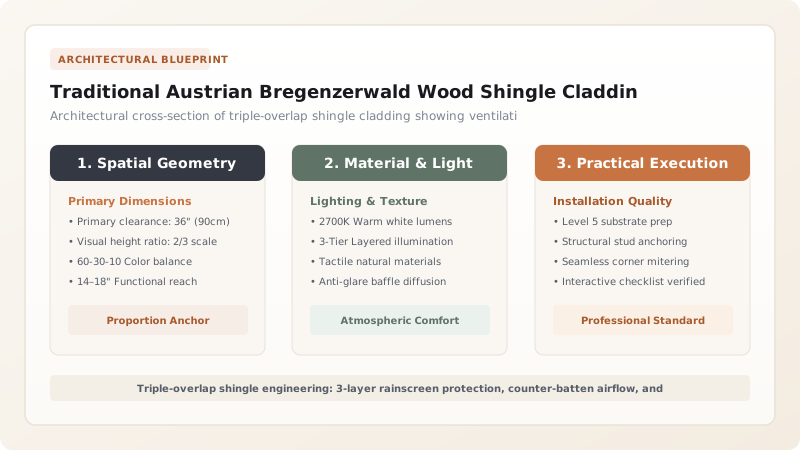
A shingle facade is not a cosmetic siding panel; it is a sophisticated, multi-tiered micro-rainscreen. In Bregenzerwald construction, wall shingles are installed strictly according to the rule of Dreifachdeckung (triple-overlap). Each shingle is cleaved to a length of approximately 300 to 360 mm. When mounted on horizontal wooden battens, each subsequent course overlaps the preceding ones such that only one-third of the shingle's length (100 to 120 mm) remains exposed to the weather.
Consequently, at any arbitrary point on the facade, three independent layers of solid wood stand between the exterior environment and the interior structure. Driving rain must breach three successive shingle barriers before reaching the sub-frame. The shingles are mounted over vertical counter-battens that create a continuous 25 mm rear ventilation cavity (Hinterlüftung). Natural convective draft in this cavity instantly draws away any microscopic vapor that penetrates the joints, ensuring the wood dries rapidly after every storm and completely preventing rot.
Chemical-Free Durability & Sustainable Alpine Modernism
In an era dominated by synthetic petroleum-based claddings, plastic vapor barriers, and toxic chemical wood preservatives, Bregenzerwald shingle cladding stands as a triumph of biological engineering. The shingles receive zero paint, zero chemical pressure treatment, and zero clear varnishes. The wood relies solely on its natural cellular structure and solar-driven oxidation to protect itself against the elements.
When a shingled facade reaches the end of its operational lifespan—often 80 to 120 years after installation—the wood is 100% biodegradable and non-toxic. During its century of service, the building envelope acts as a permanent carbon sink, sequestering atmospheric carbon dioxide while providing superior acoustic insulation against mountain winds. Bregenzerwald shingle craft proves that the most advanced sustainable architecture is often the perfection of an ancestral vernacular technique.
Alpine Shingle Siding: Material Selection & Performance Matrix
Use this reference table to calculate exact physical dimensions, ratios, and specifications before purchasing:
| Wood Species | Cleaving Characteristics | Tannin / Resin Content | Patina Chromatic Evolution | Expected Lifespan |
|---|---|---|---|---|
| Silver Fir (Weißtanne) | Straight radial grain; exceptionally clean cleavage | Resin-free; high cellulose purity | Uniform shimmering silver-grey (Silbergrau) | 90–120 years |
| Mountain Spruce (Bergfichte) | Fine, dense annular rings (<1 mm width) | Low resin; high elasticity | Muted weathered graphite to slate grey | 70–90 years |
| Alpine Larch (Lärche) | Dense, heavy heartwood; harder to cleave | High resin content & water repellency | Deep reddish-brown shifting to charcoal grey | 100–140 years |
| Swiss Stone Pine / Cedar (Zirbe) | Aromatic, soft, tight grain structure | High natural pinosylvin biocides | Warm golden amber shifting to soft silver | 80–110 years |
| Machine-Sawn Western Red Cedar | Cross-cut severed capillaries | Variable depending on cut angle | Uneven blotchy grey; prone to surface moss | 25–35 years |
Practical Constraints
Every successful decoration project must account for physical and environmental constraints:
Microclimatic exposure differentials across North vs South facade orientations
South walls receive intense UV turning golden-brown, while north walls stay damp and turn dark grey Mitigation: Design generous roof overhangs (600–900 mm) to equalize rainwater wash across all orientations
Labor intensity and specialized artisan scarcity for hand-cleaved shingles
Hand-shaving thousands of individual shingles demands significant artisan lead time and budget Mitigation: Prefabricate modular shingle cassette panels in winter workshops ahead of on-site summer assembly
Execution Blueprint & Craftsmanship Sequence
Execute this professional sequence to achieve flawless results without backtracking:
Winter Felling & Mondholz Selection
Fell mature silver fir and spruce growing above 1,000 m elevation in mid-winter when sap flow is completely dormant.
Radial Cleaving with Froe (Spalten)
Split shingle bolts radially into pie-shaped wedges along medullary rays using a heavy steel froe and beechwood club.
Drawknife Tapering on Shaving Horse
Clamp each cleft shingle on a foot-pedal shaving horse (Schnitzbank), beveling the head to 2 mm while preserving an 8 mm butt.
Rear-Ventilated Substructure Framing
Install vertical 25 x 50 mm counter-battens over a breathable windproof membrane, topped with horizontal spruce laths.
Starter Course Doubling
Fix a double starter course along the base perimeter flashing, staggering joints by at least 50 mm to shed splash water.
Triple-Overlap Course Geometry
Lay subsequent courses with 1/3 weather exposure (e.g. 110 mm exposure on 330 mm shingles) to ensure three continuous wood layers.
Precision Copper Nailing
Drive two copper ring-shank nails per shingle approximately 20 mm above the exposure line, hidden by the overlapping tier above.
Corner Weaving & Flashing Integration
Weave corner shingles in overlapping alternating courses or miter tightly against vertical timber corner cornerboards.
Common Mistakes & Countermeasures
Avoid these costly errors that compromise aesthetics, ergonomics, and budget:
Using machine-sawn shingles instead of hand-cleaved (hand-split) shingles
Applying synthetic polyurethane clear coats or chemical stains to 'protect' the raw wood
Fastening shingles with cheap electro-galvanized steel nails or framing staples
Project Execution Checklist
Track your physical progress. Checkboxes persist automatically on this device:
Frequently Asked Questions
Why is Bregenzerwald shingle architecture celebrated in contemporary modern design?
Pioneered by the Vorarlberg School of Architecture (Vorarlberger Bauschule), architects like Hermann Kaufmann and Peter Zumthor demonstrated that hand-crafted Bregenzerwald shingles are not nostalgic pastiche, but the ultimate high-performance bioclimatic building envelope: 100% renewable, locally sourced, breathable, durable, and aesthetically stunning without paint.
What is the difference between hand-split and machine-sawn shingles?
Hand-split shingles follow the natural cellular fiber of the wood without tearing it. Sawn shingles are cut with circular or band saws that sever millions of microscopic wood cells, exposing open capillary tubes that wick moisture deep into the core of the wood, promoting fungal rot and warping.
Do wooden shingles pose a severe exterior fire risk?
When installed in dense triple-overlap configurations with tight joint margins and rear ventilation, cleaved silver fir shingles exhibit remarkable fire resistance. Without air between the tightly packed shingle layers, the wood chars slowly from the outside, creating an insulating carbon barrier that retards flame spread.
How long does it take for raw wooden shingles to turn silver-grey?
The transition begins within months. In high-altitude alpine settings with strong UV radiation, unshielded facades transition from fresh pale straw to warm honey, then to silver-grey within 2 to 5 years, depending on sun exposure and annual rainfall.