The iconic silver-grey patina of Bregenzerwald wooden facades is the result of a sophisticated natural photochemical and biological weathering process. Left entirely untreated, raw silver fir and spruce shingles undergo solar photo-oxidation: high-altitude ultraviolet radiation breaks down complex wood lignin at the surface, which is washed away by rain to expose pure, light-reflective white cellulose fibers. Micro-colonization by benign dark-pigmented micro-fungi (Aureobasidium pullulans) then transforms the exterior into a durable, self-regulating silver-grey protective shield that never needs painting.
At a Glance: Key Takeaways
- Weathering Mechanism: UV photo-oxidation of lignin + rainwater leaching + cellulose exposure
- Protective Micro-Organism: Aureobasidium pullulans (benign black yeast / surface micro-fungus)
- Color Progression: Fresh pale straw -> warm honey amber -> graphite umber -> luminous silver-grey
- Orientation Contrast: South facades turn golden-brown; North/West facades turn lustrous silver-grey
- Maintenance Requirement: Zero paints, zero chemical sealers, zero ongoing surface interventions
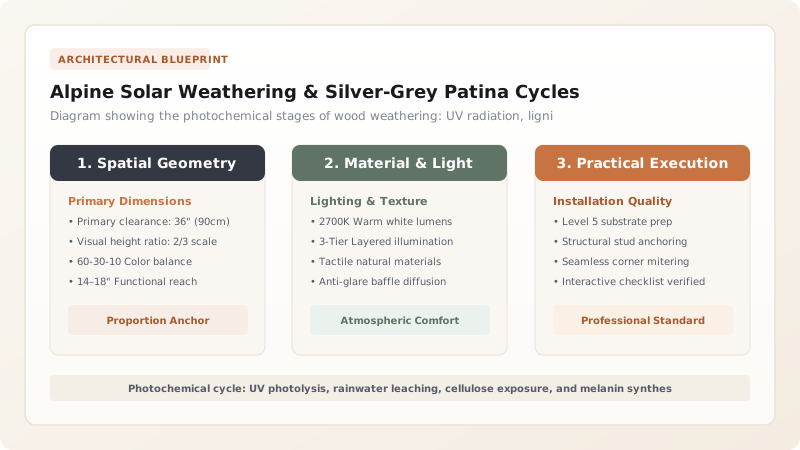
The Photochemistry of Alpine Solar Weathering
When a Bregenzerwald building is completed, its fresh silver fir and mountain spruce shingles exhibit a pale, warm straw-like luminescence. Within days of exterior exposure, a complex photochemical chain reaction begins. The primary driver is solar radiation, specifically high-energy ultraviolet wavelengths (UV-A and UV-B) which are exceptionally intense in high-altitude alpine valleys.
Wood is chemically composed of three primary polymers: cellulose, hemicellulose, and lignin. Lignin acts as the natural glue holding the structural cellulose fibers together and contains aromatic phenolic rings that absorb UV light vigorously. As UV photons strike the outer cell walls of the shingle, they initiate free-radical reactions that sever the ether bonds of the lignin molecule—a process known as photolysis. Over the first twelve months, surface lignin degrades into simple, water-soluble aromatic compounds, while the structural cellulose remains largely impervious to UV photons.
Rainwater Leaching & the Exposure of Pure Cellulose
Solar radiation prepares the surface; alpine precipitation completes the transformation. When heavy mountain rains wash across the building facade, the water dissolves the photo-oxidized, broken-down lignin fragments and carries them away. As this brown, light-absorbing polymer is stripped from the exterior 0.1 to 0.2 mm of the wood, something extraordinary occurs: pure, pristine cellulose micro-fibrils are left exposed.
Cellulose is naturally snow-white and exhibits high optical reflectivity. If shingles were exposed to solar UV and rain in a sterile laboratory vacuum, the facade would turn chalky white. In the living alpine environment, however, this exposed, porous cellulose scaffolding becomes the ecological habitat for specialized, non-decaying micro-flora that guide the final aesthetic evolution of the facade.
Micro-Ecology: Aureobasidium Pullulans & the Melanin Shield
Shortly after the white cellulose scaffolding is revealed, microscopic airborne spores of benign, non-wood-rotting micro-fungi colonize the surface. The dominant organism is Aureobasidium pullulans, an extremotolerant black yeast widespread across Central European alpine forests. Crucially, this organism does not secrete cellulase enzymes; it cannot metabolize or degrade the structural cellulose of the wood, feeding solely on microscopic atmospheric deposits, pollen grains, and trace wood sugars.
To protect itself against the scorching high-altitude ultraviolet rays of the alpine sun, Aureobasidium pullulans synthesizes dense quantities of dark melanin in its fungal hyphae. When viewed by the human eye from several meters away, the optical blend of dark melanin grains embedded within the highly reflective, snow-white cellulose fibers creates the legendary metallic silver-grey hue known throughout Austria as Silbergrau. Far from being a sign of decay, this biological coat acts as a natural sunscreen, shielding the deeper wood cells from further UV degradation.
Directional Chromatic Divergence & Architectural Harmony
A hallmark of authentic Bregenzerwald architecture is that a building never weathers uniformly on all four elevations. Instead, the structure becomes an environmental compass reflecting the microclimate of its valley. The south facade—baked by intense midday sun and sheltered from predominant driving rain—develops a warm, deep, golden-brown and bronze-umber tone as wood resins oxidize and caramelize in place without washing away.
Conversely, the west and north facades—assaulted by driving gales and sheltered from direct drying sun—transition rapidly into shimmering graphite and uniform silver-grey. Rather than viewing this chromatic divergence as a defect, Vorarlberg architects celebrate it as the highest expression of organic authenticity. The building is not an alien object imposed upon the mountain; it is a dynamic living canvas that continuously records the passage of sun, wind, and rain across its handcrafted timber skin.
Chromatic Weathering Cycles Across Building Orientations
Use this reference table to calculate exact physical dimensions, ratios, and specifications before purchasing:
| Facade Orientation | Primary Environmental Vector | Year 1–2 Appearance | Year 3–5 Appearance | Year 10+ Matured Patina |
|---|---|---|---|---|
| South Elevation | High UV radiation; rapid rain dry-off | Warm honey amber to caramel | Rich chocolate brown / burnt umber | Deep lustrous bronze-brown with silver highlights |
| North Elevation | Diffuse light; persistent humidity | Muted dull straw | Soft pewter to slate grey | Uniform, velvety matte graphite grey |
| West Elevation (Weather Side) | Driving rain + intense afternoon sun | Blotchy grey-brown transitional | Rapid silvering across lower shingle thirds | Luminous metallic silver-grey (Silbergrau) |
| East Elevation | Morning sun; low rain impact | Golden ochre | Warm muted light grey | Pale silvery fawn with golden undertones |
| Protected Overhang Soffit | Zero rain; zero direct UV | Pale natural wood tone | Light yellow-straw | Warm natural wood color preserved for decades |
Practical Constraints
Every successful decoration project must account for physical and environmental constraints:
Aesthetic impatience from contemporary clients expecting immediate uniform color
Transitional blotchy weathering between years 1 and 3 can be perceived as material failure Mitigation: Apply a breathable natural grey mineral pre-patination wash (silicate base) for instant visual uniformity
Atmospheric pollution and airborne soot in dense urban or industrial environments
Diesel particulates bind to wood pores, turning the silver patina into a dull, sooty black Mitigation: Specify shingle facades primarily in clean rural, alpine, or low-pollution suburban microclimates
Execution Blueprint & Craftsmanship Sequence
Execute this professional sequence to achieve flawless results without backtracking:
Installation of Fresh Untreated Shingles
Mount freshly cleft, unfinished silver fir shingles displaying their natural pale creamy-white color.
UV Lignin Photolysis (Months 1–6)
Solar ultraviolet radiation breaks down complex aromatic lignin polymers within the outer 0.2 mm of wood cells.
Rainwater Leaching (Months 6–12)
Alpine rainwater dissolves water-soluble photo-degraded lignin fragments, washing them away from the surface.
Cellulose Fiber Exposure
With lignin stripped away, insoluble, chemically inert white cellulose and hemicellulose micro-fibrils are left exposed.
Micro-Fungal Bio-Colonization (Years 2–3)
Airborne spores of benign Aureobasidium pullulans colonize the exposed cellulose, synthesizing dark melanin pigments.
Optical Blending to Silver-Grey (Years 3–5)
The optical blend of dark fungal melanin and reflective white cellulose micro-fibers produces the iconic silver-grey hue.
Patina Equilibrium & Long-Term Shielding
The biological patina reaches a stable equilibrium, shielding underlying wood cells from further UV breakdown for decades.
Common Mistakes & Countermeasures
Avoid these costly errors that compromise aesthetics, ergonomics, and budget:
Washing the weathered grey shingles with high-pressure power washers or chemical bleach
Applying tinted wood oils to 'even out' the transitional blotchy weathering stages
Allowing copper roof downspout runoff to discharge directly across shingle facades
Project Execution Checklist
Track your physical progress. Checkboxes persist automatically on this device:
Frequently Asked Questions
Does the silver-grey color mean the wood is rotting?
No. The silver-grey patina is purely a superficial surface phenomenon limited to the outermost 0.1 to 0.3 mm of the shingle. The structural heartwood underneath remains completely sound, dry, and structurally robust. Wood rot requires persistent moisture contents exceeding 20%, which hand-cleaved, rear-ventilated shingles never maintain.
What is Aureobasidium pullulans and is it harmful to building occupants?
Aureobasidium pullulans is a completely benign, naturally occurring epiphytic micro-fungus (often called 'black yeast') found on leaves, rocks, and trees throughout alpine Europe. It feeds exclusively on microscopic surface trace sugars without consuming structural wood cellulose, producing protective melanin pigments that shield the wood from solar UV radiation.
Why do the south and north sides of a shingled house look completely different?
Sunlight and rain drive different chemical pathways. The south facade receives intense solar UV radiation that bakes wood extractives and oxidizes resins into deep caramel-browns. The north and west facades receive frequent rain that washes away degraded lignin, allowing fungi and cellulose to dominate, creating cool silver-grey tones.