
Select and install bonded sheet vapor membranes rated at less than 0.5 perms according to ASTM E96 (Procedure E) for all residential steam showers (such as Schluter Kerdi 0.48 perms or Laticrete Hydro Ban Sheet 0.18 perms). Apply the membrane to 100% of walls, bench, and ceiling using polymer-modified thinset, overlapping all seams by 2 inches.
At a Glance: Key Takeaways
- ASTM E96 Permeance Standard (<0.5 Perms): The Tile Council of North America (TCNA SR613/SR614) mandates <0.5 perms for steam rooms.
- Vapor Pressure Differential: 115°F steam creates high vapor pressure that pushes through standard liquid coatings like gas through a screen.
- Bonded Polyethylene Sheet Structure: Dual-sided non-woven anchoring fleece laminated to an impermeable modified polyethylene core.
- 2-Inch Seam Overlap Bands: Factory waterproof sealing bands (Kerdi-Band) bedded in thinset seal all corner and wall-to-ceiling transitions.
- Complete 100% Envelope Coverage: Walls, ceiling, floor, bench, and curb must form a continuous sealed vapor-tight containment box.
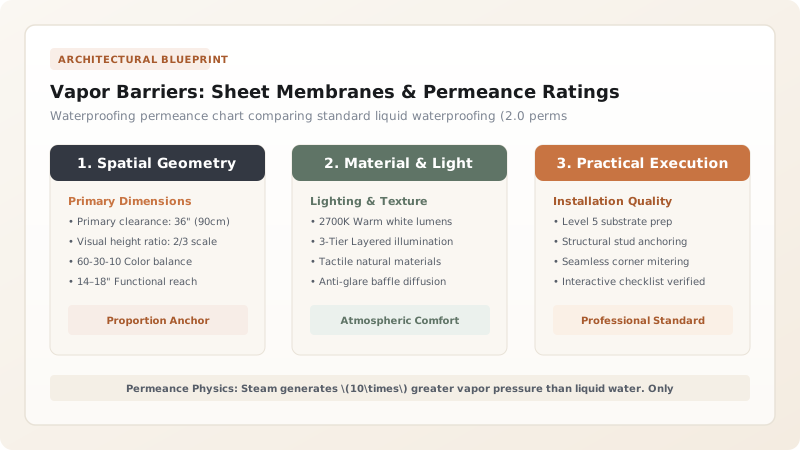
1. Material Science: ASTM E96 Permeance & TCNA Steam Room Standards
Water liquid molecules are large, but water vapor molecules are microscopic and driven by thermal vapor pressure. Standard roll-on liquid waterproofing membranes (such as RedGard or Hydro Ban liquid) have a Permeance Rating of 1.5 to 2.5 Perms.
In a hot steam shower, water vapor passes straight through liquid membranes, condensing inside wood stud cavities and growing hidden black mold. The Tile Council of North America (TCNA Handbook Section SR614) mandates a Class II Vapor Retarder (<0.50 Perms). Explore generator math in steam generator sizing.

2. Sheet Membrane Bonding & 100% Continuous Envelope Sealing
Sheet membranes (like Schluter Kerdi [0.48 Perms] or Laticrete Hydro Ban Sheet [0.18 Perms]) are bonded to cement backer board using a 1/4" × 3/16" V-Notched Trowel and Unmodified or Polymer-Modified Thinset.
Embed the non-woven fleece into the wet mortar with a smooth plastic trowel, removing all air bubbles. Review ceiling slope dynamics in sloped ceiling mechanics and coordinate with steam shower architecture.
Waterproofing vs Vapor Membrane Permeance Comparison
Use this reference table to calculate exact physical dimensions, ratios, and specifications before purchasing:
| Membrane Product | Material Composition | ASTM E96 Permeance | Steam Shower Suitability |
|---|---|---|---|
| Laticrete Hydro Ban Sheet (Optimal) | Cross-laminated polyethylene | 0.18 Perms (Ultra-Vapor Tight) | 100% Certified for Continuous Steam Rooms |
| Schluter Kerdi Sheet Membrane | Modified polyethylene with fleece | 0.48 Perms (Passes <0.5 standard) | 100% Certified for Residential Steam Showers |
| Custom Building Products RedGard (Liquid) | Liquid elastomeric polymer | 1.80 Perms (Vapor permeable) | FAILS: Standard Showers Only (Vapor leaks) |
| Standard 15-lb Roofing Felt (Avoid) | Asphalt-saturated paper | >5.0 Perms (Porous) | FORBIDDEN for steam shower use |
Air Pocket Blistering Delamination Constraints
Every successful decoration project must account for physical and environmental constraints:
Trapped Air Pockets Under Sheet Membrane Expanding Under Steam Heat
Air bubbles trapped behind sheet membranes expand when heated by 115°F steam, blistering tiles off walls; press out 100% of trapped air using a flat drywall taping knife or rubber grout float, working from center of sheet outward to edges.
How to Install and Seal a Sheet Vapor Retarder Membrane
Execute this professional sequence to achieve flawless results without backtracking:
Clean Cement Board Substrate and Dampen Surface
Vacuum dust off cement board; wipe with damp sponge to prevent dry boards from sucking water from thinset.
Comb Thinset with 1/4" V-Notched Trowel
Spread premium thinset mortar evenly across wall; comb in horizontal parallel ridges.
Hang Sheet Membrane and Embed Fleece
Position sheet membrane; press firmly into wet mortar using smooth plastic squeegee or float to collapse ridges.
Apply 2-Inch Overlap Bands at All Seams
Apply thinset over seams; center 5-inch wide Kerdi-Band sealing tape, smoothing flat with zero wrinkles.
Seal Steam Pipe and Showerhead Penetrations
Install prefabricated elastomeric mixing valve and pipe collars (Kerdi-Kereck) bedded in thinset and silicone.
Perform 24-Hour Flood Test on Shower Pan
Plug drain and fill pan with 2 inches of water for 24 hours to verify 100% zero-leak integrity before tiling.
Common Mistakes & Countermeasures
Avoid these costly errors that compromise aesthetics, ergonomics, and budget:
Using Standard Liquid Waterproofing and Assuming It Stops Steam
Project Execution Checklist
Track your physical progress. Checkboxes persist automatically on this device:
Frequently Asked Questions
Do I need to install a vapor membrane on the ceiling of a steam shower?
YES. The ceiling is where the hottest, highest-pressure steam accumulates. The entire ceiling must be wrapped in the same <0.5 perm sheet membrane as the walls, with all ceiling-to-wall corner joints sealed with waterproof overlap banding.


