
Size residential steam shower generators by calculating room cubic volume (\(L \times W \times H\)) and applying material adjustment factors: multiply volume by 1.0 for ceramic/porcelain tile, 1.5 for lightweight stone, 2.0 for dense marble or granite, and add 15% for each glass wall. Select a generator whose kilowatt (KW) rating covers the final Adjusted Cubic Foot calculation.
At a Glance: Key Takeaways
- Adjusted Cubic Volume Formula: Sizing is never based on simple cubic feet; wall surface materials determine 60% of total thermal load.
- Dense Natural Stone Thermal Sink (+100% Load): 1/2" marble and granite pull heat from steam, requiring 2x the generator capacity of acrylic.
- Kilowatt (KW) Electrical Sizing: Residential generators typically range from 6KW (up to 150 adj cu ft) to 15KW (up to 550 adj cu ft).
- Dedicated 240V / 50A Circuit: High-output generators require heavy 6/2 or 8/2 AWG copper wire and dedicated double-pole breakers.
- ASME Pressure Relief Plumbing: 3/4" copper safety relief pipe must gravity-drain to a floor drain, pan, or outside wall.
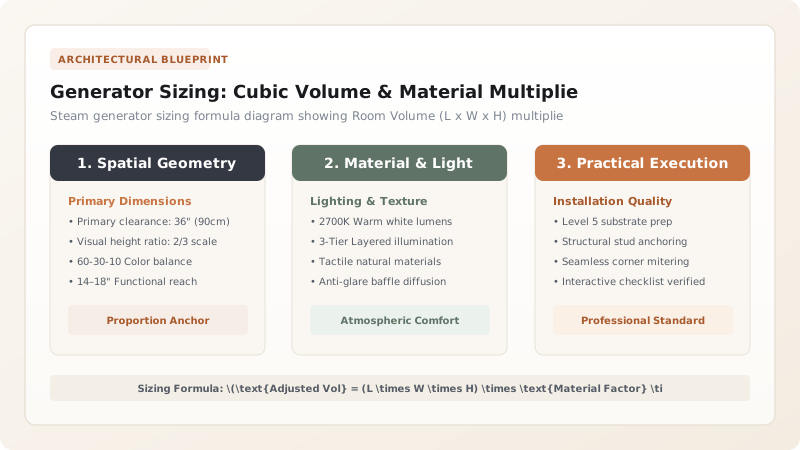
1. Engineering Calculations: Adjusted Cubic Volume & Material Multipliers
An undersized steam generator will run continuously for 45 minutes without ever reaching the desired \(115^{\circ}\text{F}\) operating temperature, while an oversized generator will short-cycle rapidly.
Calculate Raw Room Volume (\(V = L \times W \times H\)), then apply the Industry Standard TCNA / ThermaSol Adjustment Multipliers:
- Ceramic / Porcelain Tile: Multiplier \(= 1.0\times\) (Baseline)
- Natural Travertine / Limestone: Multiplier \(= 1.5\times\) (\(+50\%\))
- Dense Marble / Granite / Concrete: Multiplier \(= 2.0\times\) (\(+100\%\))
- Glass Wall / Window / Skylight: Add \(+15\%\) per glass surface
- Exterior Wall Facing Freezing Climate: Add \(+20\%\)
A 5ft × 5ft × 8ft marble shower (\(200\text{ cu.ft}\)) with a glass door requires: \(200 \times 2.0 \times 1.15 = 460\text{ Adjusted Cubic Feet}\), demanding a 12KW Generator. Learn ceiling slopes in sloped ceiling condensation mechanics.

2. Plumbing Architecture: Steam Delivery Lines & ASME Safety Valves
The steam line from the generator to the shower must be 1/2-Inch or 3/4-Inch Solid Copper Pipe sloped 1/4" per foot back toward the generator to prevent water pooling.
Plumb an ASME-Rated Pressure Relief Valve to drain safely to an open drain. Review vapor barrier installation in vapor retarder membranes and explore Japanese ofuro soaking tubs.
Steam Generator Kilowatt (KW) Sizing Matrix
Use this reference table to calculate exact physical dimensions, ratios, and specifications before purchasing:
| Generator Power Rating (KW) | Max Adjusted Cubic Feet | Electrical Circuit Requirement | Typical Shower Dimensions |
|---|---|---|---|
| 6.0 KW Generator | Up to 140 Adjusted Cu. Ft. | 240V / 30 Amp Circuit (10/2 AWG) | 3ft × 3ft × 7ft Porcelain Shower |
| 8.5 KW Generator | Up to 250 Adjusted Cu. Ft. | 240V / 40 Amp Circuit (8/2 AWG) | 4ft × 4ft × 8ft Tile Shower |
| 11.0 KW Generator | Up to 395 Adjusted Cu. Ft. | 240V / 50 Amp Circuit (6/2 AWG) | 4ft × 6ft × 8ft Marble Shower |
| 15.0 KW Dual-Unit | Up to 550 Adjusted Cu. Ft. | 240V / 60 Amp (Dual breaker feeds) | 5ft × 7ft × 9ft Grand Marble Spa |
Trapped Condensed Water Sputtering Constraints
Every successful decoration project must account for physical and environmental constraints:
Low Spots in Steam Pipe Trapping Water Causing Scalding Sputtering at Steam Head
Sagging horizontal steam pipes collect condensed liquid water; when steam rushes through, it violently blasts boiling 212°F water droplets out the steam head; pitch all copper steam lines continuously downward (1/4" per foot) from the generator to the steam head without low dips or U-bends.
How to Size, Plumb, and Wire a Steam Generator
Execute this professional sequence to achieve flawless results without backtracking:
Calculate Adjusted Cubic Foot Volume
Measure Length × Width × Height; multiply by material factors (Marble = 2.0, Glass = +15%, Exterior Wall = +20%).
Select KW Model Matching Adjusted Volume
Choose generator rated equal to or exceeding adjusted cubic volume (e.g., select 11KW for 380 cu ft).
Locate Generator Within 25 Feet of Shower
Mount generator unit in accessible closet, vanity, or warm basement space with minimum 12" clearance around unit.
Plumb 1/2" Sloped Copper Steam Line to Shower
Run hard-drawn copper pipe from generator to steam head location (8" above shower floor), sloping 1/4"/ft.
Plumb ASME Pressure Relief Valve to Floor Drain
Install 3/4" copper pressure relief line terminating over floor drain with air gap.
Run Dedicated 240V Electrical Feed and Digital Control Cable
Install double-pole breaker with 6/2 AWG copper wire; pull low-voltage multi-conductor cable to digital keypad.
Common Mistakes & Countermeasures
Avoid these costly errors that compromise aesthetics, ergonomics, and budget:
Using PEX or CPVC Plastic Piping for the Steam Line
Project Execution Checklist
Track your physical progress. Checkboxes persist automatically on this device:
Frequently Asked Questions
How long does it take for a properly sized steam shower to heat up?
A properly sized generator equipped with FastStart technology produces visible steam within 60 seconds and brings the shower enclosure to 115°F (46°C) within 10 to 12 minutes.


