
Select traditional Lead H-Came (or Zinc came) for architectural transom windows and door panels. The H-shaped cross-section functions as a miniature structural I-beam, providing 5x greater rigidity than Tiffany copper foil. Reserve copper foil for delicate curved lampshades and small organic suncatchers.
At a Glance: Key Takeaways
- Structural I-Beam Principle: Lead H-cames encase glass edges in deep 4mm channels, resisting lateral wind loads.
- Work-Hardening via Came Stretching: Stretching raw lead strips 2 to 3 inches prior to assembly increases tensile strength by 40%.
- 60/40 Tin-Lead Solder Alloy: 60% tin / 40% lead melts sharply at 370°F (188°C), flowing smoothly over fluxed lead joints.
- Black Linseed Putty Gasketing: Fills internal came voids to create a waterproof, vibration-proof mechanical bond.
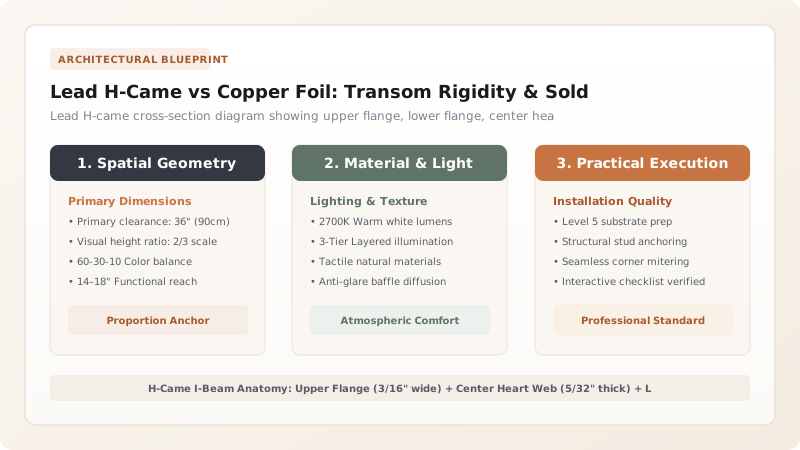
1. Structural Mechanics: The Miniature I-Beam Effect
In structural engineering, the H-Came Profile acts precisely like a steel I-beam. It consists of two outer horizontal flanges connected by a vertical center web (*The Heart*). When glass panes are seated inside the opposing channels and cemented, the glass panels themselves act as structural shear webs.
Conversely, the Tiffany Copper Foil Method relies merely on thin adhesive tape with surface solder beads. Under gravity and thermal expansion, large copper-foiled flat panels 'hinge' along solder lines and buckle outwards into a bowl shape. For wide spans, always specify lead H-cames reinforced with concealed steel rebars.

2. Solder Metallurgy & Thermal Eutectic Chemistry
Soldering lead came requires precise temperature control. Pure lead melts at \(621^{\circ}\text{F} (327^{\circ}\text{C})\). Using an uncontrolled torch or wrong solder will melt the entire came into a molten puddle.
Workrooms use 60/40 Tin/Lead Solder paired with an electric 100W temperature-controlled iron set to \(700^{\circ}\text{F}\) (371°C). Applying Oleic Acid Flux removes lead oxides, allowing the solder to melt instantly onto the joint without overheating the underlying lead came. Learn about frame mounting in over-door transom sash pocket joinery.
Lead H-Came vs Copper Foil Technical Comparison
Use this reference table to calculate exact physical dimensions, ratios, and specifications before purchasing:
| Engineering Parameter | Traditional Lead H-Came | Tiffany Copper Foil | Structural Assessment |
|---|---|---|---|
| Structural Profile | Extruded 3/16" to 3/8" H-Beam | 0.001" Flat Copper Tape | Lead H-came is 500% stiffer for flat windows |
| Max Unsupported Flat Span | 30 Inches (760mm) | 12 Inches (300mm) | Copper foil sags severely on flat windows |
| Joint Soldering | Soldered at intersections ONLY | Continuous seam soldering | Lead came retains flexibility to absorb thermal shift |
| Waterproofing Method | Linseed oil & whiting putty cement | None (Relies on foil adhesive) | Lead came is 100% weather-tight and vibration-damped |
| Aesthetic Character | Clean, uniform historic lines | Organic, variable line widths | Lead came provides authentic Victorian/Craftsman lines |
Unstretched Lead Came Twisting Constraints
Every successful decoration project must account for physical and environmental constraints:
Assembling Panels with Un-Stretched Soft Lead Cames
Raw lead came from the factory is soft and twisted; assembling without stretching results in wavy joints that sag; always clamp one end in a lead vise and stretch the strip by 2 inches until it snaps rigid and straight.
How to Stretch, Assemble, and Solder Lead Cames
Execute this professional sequence to achieve flawless results without backtracking:
Clamp Came in Lead Vise and Stretch
Pull came strip 2 to 3 inches with pliers until it stiffens and straightens completely.
Cut Cames with Precision Came Shears
Use dual-blade came shears that remove 1.5mm of came heart to prevent glass binding.
Assemble Glass Pieces on Layout Board
Fit glass into H-came channels, pinning with horseshoe nails against straight layout wood battens.
Brush Joints with Oleic Acid Flux
Apply a drop of liquid oleic acid or tallow flux to every metal intersection.
Solder Smooth Convex Domes with 60/40 Solder
Touch 100W iron tip to joint, feed solder, and pull iron away to form a clean, round button.
Flip Panel and Solder Reverse Side
Carefully flip the panel over and solder all corresponding joint intersections on the rear face.
Common Mistakes & Countermeasures
Avoid these costly errors that compromise aesthetics, ergonomics, and budget:
Using 50/50 Plumbing Solder on Delicate Lead Came
Project Execution Checklist
Track your physical progress. Checkboxes persist automatically on this device:
Frequently Asked Questions
How do you achieve a black antique patina on lead solder lines?
After cementing and cleaning the panel, wipe a chemical copper/lead black patina solution (such as Novacan Black Patina) over all lead cames and solder seams. The chemical reacts instantly to turn shiny solder into a deep, velvety charcoal black.


